
Construction Dispute Resolution: A Clear Guide for North Texas Homeowners
Building your dream home in North Texas should be exciting. But when a project hits a snag, it can feel like the whole thing is about to unravel. Construction dispute resolution isn't about pointing fingers; it's a practical roadmap designed to get your project moving again.
Think of it as hitting an unexpected detour on a road trip. You have a few different paths to choose from, ranging from a simple chat to more structured, formal proceedings. This guide will walk you through your options, from Granbury to Weatherford and beyond.
Why a Plan for Disagreements Is a Smart Move
Building a new home or tackling a major remodel in places like Glen Rose is a huge undertaking. Even with the best team and the most detailed plans, issues can pop up. A disagreement doesn't have to spell disaster for your project.
Having a clear understanding of construction dispute resolution gives you a framework for solving problems efficiently and fairly. It’s about being proactive instead of reactive. Whether you're a young family building your forever home near Aledo or a retiree creating a peaceful escape on rural property, knowing your options is the best way to protect your investment and your sanity.
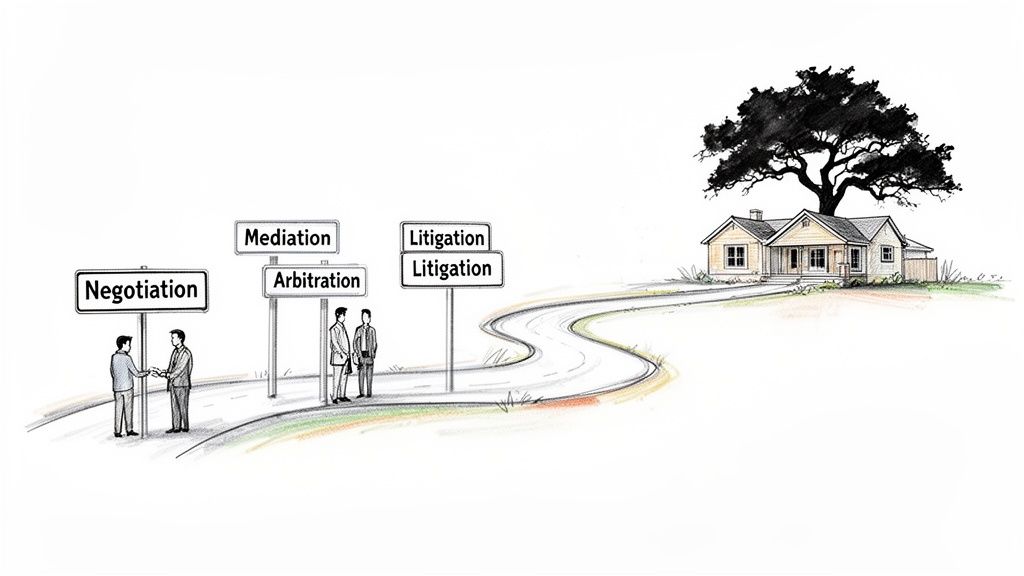
So, What Does Resolution Actually Involve?
At its core, dispute resolution is simply a structured way to handle conflicts that arise during construction. These issues are far more common than you might think and can bubble up from anywhere:
Delays: What happens when a project in Glen Rose gets held up for weeks because of supply chain problems?
Costs: How do you deal with a surprise expense, like hitting solid limestone during excavation for a new build?
Workmanship: Who’s responsible when the finished quality just doesn’t match what was promised in the contract?
The good news is the industry as a whole is leaning toward quicker, more common-sense solutions. Back in 2016, the average time to resolve a construction dispute globally dropped to just 14 months from 15.5 the year prior. This shift was largely driven by better contracts and a renewed focus on direct negotiation and mediation. You can find more insights about global construction dispute trends to see how things have evolved. It’s proof that having a clear plan works.
The goal is always to find the most direct and cost-effective path to a solution. For most homeowners in North Texas, this means starting with open communication and only escalating when absolutely necessary.
To help you get a clearer picture of the most common pathways, we've put together a simple table summarizing the options you're most likely to encounter.
Dispute Resolution Methods at a Glance
Method | Formality | Cost | Time Commitment | Best For |
|---|---|---|---|---|
Negotiation | Very Low | Low | Low | Minor disagreements, quick fixes. |
Mediation | Low | Low-Moderate | Low-Moderate | Preserving the relationship, finding creative solutions. |
Arbitration | Moderate-High | Moderate-High | Moderate | Complex issues needing a binding, private decision. |
Litigation | Very High | High | High | Last resort, for major disputes where a public record is needed. |
Each method has its place, and understanding the basics puts you in a much stronger position. Resolving disputes doesn't have to turn into an all-out battle. By getting familiar with these common methods, you can approach any bump in the road with confidence and keep your project moving forward.
Where Things Go Wrong: Common Disputes in North Texas Home Building
Every building project has its own personality. A sprawling new build on a few acres out in Weatherford will face different hurdles than a kitchen remodel in the heart of Granbury. But even with all their differences, most construction arguments boil down to just a few common themes.
Think of it like spotting the signs of a classic North Texas thunderstorm. The sooner you see the clouds gathering, the better you can prepare. Knowing what to look for helps you get ahead of problems before they spiral out of control.
Timeline Troubles and Unforeseen Delays
This is probably the biggest one. You have a move-in date circled on your calendar, but construction is often at the mercy of things no one can control.
A sudden hailstorm in Cleburne can stop a roofing job in its tracks for a week. Supply chain snags might leave your builder waiting on windows for a month. These things are frustrating, but they become real disputes when communication breaks down. The key is distinguishing between a reasonable delay and poor planning.
Wild Weather: North Texas weather is anything but predictable. Violent storms, blistering heat, or a sudden freeze can bring work to a legitimate halt.
Material Shortages: When specific items like custom cabinets or specialty tile are delayed, it creates a domino effect, holding up everyone else. For instance, waiting on custom trusses can push framing, roofing, and interior work back by weeks.
The Subcontractor Shuffle: A good builder is a master coordinator, juggling multiple skilled teams. But if a plumber gets stuck on another job, it can throw your whole schedule off.
Cost Overruns and Budget Battles
Nothing causes more stress than watching the final bill climb higher than the number you agreed on. While some budget adjustments are normal, sparks fly when it's unclear who should pay for unexpected costs.
Let's say the crew starts digging for a new home foundation in the rocky soil of Glen Rose and hits a massive shelf of limestone. Removing it requires heavy equipment and more labor, adding thousands to the budget. The argument starts when you and the builder disagree on whether this was a foreseeable risk that should have been in the original bid.
A rock-solid contract will have a "changed conditions" clause. It's a pre-agreed-upon roadmap for handling surprises like this, ensuring the process is fair for everyone.
Another classic issue is the "death by a thousand small changes." Asking your builder to move a light fixture or add an outlet during your Stephenville kitchen remodel seems simple. But dozens of these little "while you're at it" requests add up fast, leading to a huge bill and a major fight at the end of the project.
Disagreements Over Quality and Workmanship
You have a vision for your home. When the finished product doesn't live up to it, the disappointment is real. These disputes are often subjective, which makes them some of the most emotionally draining.
It could be anything from tile that isn't perfectly level to a paint job that looks rushed and sloppy. A common example we see is a disagreement over materials for a barndominium near Hico. Maybe you expected premium cedar posts for the porch, but the builder used a lower-grade, less durable wood instead. Without detailed specifications in writing, it's your word against theirs.
Being able to spot these common North Texas construction pitfalls transforms you from a spectator into an active, informed partner in your own project. When both you and your builder are watching for the same potential problems, you can navigate them as a team and keep your dream home on track.
Preventing Disputes Before They Start
The best way to handle a construction dispute is to make sure it never happens in the first place. An ounce of prevention really is worth a pound of cure—especially when your home and your savings are on the line. By getting two things right from the very beginning—picking the right partner and hammering out a crystal-clear contract—you build a foundation of trust that can see a project through to a happy conclusion.
Think of it like this: you wouldn't start a road trip without a map and a reliable car. The same goes for building a custom home or starting a big remodel here in North Texas. You need a good guide and a clear route to get where you're going.
Choosing the Right Builder for Your Project
The single most important decision you'll make is who you hire. A builder's reputation, how they communicate, and their local track record can make all the difference. In places like Weatherford and Granbury, a good builder isn’t just a contractor; they're part of the community, and their name is everything.
Don't rush the vetting process. Here’s a simple checklist to follow:
Talk to Past Clients: Don't just skim online reviews. Ask the builder for a list of recent clients—preferably from the last 12-18 months—and actually call them. Ask how communication went, how changes were handled, and whether they stuck to the budget.
See Their Work in Person: A picture is worth a thousand words, but seeing the real thing is priceless. Ask to drive by or, even better, visit a few completed homes. Look closely at the details and craftsmanship. Is this the level of quality you're expecting?
Verify Insurance and Credentials: Make sure they carry full general liability and workers' compensation insurance. A true professional will have zero issues providing you with their insurance certificates. This is non-negotiable; it protects you from any liability if someone gets hurt on your property.
Gauge Their Communication Style: During your first few meetings, do they listen more than they talk? Do they explain things clearly, without a lot of confusing jargon? That initial gut feeling about how they communicate is a strong indicator of how they'll handle problems when they inevitably crop up.
A builder who is upfront, experienced, and respected locally is your best defense against future headaches.
Creating an Ironclad Construction Contract
Once you've found the right builder, it’s time to get everything in writing. Your contract is the official rulebook for the entire project, and a vague one is a recipe for disaster. While standard forms from groups like the American Institute of Architects (AIA) are a decent starting point, they must be customized for your specific North Texas project.
Your contract isn't just a legal document—it's a communication tool. A well-written agreement forces everyone to get on the same page from day one, leaving very little room for arguments later.
A solid contract spells out the scope, schedule, and cost so clearly that there’s nothing left to guesswork. For anyone building on rural land or planning their retirement home, this clarity is essential. For more on what to look for during the build itself, our homeowner's construction quality control checklist is a great resource.
Here are the non-negotiables that every residential construction contract should have:
A Detailed Scope of Work: This needs to be incredibly specific. It should list all work, materials, brand names, and even model numbers. Don't accept "windows"; insist on something like "Pella Impervia Fiberglass Windows, Model #123."
A Clear Payment Schedule: Payments should be tied to tangible progress—things like the foundation being poured, the framing going up, or the drywall being finished. Be wary of large upfront deposits. A typical payment to get started is around 10-15%, with the rest tied to these milestones.
A Formal Change Order Process: This is critical. The contract must state that any change from the original plan, no matter how small, has to be written down, priced out, and signed by both you and the builder before any work begins. This one clause prevents 90% of budget overruns and "surprise" bills.
Dispute Resolution Procedures: A smart contract lays out the playbook for disagreements. It often requires starting with simple negotiation or mediation before anyone can jump to lawyers and lawsuits. Having this plan in place ahead of time can save a fortune in legal fees down the road.
Putting in the time to carefully select your builder and meticulously craft your contract might feel slow, but this upfront diligence is the single most effective thing you can do to keep your project on track, on budget, and free of conflict.
A Step-by-Step Guide to the Resolution Process
When a problem pops up on your North Texas project that you can’t solve with a quick chat, it’s easy to feel stuck. But there’s a clear, logical path for handling disagreements, starting with simple conversations and moving toward more formal methods only when needed.
Let’s walk through the step-by-step guide to construction dispute resolution.
Stage 1: Start with Direct Negotiation
Before you even think about lawyers or mediators, the first stop is always direct, one-on-one negotiation with your builder. This is the least formal, cheapest, and fastest way to get things back on track. The goal here is a productive, business-like conversation focused on finding a fix, not pointing fingers.
Imagine this: your custom home build in Tolar hits a snag because the wrong exterior stone was delivered. Instead of firing off an angry text, schedule a time to meet on-site. Bring your contract, the material specs, and a level head.
Prepare Your Points: Jot down exactly what the issue is, what your contract says, and what you think is a fair solution.
Listen Actively: Hear your builder out. Maybe their supplier goofed, and they already have a plan to make it right.
Focus on the Goal: The objective isn't to "win" the argument; it's to get the right stone installed and keep your project moving forward.
If you reach a solution, get it in writing immediately. A simple email summarizing the conversation and the agreed-upon next steps is often all you need to make it official.
Stage 2: Move to Mediation
If talking it out directly hits a wall, mediation is the next logical step. In Texas, mediation is a very popular and effective method where a neutral third party—the mediator—helps you and your builder find some common ground. The mediator doesn’t make decisions or take sides; their job is to guide a structured conversation to help you reach your own agreement.
Mediation is all about finding a creative, mutually acceptable solution. It’s a powerful tool for preserving the working relationship, which is critical if you're only halfway through a project.
The whole process is confidential and voluntary. A typical mediation session for a residential dispute in the DFW area might last a half-day or a full day. Costs are usually split between you and the builder, often ranging from $1,500 to $5,000 total—a fraction of what it costs just to start a lawsuit.
Stage 3: Consider Arbitration
When mediation doesn't lead to a handshake, arbitration is the next level of formal construction dispute resolution. Think of it as a private, less formal version of court. An arbitrator, usually a retired judge or an experienced construction attorney, hears the evidence from both sides and then makes a legally binding decision.
The flowchart below shows how putting in the work upfront—in builder selection and contract drafting—is your best defense against ever reaching these more intense stages.
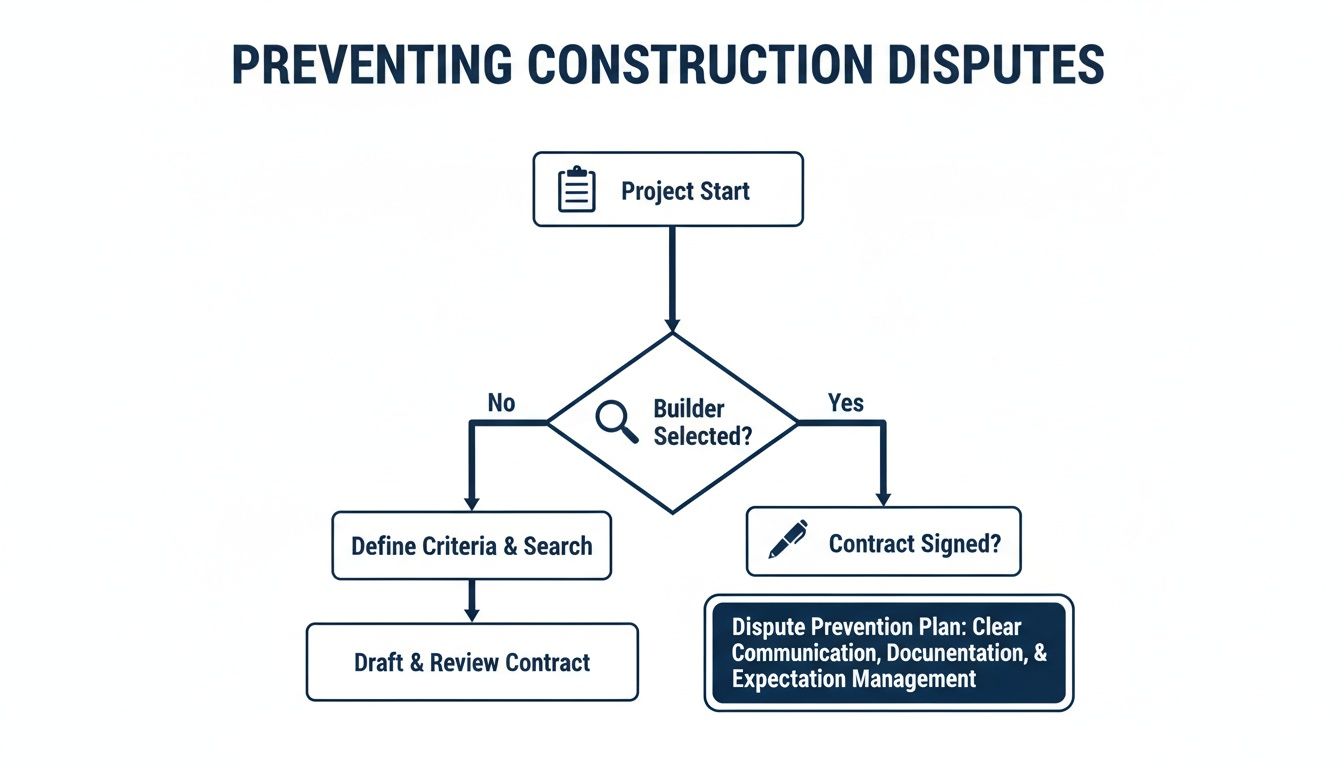
As you can see, a solid builder and a watertight contract are the foundations of dispute prevention. Many modern construction contracts, including those based on American Institute of Architects (AIA) forms, actually require arbitration as the default method for resolving disputes.
It’s generally faster and less expensive than going to court, but don't underestimate it. It’s a serious legal proceeding, and you’ll need representation. The arbitrator's decision, known as an "award," is final and incredibly difficult to appeal.
Stage 4: Use Litigation as a Last Resort
Litigation—filing a lawsuit and going to court—should always, always be the final option. It is the most expensive, time-consuming, and emotionally draining path you can take. A lawsuit makes your dispute a public record and will permanently destroy any relationship with your builder.
The sheer volume of paperwork in modern construction has made litigation even more daunting. Construction disputes in North America saw their average values jump a staggering 42% between 2021 and 2022, with cases now requiring lawyers to sift through thousands of documents. There are new tools emerging to handle this; one analysis showed a case that cost $216,000 for attorneys to review over seven weeks was handled by an AI platform in just four days for $27,000. You can find more insights on how technology is changing dispute resolution and its impact on costs.
This complexity just reinforces why litigation is best avoided unless absolutely necessary. Simply managing the constant flow of paperwork, especially change orders, is a huge part of staying out of court, as we detail in our guide on mastering construction change order management.
Knowing these steps empowers you to handle conflicts strategically, from the ground up.
The Power of Clear Communication and Documentation
In any construction project, whether it’s a full custom home in Weatherford or a simple bathroom remodel in Granbury, your records are your best friend. Good documentation isn’t about expecting a fight; it’s about creating a shared, factual history of the project that keeps little misunderstandings from spiraling out of control.
When every decision, every change, and every key conversation is written down, there’s very little room for memory to get fuzzy or details to get twisted. This simple habit can snuff out a potential conflict before it even has a chance to start.
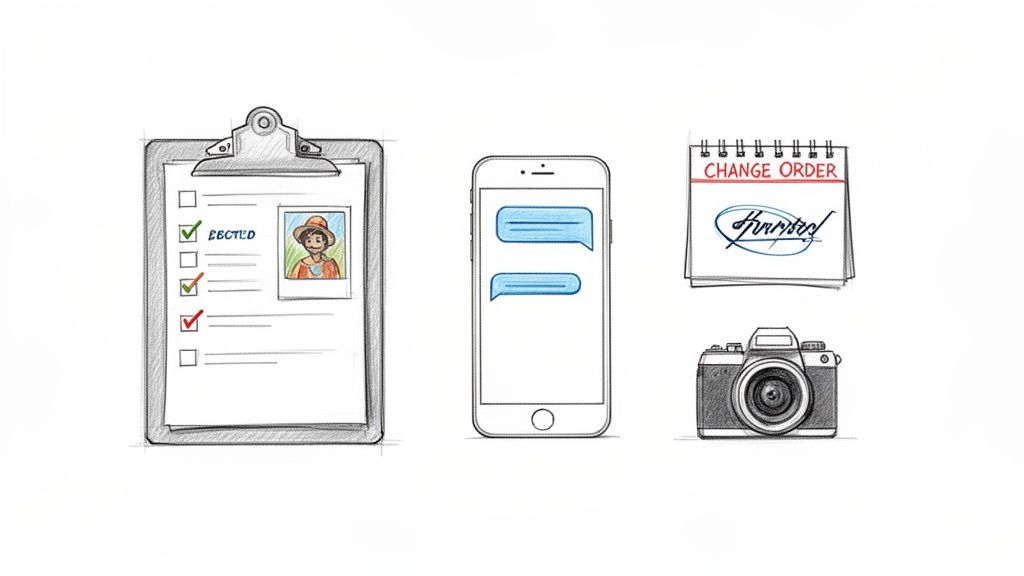
Building Your Paper Trail
You don't need fancy software to create a solid record. It’s about building a few easy habits that pay off big time if a disagreement pops up. Having this information neatly organized gives you a huge amount of confidence.
Here’s what every North Texas homeowner should be tracking from the moment the project begins:
Keep a Simple Daily Journal: At the end of each day work happens on-site, take five minutes. Jot down who was there, what got done, and if anything unexpected occurred. This creates a powerful, real-time timeline of your project.
Take Photos and Videos—Constantly: Your smartphone is an incredible tool. Snap pictures of the daily progress, of materials when they're delivered, and especially of anything that looks off or concerns you. A time-stamped photo is hard evidence that’s nearly impossible to argue with.
Save Every Digital Message: Treat every single email and text message like it’s part of the official project file. Make a dedicated folder in your email client and be sure to screenshot any important text conversations about changes or key decisions.
These straightforward steps build a clear, undeniable history of what actually happened on your project.
The Unbreakable Rule: No Verbal Agreements
If you only remember one thing from this entire guide, make it this: get every single change in writing. That casual "Hey, while you're at it, can you just move this wall six inches?" is the single biggest cause of budget blowouts and nasty disputes.
Any change from the original plan, no matter how small it seems, needs to be formalized with a change order. A change order is just a simple document that spells out three things:
A clear description of the new or different work.
The exact cost of the change, including both labor and materials.
How this change will impact the overall project schedule.
Crucially, both you and your builder need to sign this document before the new work begins. This simple process eliminates any "he said, she said" arguments later and ensures everyone is crystal clear on costs and timelines.
Imagine your builder installs the wrong backsplash tile in your new Joshua kitchen—a costly mistake to tear out and replace. But a quick search of your email pulls up the message from three months ago where you clearly specified "Silver Crest Marble, Model #45B" and even attached a picture. Just like that, the dispute is over. You have the proof.
This level of detail protects you and your builder. It transforms subjective disagreements into objective, fact-based conversations. It’s not about mistrust; it’s about keeping things professional and transparent for everyone involved.
Comparing the Costs and Timelines for Resolution
When you’re staring down a construction dispute, two things immediately come into focus: your wallet and your calendar. To get through this, you need a realistic look at what each resolution path will actually cost you here in North Texas—not just in dollars, but in days, weeks, and even months.
This isn't about pride or "winning" at all costs. It's about making a smart, strategic decision that fits your family's budget and gets your project—and your life—back on track. Whether you're in Aledo or Weatherford, going in with this mindset is your best defense against expensive surprises.
Breaking Down the Financial Investment
The bill for resolving a dispute can range from the price of a cup of coffee to the cost of a new car. A direct negotiation might just take a few hours of your time, but a full-blown lawsuit can easily climb into the tens of thousands. You have to weigh the investment against what you stand to gain.
Mediation: This is often the most sensible and cost-effective first step into a formal process. A qualified DFW-area mediator typically charges between $300 and $700 per hour, an expense you'll usually split with the builder. For a half-day session, you might each pay around $1,000 to $2,000. A full day could run $2,000 to $3,500 per party.
Arbitration: Things get more involved here. You're looking at fees for the arbitrator (whose hourly rate is similar to a mediator's, but for many more hours), your own attorney's fees, and potentially fees for expert witnesses. For a standard residential dispute, it's realistic to expect a total cost between $10,000 and $30,000, though it can certainly go higher.
Litigation: This is, without a doubt, the most expensive route. Legal fees, court filing costs, expert witness testimony, and the discovery process (gathering evidence) add up incredibly fast. It's not at all unusual for a straightforward construction lawsuit to soar past $50,000 in legal expenses.
How Timelines Differ for Each Method
Just like the costs, the timelines stretch out the more formal the process gets. What feels like a minor hiccup can quickly become a months-long saga, putting your entire project and daily life in limbo.
Remember, the timeline isn’t just a number on a calendar. It represents the emotional toll and stress a drawn-out conflict takes on you and your family. A faster resolution almost always means a better quality of life.
To help you weigh your options, we've put together a table that breaks down the typical costs and timelines you can expect for a residential project dispute in Texas.
Comparing Dispute Resolution Costs and Timelines in Texas
Resolution Method | Estimated Cost Range | Estimated Timeline | Level of Control |
|---|---|---|---|
Negotiation | Minimal (your time) | A few hours to a few days | High (You control the outcome) |
Mediation | $1,000 - $3,500 per party | Typically one day | High (You control the agreement) |
Arbitration | $10,000 - $30,000+ | 2 to 6 months | Low (Arbitrator decides) |
Litigation | $50,000+ | 12 to 24+ months | Low (Judge or jury decides) |
These figures aren't just abstract numbers; they reflect a growing trend. The construction industry is seeing more conflicts pop up, driven by everything from supply chain issues to defects in high-end custom homes—a trend particularly noticeable right here in Texas. One recent industry report highlighted that 53% of firms have had to delay or abandon projects due to rising costs, which gives you a sense of the immense financial pressure that often sparks these disagreements. If you want to dig deeper, you can read more about the state of the construction industry and see the bigger picture.
Understanding these real-world numbers empowers you. It lets you step back and make a calculated business decision for your family, choosing the path that gives you the best shot at a fair outcome without draining your bank account or your sanity.
Finding Professional Help and Your Next Steps
Knowing when to call in an expert isn’t a sign of failure—it's a smart, strategic move to protect your investment. Once a dispute gets complicated, trying to go it alone can quickly get overwhelming.
The idea is to bring in support from a position of strength, not desperation. The right professional can lay out your options clearly and steer you toward the most efficient path forward, which is exactly what a homeowner in Granbury or Weatherford needs.
Who to Call for Help in North Texas
When your own attempts at negotiation have hit a wall, it’s time to bring in the pros. Each one has a specific job to do.
Independent Inspector: Is the argument about shoddy workmanship? Your first call should be to a neutral, third-party inspector. They provide an unbiased, professional assessment of the work, which is pure gold in any negotiation or mediation. Their report turns a "he said, she said" argument into a conversation based on objective facts.
Construction Mediator: A mediator is a trained neutral party who acts as a referee for a structured conversation. They don't pick sides; their goal is to help you and the builder find common ground. This is a fantastic step if you’re hoping to salvage the working relationship and find a creative fix.
Construction Attorney: If the dispute involves a lot of money or you suspect a serious breach of contract, it's time to talk to an attorney specializing in Texas construction law. They can dissect your contract, tell you exactly where you stand legally, and represent you if things escalate to arbitration or, worst-case, a lawsuit.
Your Best Defense is a Strong Partnership
At the end of the day, the best way to handle a dispute is to avoid it in the first place. Every step you take, from carefully vetting builders to signing a rock-solid contract, is really about building a transparent and strong partnership.
When you and your builder are on the same page from day one, you can tackle problems as a team instead of as adversaries. For a deeper look into the builder's role, you might be interested in our guide on what a general contractor does for your North Texas home.
A successful project is always built on a foundation of clear communication, mutual respect, and a shared goal of bringing your vision to life. That foundation is more powerful than any legal document you can sign.
At Gemini Homes, we believe a strong partnership is the key to a beautiful, stress-free build. If you're planning a project in the Granbury area and want to learn how to structure it for success right from the start, our team is here to help. Contact us for a straightforward, no-pressure consultation to discuss your vision.
Comments