
A Guide to Building Custom Houses in North Texas
Building a custom home in North Texas isn't just another construction project—it's about creating a space that works perfectly for your family, now and for years to come. Whether you're picturing a home on the rolling hills of Granbury or a spacious lot in Weatherford, a successful build always starts with a solid plan and a partner you can trust.
Your North Texas Custom Home Journey Begins Here
Deciding to build your own home is one of the most rewarding journeys you can take. You get to call all the shots, designing a home that fits your life instead of compromising on a house that’s almost right. Every detail, from the kitchen layout to the window placement for that perfect Glen Rose sunrise, is yours to decide.
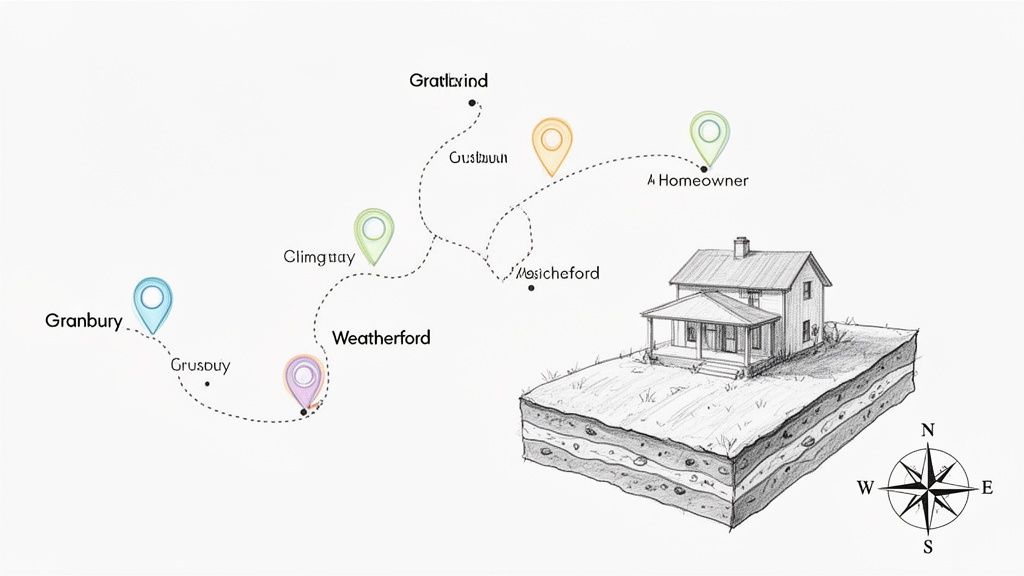
Building here in our corner of Texas has its own unique challenges that a generic guide won't cover. It’s about more than just blueprints and lumber; it’s about understanding the land, the climate, and the local requirements.
Why Local Knowledge is Everything
The real work starts long before anyone pours a foundation. For instance, the clay-heavy soil we see across Parker County demands specific foundation engineering. Getting this wrong can lead to costly shifting and cracking down the line. A builder who knows the local geology can prevent these problems from ever starting.
Similarly, if you're planning to build on acreage out near Stephenville, you have to factor in septic systems, well water access, and local deed restrictions. These aren't afterthoughts—they are critical first steps that shape your entire project.
A successful custom home build is 10% inspiration and 90% perspiration. Most of that hard work happens in the planning phase. Nailing the details before you break ground is the single best way to save time, money, and a whole lot of stress.
This guide is your practical roadmap, cutting through the fluff to give you actionable steps for building in North Texas. We'll walk you through everything from evaluating land to making final design choices.
What to Expect in This Guide
We’ve broken the entire process down into clear, manageable stages. Here’s a glimpse of what we'll cover:
Pre-Build Planning: We'll dive into setting a realistic budget, lining up financing, properly evaluating land, and defining what your family truly needs in a home.
Assembling Your A-Team: You'll get practical tips for finding the right local builder and designer—people who genuinely understand the ins and outs of building in North Texas.
Construction Milestones: We'll provide a straightforward overview of each building phase, so you know what’s happening, when it's happening, and what your role is.
Budgeting and Avoiding Pitfalls: Learn how to keep costs in check and steer clear of common mistakes that can derail a project.
Consider this your step-by-step companion, filled with hard-won insights from a local builder. To get a better feel for the communities we serve, take a look at the unique characteristics of our North Texas service areas.
Laying The Groundwork Before You Break Ground
Before the first scoop of dirt moves, your most important tool is a solid plan. I can't stress this enough. The decisions you make now set the rhythm for the entire project. This initial phase is all about translating the dream in your head into a practical, buildable blueprint.
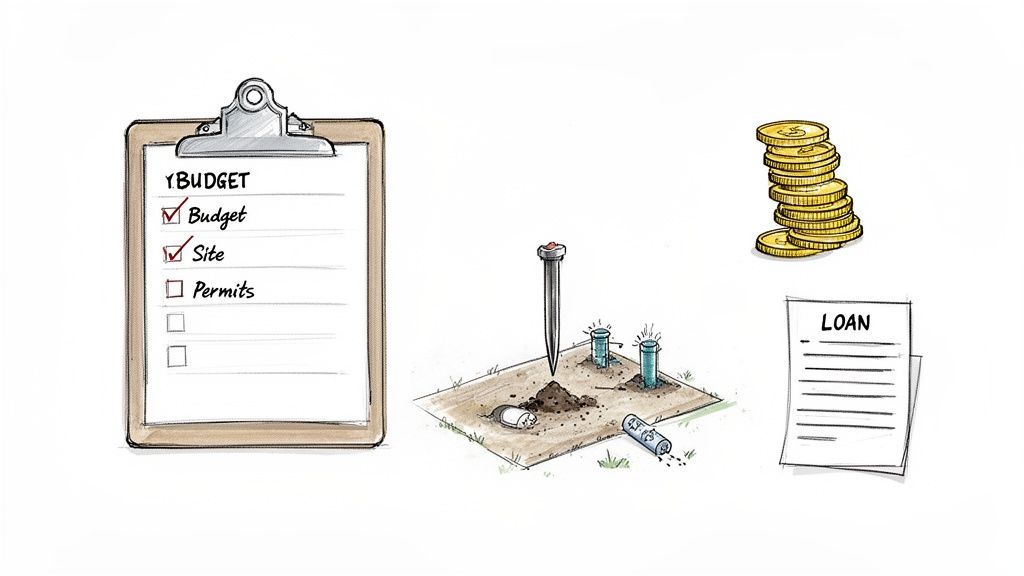
It’s easy to get swept up in the excitement of designing your forever home, but grounding that vision in a realistic financial framework from day one is absolutely crucial. Getting these foundational pieces right makes for a much smoother journey.
Establishing A Realistic Budget
Your total project cost goes far beyond just lumber and labor. A comprehensive budget is the bedrock of a successful build, preventing surprises and ensuring the home you envision is the home you can afford. For any build here in North Texas, you've got to account for several key categories.
Break down your costs into these main buckets:
Land Acquisition: The cost of the lot itself, which can vary dramatically between a neighborhood plot in Granbury and raw acreage outside of Stephenville.
Design & Engineering Fees: This covers your architect, draftsmen, and structural engineers. Expect this to be 5-15% of the total construction cost.
Permits & Fees: Costs from local municipalities like Parker or Hood County for building permits, septic permits, and impact fees.
Site Work: Getting your land ready for construction is a big expense, especially on rural lots. This can involve clearing trees, grading, and bringing in utilities.
Construction Costs: The main event, covering all materials and labor to physically build the house.
Contingency Fund: This is non-negotiable. Set aside 10-20% of your total construction cost for unexpected issues or those "while we're at it" upgrades that inevitably come up.
Securing The Right Financing
Unless you're paying cash, you’ll need a specific type of loan. Most of our clients use a construction-to-permanent loan. It's a single-close loan that finances the construction phase and then automatically converts into a traditional mortgage once the house is finished. This is far more efficient and saves you the cost and hassle of closing twice. Lenders will want to see your detailed plans and a signed contract with a reputable builder before giving you the green light.
Pro Tip: Working with a local lender who understands the North Texas market is a huge advantage. They're already familiar with land values, local builders, and the unique challenges of financing rural or acreage properties.
Choosing Your Piece Of North Texas
The land you choose dictates almost everything, from your home’s design to its final price tag. If you're looking at property in places like Glen Rose or Weatherford, there are a few critical things to investigate before you buy.
First, soil testing is essential. The expansive clay soils common across our region can cause massive foundation problems if not handled correctly. A geotechnical report will tell your builder exactly what kind of foundation your home needs.
For rural lots, you also have to confirm utility access:
Water: Can you tap into a municipal line, or will you need to drill a well? A new well can cost $5,000 to $15,000, sometimes more, depending on depth.
Wastewater: Is a sewer hookup available? If not, you'll need a septic system, which is a significant cost and requires a percolation test to confirm your soil is suitable.
Power & Internet: How far are the nearest utility poles? The cost to extend power lines to a remote build site can be surprisingly expensive.
Defining Your Home's 'Program'
With your budget and land sorted, it’s time to define your "program"—a detailed wish list of your wants and needs. It’s the brief you'll hand to your designer and builder.
Think about your family’s real, day-to-day life. Are you retirees looking for a single-story home with wide doorways for aging in place? Or are you a young family that needs a durable mudroom and a wide-open living area for the kids?
Start making a list:
How many bedrooms and bathrooms do you need?
Is a dedicated home office or a flex space a must-have?
What's your vision for outdoor living—a simple covered porch or an elaborate patio with a pool?
What are your true storage needs? Be honest!
This personalized approach is why custom building remains so strong. Even as interest rates impact the spec home market, families are choosing to build a home that fits them perfectly instead of settling for what’s already out there. You can read more about these custom home building trends and what they mean for the market.
Once you have this groundwork laid, you're ready to find the team that will bring it all to life.
Finding Your Builder and Design Team
Choosing the professionals who will turn your ideas into a real, physical home is likely the single most important decision you'll make. This partnership shapes everything from the budget and schedule to the final craftsmanship you see every day. Here in North Texas, you have two common ways to structure this team.
Design-Build vs. Hiring an Architect and Builder Separately
A design-build firm brings the architect and the construction crew under one roof. Think of it as a one-stop shop with a single point of contact. This integrated approach is a game-changer for simplifying communication, controlling costs, and often shortening the build time. For many families we work with in Granbury and Weatherford, this streamlined path is a lifesaver.
The other route is to hire an independent architect first. They’ll draw the plans, and then you take those plans to several builders for bids. This traditional method offers great control over the design, but it also makes you the project manager, stuck between two separate companies. If the architect designs a home that comes in over budget, you’re the one managing those tough conversations.
How to Find the Right Partner for Your Project
Your goal is to find a team whose experience and work style clicks with you. Start by looking at portfolios. If you're dreaming of a modern barndominium near Glen Rose, a builder who only does traditional brick homes in subdivisions probably isn't the right match.
Here's a practical checklist to help you vet potential partners:
See Their Work Up Close: Don't just rely on polished online photos. Ask to see homes they’ve built that are similar in size and style to what you want.
Talk to Past Clients: A good builder will have a list of references. Ask those homeowners about communication, how budgets were handled, and—most importantly—how the builder dealt with problems when they arose.
Gauge Their Communication Style: In that first meeting, are they listening more than talking? A builder should be your guide and collaborator, not just a salesperson. The conversation should feel like a strategy session.
The true test of a builder isn’t when everything is going perfectly. It's how they react when something unexpected happens. A seasoned local builder has the relationships and problem-solving skills to navigate those bumps without throwing your project off the rails.
The Advantage of a Local, Hands-On Builder
Working with a local, family-owned company offers a huge advantage over large corporate builders. There's real power in knowing you can call the owner directly and that they’ll actually be on your job site, checking on the details. That level of personal accountability is invaluable. A smaller, dedicated team is more agile and personally invested; their reputation in communities like Cleburne and Stephenville is built one project at a time.
When you interview builders, have these critical questions ready:
How do you manage budget changes or change orders from us?
What's your process for building and sticking to a realistic construction timeline?
Who will be my main point of contact day-to-day?
Can you walk me through your warranty and what it covers after we move in?
Looking at my lot and my ideas, what potential challenges do you see?
Finding the right team can feel like a lot of work upfront, but the time you invest here pays off tenfold. A solid relationship built on trust and clear communication is the real foundation of a successful custom home.
From Foundation To Finishes: What to Expect During Construction
Once your plans are finalized and your team is in place, the real excitement begins. Watching your property transform from an empty lot into the home you've envisioned is an incredible experience. Understanding the rhythm of the build will help you know what to expect and when your input is most critical.
This timeline gives you a bird's-eye view of how we guide clients through researching, interviewing, and ultimately selecting the right partners to bring their vision to life.
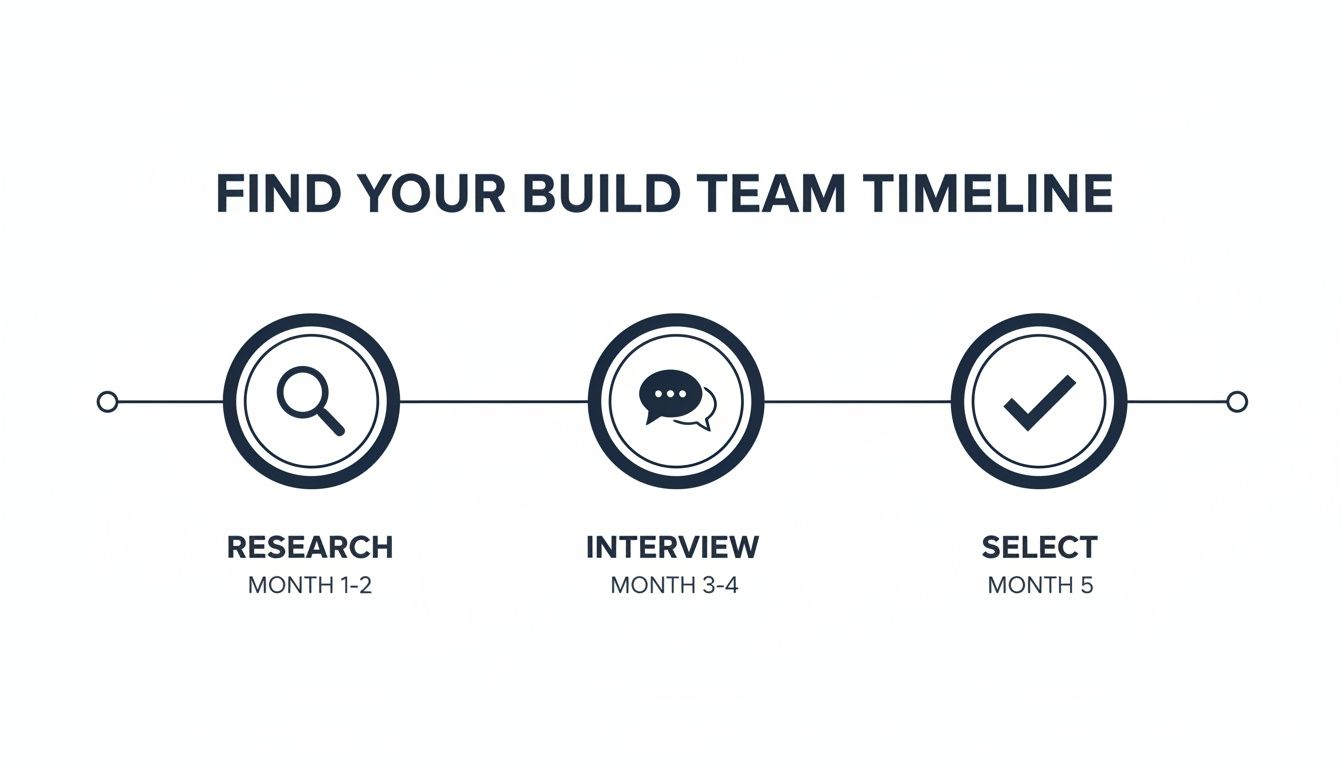
Choosing the right builder from the start is what makes the difference between a stressful ordeal and a smooth, well-managed project.
From Dirt Work To A Solid Foundation
Everything starts with the land itself. We prepare the site by clearing the homesite, grading the land to control water drainage (a huge deal here in Texas), and excavating for the foundation. In North Texas, we're dealing with expansive clay soil, so this stage is absolutely critical. We'll follow the geotechnical engineer's report to the letter, building a foundation engineered to handle that soil movement. This phase usually takes a few weeks and is heavily dependent on weather.
The Skeleton Of Your Home: Framing And Roofing
After the concrete foundation cures, your home starts to go vertical—and it happens fast. During framing, the floor systems, walls, and roof structure are built. You can finally walk through the rooms and get a true sense of the space and flow. Next, we "dry in" the house by installing sheathing, house wrap, windows, and the roof. Here in our storm-prone region, many of our clients in Granbury and Weatherford are choosing more durable options like standing seam metal or Class 4 impact-resistant shingles to stand up to hail.
Builder's Insight: This is a huge quality control checkpoint. A good builder is obsessive at this stage, making sure everything is square, level, and plumb. The integrity of the frame is the backbone of the entire home.
The Hidden Systems: Mechanical, Electrical, and Plumbing
With the house protected from the elements, it’s time for the "guts" of the home to be installed. This is the MEP rough-in phase: Mechanical (HVAC), Electrical, and Plumbing. Crews run all the supply and drain lines, install ductwork, and pull wire to every outlet, switch, and light fixture. Your timely decisions on things like sink and faucet selections are crucial here to keep the project moving smoothly. It's a great time to walk your new home build with your builder to make sure everything feels right.
Closing Up The Walls: Insulation and Drywall
Once the MEP systems pass their rough-in inspections, we can close up the walls. First comes insulation—a non-negotiable for energy efficiency against our brutal Texas summers. Then, the drywall goes up, and in just a few days, your home transforms from a wooden skeleton into a collection of defined rooms.
The Final Stretch: Interior and Exterior Finishes
This is where your personality and style really start to shine. The finishing stage is the longest and most detailed part of the build. Outside, the final siding, brick, or stone is installed, driveways are poured, and we might start on landscaping. For many of our clients, this is also when we build out that dream Texas outdoor living space.
Inside, it's a whirlwind of activity:
Painters apply the final colors you've selected.
Flooring goes down, whether it's tile, hardwood, or carpet.
Cabinetry and countertops are installed in the kitchen and bathrooms.
Plumbers and electricians return for the "trim" phase—installing light fixtures, faucets, and appliances.
This focus on high-quality, personalized finishes is part of a larger trend, with homeowners valuing spaces that are both beautiful and highly functional. Understanding these phases helps you partner effectively with your builder every step of the way.
Custom Home Build Timeline North Texas Overview
Building a custom home is a marathon, not a sprint. While every project is unique, this table outlines a typical timeline for a custom build in the Granbury and Weatherford area, helping you visualize the journey from start to finish.
Phase | Description | Typical Duration | Key Homeowner Decisions |
|---|---|---|---|
Pre-Construction | Site selection, financing, architectural design, builder selection, and permitting. | 2–6 Months | Finalizing floor plans, elevations, budget, and making initial material selections. |
Site Work & Foundation | Clearing the land, grading for drainage, utility trenching, and pouring the concrete foundation. | 3–5 Weeks | Confirming house placement and driveway location on the lot. |
Framing & Dry-In | Building the home's structural skeleton, including walls, roof, sheathing, windows, and exterior doors. | 4–8 Weeks | Selecting roofing material and window styles/colors. |
MEP Rough-In | Installing plumbing, electrical wiring, and HVAC ductwork inside the walls before insulation. | 2–4 Weeks | Finalizing appliance locations, plumbing fixtures, and lighting/outlet placements. |
Insulation & Drywall | Insulating all exterior walls and the attic, followed by hanging, taping, and texturing drywall. | 2–3 Weeks | Choosing drywall texture (e.g., smooth, orange peel) and any soundproofing needs. |
Exterior Finishes | Installing brick, stone, siding, and completing exterior paint. | 3–6 Weeks | Confirming stone/brick selections, mortar color, and exterior paint colors. |
Interior Finishes | Painting, flooring, cabinets, countertops, tile work, and final MEP trim-out. | 6–10 Weeks | Choosing paint colors, flooring, tile, light fixtures, faucets, and hardware. |
Final Details & Punchout | Landscaping, final cleaning, builder walkthroughs, addressing the "punch list" of minor items. | 2–4 Weeks | Creating a detailed punch list with your builder and scheduling final inspections. |
This timeline serves as a general guide. Factors like weather, the complexity of the design, and the availability of materials can influence the actual schedule, making clear communication with your builder absolutely essential.
Keeping Your Custom Build on Budget (And Avoiding a Few Headaches)
Let's talk about the money. Keeping the finances in check requires a solid plan and a great relationship with your builder. The first step to staying on track is knowing exactly where the money is going.
In North Texas, the big-ticket items are fundamentals like lumber, concrete, and skilled labor. But where budgets can really swing are in two key areas: the finishes you choose and the site work your land requires. A rocky, sloped lot out in Glen Rose is going to require more prep work—and a bigger budget—than a flat lot in a Granbury subdivision.
How to Actually Stick to Your Budget
Making a budget is the easy part; the real discipline comes in sticking to it. My best advice is to create two lists before you break ground: your 'must-haves' and your 'nice-to-haves.' This becomes your guide for every decision.
The number one budget-killer is the change order—any decision that deviates from the original plan. Sometimes they're unavoidable, but most happen because of second-guessing. Each one adds material and labor costs and can cause delays that have their own financial consequences.
The single best way to control your costs is to finalize as many decisions as possible before the first shovel hits the dirt. Lock in your tile, fixtures, flooring, and paint colors upfront. It prevents the expensive ripple effect that last-minute changes always cause.
Navigating Common Pitfalls We See All the Time
Beyond the budget, a few common hurdles can trip up even the most prepared homeowners. Knowing them ahead of time is half the battle.
Analysis Paralysis: The internet offers endless options for every fixture and finish. It's easy to get overwhelmed. Trust the design plan you created and lean on your builder. We’ve seen what works and can help you make confident decisions.
Forgetting About Site Work: This one is huge, especially on rural Texas properties. Never underestimate the cost of getting your land ready. We're talking about pouring a long driveway, trenching for utilities, and installing a septic system. These items can easily add $20,000-$50,000 or more to the bottom line if not planned for from the beginning.
Communication Gaps: When communication breaks down, mistakes happen. You need to be able to get your builder on the phone. This is where a local, hands-on builder you have a real relationship with makes all the difference.
More families are choosing this path. Custom home building's market share has grown significantly, showing how much people value getting a home built specifically for them. If you're interested, you can discover more insights about custom home building's strength and its place in the market.
The Value of a Storm-Ready Builder
Living in North Texas means living with the threat of severe weather. Hail is a certainty. Partnering with a builder who is also an expert in roofing and insurance claims is a massive advantage. We can help you select impact-resistant materials from day one. And if a storm does hit, you have an expert in your corner who knows how to work with the insurance company to make your home whole again. It’s a layer of security that provides real peace of mind.
The Final Walk-Through and Life in Your New Home
Getting to the finish line is exhilarating, but the last few steps are every bit as important as the first. As construction wraps up, you'll join your builder for the final walk-through—your opportunity for a detailed inspection.
Together, you'll create a "punch list," a final to-do list of minor fixes, like a paint scuff or a sticky drawer, that need attention before you officially take ownership. Don't be shy during this process. A good builder expects a keen eye and wants to deliver a home that's truly move-in ready.
Your Warranty and Life After Move-In
Once the punch list is complete and you have the keys, your relationship with the builder doesn't end. A solid warranty is your safety net, proving they stand behind their work. Most reputable North Texas builders offer a tiered warranty structure, often called a 2-10 warranty:
Year One: Covers workmanship and materials (drywall touch-ups, cabinet adjustments, etc.).
Year Two: Protects major systems like your HVAC, electrical, and plumbing.
Year Ten: A long-term structural warranty covering the foundation and frame.
This isn't just a piece of paper; it's a promise. Make sure you receive a clear, written document detailing your coverage. Many of our clients in Weatherford and Glen Rose are already dreaming of their next project before the first one is finished. To get a feel for what’s possible, you can see our approach to creating exceptional North Texas outdoor living spaces.
A Few Questions We Hear All The Time
Even after walking through the entire process, most folks still have a few key questions. We’ve pulled together the most common ones we get from clients in Granbury, Weatherford, and all over North Texas to give you clear, honest answers.
So, How Long Does This Actually Take?
It’s the million-dollar question. From the day we start designing to the day you get your keys, a typical custom home build around here takes anywhere from 9 to 18 months.
That’s a big window, and a few things can move the needle on your timeline:
Design Complexity: A straightforward ranch home is faster to build than an intricate modern design.
The Permit Game: Getting permits approved can differ between Hood County, Parker County, and their neighbors.
Texas Weather: Spring storms can delay foundation work and framing.
Your Decisions: How quickly you make decisions on finishes has a huge impact. Indecision is a major cause of delays.
A good local builder knows how to build a realistic schedule and navigate the inevitable hiccups along the way.
What's The Real Cost Per Square Foot?
Everyone wants a simple number, but it’s more complicated than that. Generally, you can expect the cost to build in our part of Texas to fall somewhere between $175 and over $300 per square foot.
Be careful with that number. A price-per-square-foot figure can be deceptive because it often leaves out massive costs like the land itself, installing a septic system, or running utilities to a rural lot.
We always tell our clients to focus on the total project budget, not just a cost-per-square-foot guess. A builder who values transparency will give you a detailed, line-item budget that reflects your specific design, your land, and the finishes you've chosen.
Ultimately, your choices drive the final cost. High-end materials and extra features like a gunite pool or a large outdoor kitchen will naturally push the price up.
Is Building A Barndominium On My Land A Real Option?
Yes, absolutely! Barndominiums are more popular than ever, especially in places like Stephenville and Glen Rose. People love them for their wide-open living spaces and unique style—they're perfect for building on a piece of land.
It’s not as simple as just throwing up a metal shell, though. You have to deal with specific zoning regulations and deed restrictions, which can vary wildly between counties. You need a builder who has actually built barndos before. They’ll know how to ensure the design meets all residential building codes and that your property is a good fit for this kind of home.
If building a custom home feels like the right path for your family, the next step is a conversation. We’re here to answer your questions and help you explore what’s possible for your property, with no pressure or obligation. Visit our website to start the conversation.
Comments