
A Homeowner's Guide to Reading Floor Plans in North Texas
- scott shipp
- Feb 11
- 13 min read
That first look at your future home’s floor plan can feel like trying to read a map in a foreign language. It’s exciting, but also overwhelming. Before you start planning where the sofa will go, there are two crucial elements you need to understand first: scale and dimensions. Getting these right is the single most important step in ensuring the home on paper matches the dream in your head.
Reading the Map: Scale and Dimensions
Think of the scale as the Rosetta Stone for your floor plan. It’s a ratio that shrinks your entire house to fit on paper, translating those lines back into real-world size.
Most professional floor plans for custom homes in Granbury and Weatherford are drawn to a standard scale. Builders like Gemini Homes, who have been building in North Texas since 2006, almost always use a standard 1/4-inch scale. This is your magic number. It means every quarter-inch on the drawing equals one full foot in real life. You’ll usually find it noted in a corner, written as 1/4" = 1'-0".
So, if you pull out a ruler and measure a bedroom that’s 3 inches wide on paper, you know it’ll be 12 feet wide once the walls are up. It’s a simple but powerful check. You can get more insights on reading floor plan basics from industry experts, but mastering that 1/4" scale is your best first step.
We once had a client in Aledo who misread the scale on their initial kitchen design. They wanted a huge island, but the plan left walkways too narrow to even open the dishwasher. Catching that on paper saved them a five-figure change order after framing.
Now, look for the dimension lines. These are thin lines with tick marks at each end that give you exact measurements, like "15'-6"" for a fifteen-and-a-half-foot wall. Here’s a pro tip: always trust the written dimensions over your own ruler measurements. The drawing might be a tiny bit off, but those numbers are the gospel. Use them to confirm if your king-size bed and two nightstands will fit in the master bedroom with room to walk, or if the garage is deep enough for your truck.
To help you focus on what's most important during that initial review, here's a quick reference table. These are the five things I always tell my clients to check first to get a solid understanding of their new home's layout.
Essential Floor Plan Components at a Glance
Component | What It Tells You | Why It's Critical in North Texas |
|---|---|---|
Scale & Dimensions | The real-world size of every room and feature. | Guarantees your furniture fits and avoids cramped spaces. Essential for planning large, open-concept family rooms popular here. |
Room Labels & Flow | The intended purpose and traffic patterns of the home. | Verifies the layout makes sense for your family's daily life, from bringing in groceries to a functional mudroom for messy kids. |
Walls, Doors & Windows | The home's structure, entry/exit points, and natural light sources. | Crucial for furniture placement and maximizing views. We also need to consider window placement for morning/afternoon sun. |
Plumbing & Electrical | Location of sinks, outlets, and light fixtures. | Affects everything from kitchen functionality to where you'll mount your TV. Planning this early saves costly rewiring later. |
North Arrow | The home's orientation on the lot. | Determines sun exposure. A west-facing backyard can be brutal in a Texas summer, impacting patio design and energy bills. |
Looking at these five elements first gives you a fantastic baseline before you dive deeper into the nitty-gritty details. It helps you see the big picture and catch any major red flags right away.
Decoding Walls, Doors, and Windows on Your Floor Plan
Once you've got a feel for the scale, the next layer is translating all those lines and symbols into the actual structures of your home. It’s like learning a new language, but this one is all about how your home will be built and how you'll live inside it.
The first thing to notice is the line thickness. Those bold, heavy lines are your exterior walls—the structural heavy lifters designed to stand up to North Texas weather. The thinner lines inside are the partition walls, which simply divide one room from another, like the wall between a bedroom and a walk-in closet.
How Doors and Windows Appear on a Blueprint
Doors and windows show up as breaks in the walls, but their symbols tell you much more. A simple curved arc shows the swing of a standard door—a tiny detail that's a huge deal when you’re placing furniture. A thin rectangle sliding into the wall cavity represents a pocket door, a fantastic space-saver for a tight pantry or powder room.
Windows have their own set of symbols:
Single-hung or double-hung windows usually look like a few thin lines inside the wall frame.
Sliding glass doors are drawn as overlapping panes of glass, showing exactly how they open.
Bay or bow windows are shown jutting out from the exterior wall line, clearly illustrating their unique shape.
This quick visual guide can help you get started with the basics.
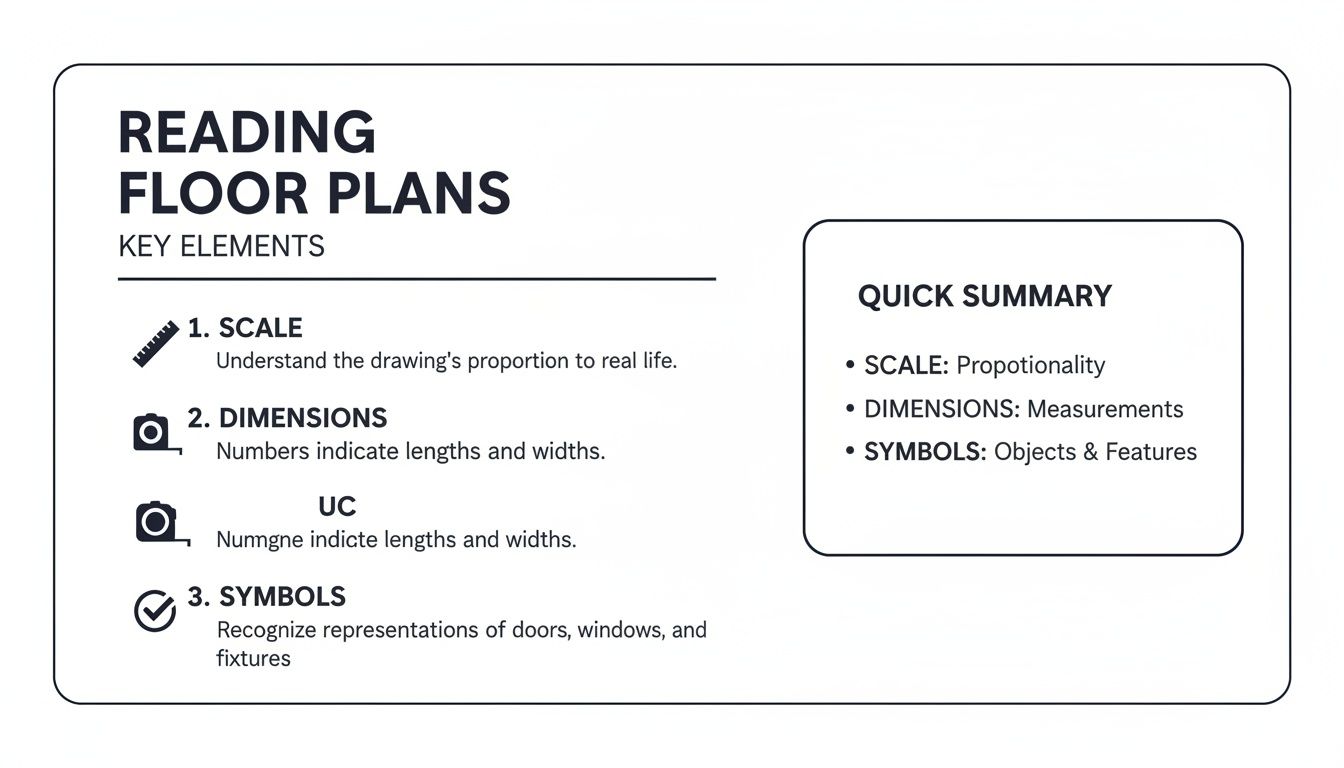
Getting comfortable with these fundamentals—scale, dimensions, and the common symbols—is what allows you to really start to analyze how a space will function and feel long before the first wall ever goes up.
Placing Openings with the Texas Lifestyle in Mind
Understanding why openings are placed where they are is where a builder’s local experience shines. For a custom home in Weatherford, we might position large windows on south-facing walls to capture winter sun, but design deep roof overhangs to shade them during our brutal summers. It's a design choice that makes a real difference in your energy bills.
I remember working with a family building on a beautiful piece of land in Granbury. We made one small tweak to their plan: adding a large sliding glass door in the great room. This gave them a perfect, unobstructed view of the backyard where their kids would be playing. It looked like a minor change on paper, but it gave them immense peace of mind.
We also think about the future. When designing a forever home for a retired couple in Glen Rose, we focus on accessibility. That means incorporating wider, 36-inch doorways right into the initial plan, especially for the master bedroom and bathrooms. Planning for this at the blueprint stage is a minor adjustment; trying to widen doorways in a finished home is a costly and messy renovation.
It's all about looking past the lines on the page and imagining your life unfolding within those walls. When you do that, you can make sure the final home truly supports your family for years to come.
Mapping Your Home’s Plumbing, Electrical, and HVAC Systems
A truly functional home goes way beyond just walls and windows. The real magic happens behind the drywall. When you learn how to read your floor plans, you’re mapping out these vital components—plumbing, electrical, and HVAC—to make sure your home works for you from the moment you move in.
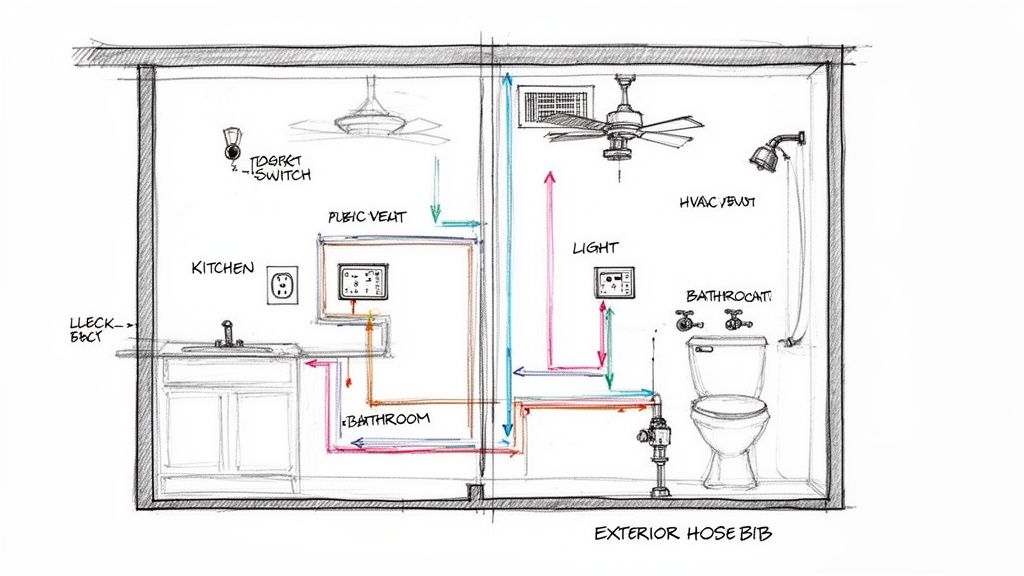
The electrical plan sets the stage for your daily life. Tiny circles with two parallel lines are standard outlets; circles with an "S" are light switches. Mentally walk through your day and think about where you’ll need power. If you're planning a home office, do you need extra outlets for a computer, monitors, and a printer? Adding them now is easy. Adding them after drywall is up involves cutting, patching, and painting, which can easily cost $150 to $250 per outlet.
Locating Plumbing and HVAC Fixtures
Plumbing fixtures are easy to spot with recognizable outlines of sinks, toilets, and showers. Don't forget to look for outdoor hose bibs—a must for maintaining your landscape, especially on a rural property in Granbury or Weatherford.
A smart plumbing layout can save you real money. On a recent build in Stephenville, we designed the master and guest bathrooms back-to-back.
By grouping the plumbing this way, we ran all the supply and drain lines through a single "wet wall." This simple strategy cut down on the amount of copper piping and PVC needed, saving the client nearly $1,500 in material and labor costs.
Finally, you’ll see symbols for your HVAC system, typically squares or rectangles marking supply vents and returns. Their placement should suggest balanced airflow. Also, find the thermostat, marked with a "T" inside a circle. It needs to be in a central spot, away from direct sunlight or drafts, to get an accurate reading and keep your home comfortable during scorching North Texas summers.
Understanding these system layouts lets you make small but impactful decisions, ensuring your home isn't just beautiful, but perfectly functional for your family’s needs.
Going 3D: What Elevations and Sections Tell You
A floor plan gives you the bird's-eye view, but we don't live in a 2D world. To get a feel for your new home's character, you need to look at the elevations and sections. These drawings bring a flat plan to life, showing what it will look like from the street and how the spaces will feel from the inside.
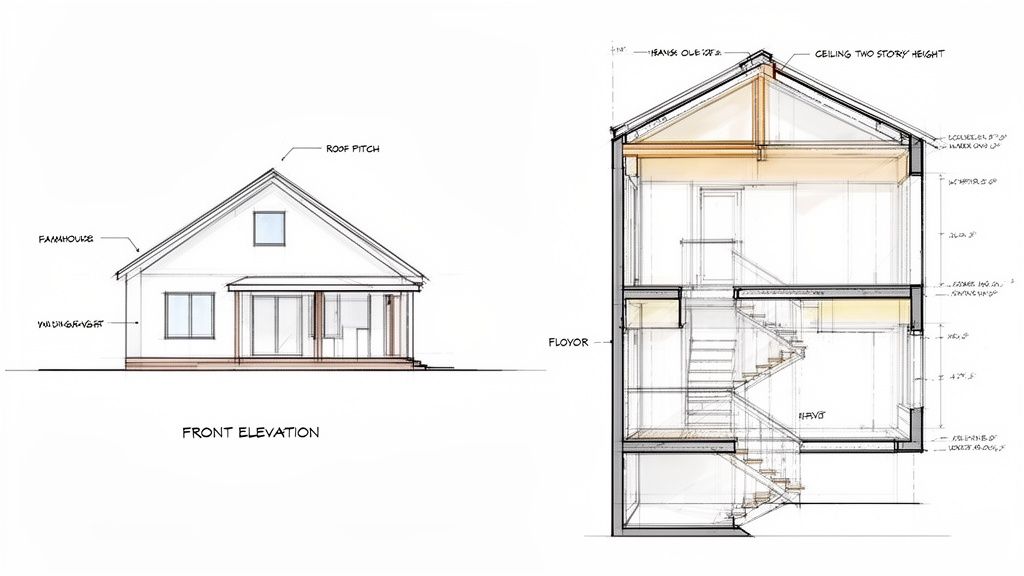
Elevations are head-on portraits of your house—one for the front, back, and each side. They’re critical for ensuring the exterior style you’ve dreamed of for your North Texas property is what actually gets built.
What to Look for in Exterior Elevations
When you look at an elevation, you're seeing your home as if you were standing in front of it. This is where curb appeal details come together.
Materials and Finishes: Plans will have notes calling out specific materials, like Austin stone, classic brick, or board-and-batten siding.
Roof Pitch: You'll see the steepness of your rooflines, a key feature that defines styles from a Texas farmhouse to something more contemporary.
Window and Door Styles: Elevations confirm the exact look and placement of windows and the design of your front door.
Architectural Details: This is where you'll spot porch columns, shutters, dormers, and other trim that gives your home its unique personality.
I remember working on a Gemini Homes project in Cresson where the clients had a specific modern farmhouse vision. The elevation drawings were a game-changer. We could show them precisely how bold, black-framed windows would pop against crisp white siding. It gave them total confidence in the look before we even broke ground.
Feeling the Space with Section Drawings
If elevations are the "outside-in" view, section drawings are "inside-out." Imagine slicing through the middle of your house—that's a section view. These are essential for grasping vertical volume and how different floors connect.
A section drawing shows you things a floor plan can't:
Ceiling Heights: You can see how a grand 10-foot ceiling in the living room transitions to a standard 8-foot ceiling in a hallway.
Two-Story Spaces: For homes with a two-story foyer or a vaulted great room, the section cut makes that soaring, open feeling clear on paper.
Staircase Details: The drawing reveals the structure of your staircase, placement of landings, and height of railings.
Getting comfortable with these drawings ensures the airy atmosphere you want is what's in the plans. We often find that taking this a step further helps; you can learn more about how we visualize your dream home with interactive floor plans to truly bridge the gap between 2D paper and 3D reality.
How to Walk Through Your Floor Plan (Before It’s Built)
You’ve got the basics down. Now comes the most important part: moving beyond reading the plan to truly living in it, at least in your mind. This is where you stop seeing lines on paper and start imagining your family's life unfolding.
The best way to start? Walk through your daily routines. Imagine hauling groceries from the car. Is it a straight shot into the kitchen and pantry? Or will you be cursing a tight corner every time? This simple test quickly uncovers little annoyances that can become major frustrations.
Place Your Furniture Before the Walls Go Up
Next, let's talk furniture. That primary bedroom labeled 15' x 17' sounds massive, but after you account for a king-size bed, two nightstands, and a dresser, will you still have comfortable walking space? Where does the sofa go in the living room? Is there a good spot for the TV that avoids window glare?
Don't just guess. Grab a roll of painter's tape and head to an empty garage or driveway. Mark the exact footprint of your key furniture pieces on the ground. This gives you a real-world feel for the scale. Getting the flow right in large, open-concept spaces can be a challenge, so it's a good idea to check out some expert strategies for decorating open floor plans in North Texas to make sure the layout truly works.
Day-to-Day Functionality: The Make-or-Break Details
Scrutinize every corner of the plan, thinking about how you actually live. The goal is to catch problems now, when a fix is a quick digital edit, not an expensive change order.
The Storage Sanity Check: Are the closets big enough? Will the pantry handle your Costco runs? Where will you put seasonal decorations? "Not enough storage" is one of the top regrets new homeowners have.
Planning for the Future: Is this your forever home? If you're building in a community like Glen Rose, think about life in 10 or 20 years. Is there a room on the main floor with a nearby full bath that could one day become a primary suite?
Life on the Land: For those building on acreage around Granbury, the home's placement on the lot—its "siting"—is everything. Did the builder angle the great room windows to catch that incredible sunset view? Is the house positioned correctly to accommodate a septic system and well?
A floor plan isn’t just a blueprint; it’s the script for your future life. This review is your final dress rehearsal. Make sure every scene, from your morning coffee ritual to hosting a big family Thanksgiving, plays out exactly the way you envision it.
By mentally walking through these scenarios, you’re ensuring that every detail of your new home is perfectly aligned with your family’s lifestyle.
Critical Questions to Ask Your Builder
Before signing off, have a detailed conversation with your builder. This checklist will help you cover all the bases, ensuring nothing is left to chance.
Area of Focus | Key Question | What to Look For in the Plan |
|---|---|---|
Entry & Garage | Where will guests put coats? Is there a clear path from the garage to the kitchen? | A well-placed coat closet or "drop zone" near the main entry points. Unobstructed, direct walkways. |
Kitchen & Pantry | Is the "work triangle" (sink, stove, fridge) efficient? Is there enough counter space next to the oven/fridge? | A logical flow between major appliances. Ample counter space on both sides of the cooktop and sink. |
Living & Dining | How will furniture be arranged? Where is the focal point (fireplace, view, TV)? | Sufficient wall space for sofas/media centers. A layout that naturally orients toward the focal point. |
Bedrooms & Closets | Will our existing furniture fit comfortably? Is the closet storage practical for our needs? | Dimensions that allow for walking space around beds/dressers. Shelving/rod layout in closets. |
Bathrooms & Laundry | Is there enough vanity counter space? Is the laundry room located conveniently? | A clear depiction of vanity size. The laundry room's proximity to bedrooms or the mudroom. |
Outdoor Living | Is the patio oriented to maximize views and minimize afternoon sun? Is there a gas line for a grill? | The home's orientation on the lot map. Utility symbols (like a gas stub-out) on the exterior wall. |
Systems & Utilities | Where is the HVAC unit located? Will it be noisy near a bedroom? Where are the key electrical outlets placed? | The location of mechanical units (often marked 'Mech'). Placement of outlets, switches, and lighting. |
Going through these questions systematically turns your review from a quick glance into a thorough analysis. It's your last, best chance to refine the details and build with total confidence.
Common Floor Plan Pitfalls to Avoid in North Texas
Building a custom home is an incredible journey, but it's easy to overlook small details on the floor plan that can become big headaches. Here in North Texas, we have our own unique considerations, and knowing what to look for can save you from serious post-construction regret.
One of the biggest culprits is wasted space. Think long, rambling hallways that serve no purpose or oversized foyers that eat up valuable square footage. Every square foot of a custom home has a price tag, and inefficient areas add to your cost without adding to how you live in the home.
Underestimating Room Scale and Flow
A bedroom might look huge on a 2D plan until you mentally place your king-sized bed and furniture. Suddenly, that spacious retreat feels cramped. The same problem pops up in living areas. If the natural flow from the kitchen is blocked by a poorly placed sofa, you'll feel that bottleneck every day.
Here's a practical tip I always give my clients—get out some graph paper.
Draw the room out to scale (1 square = 1 foot works great).
Make paper cutouts for your key furniture pieces, also to scale.
Move the pieces around. See how it feels. Can you walk around the bed easily?
This hands-on exercise gives you a much better sense of the actual space than just staring at a blueprint.
The most critical mistake, however, is ignoring how your home is oriented on the property. We see this with builds on rural land around Glen Rose and Weatherford. Putting a wall of large windows on the west-facing side without a deep porch for shade is a recipe for disaster. That great room will feel like an oven every summer afternoon, and your AC bill will be astronomical.
A thoughtfully designed plan works with the Texas sun, not against it, bringing in soft morning light while blocking harsh afternoon heat. Spotting these issues in the planning stage is key to creating a home that’s not just beautiful, but comfortable and efficient to live in.
A Few Common Questions We Get About Floor Plans
As you dive into the floor plans for your custom home, you're bound to have questions. Over the years, we've heard just about all of them from clients across Granbury, Weatherford, and North Texas. Here are a few of the most common ones.
What’s the Very First Thing I Should Check?
Before anything else, check the overall dimensions and the scale. Find the scale (usually 1/4" = 1'-0") and then find the main exterior dimensions. This gives you a tangible sense of the home's total footprint and prevents major surprises. Everything else hinges on getting this foundational understanding right.
How Can I Know If a Room Will Actually Feel Big Enough?
Numbers on a page can be tough to visualize. The best trick is to grab a tape measure and find a similar-sized room in your current house. Measure it out and stand in it. How does it feel? This real-world comparison is far more telling than just trying to picture it in your head. Also, look at door and window placement, as this dramatically affects furniture arrangement and how large a space feels.
Making changes on paper is always cheaper and faster than making them once the foundation is poured. Never be afraid to speak up. A good builder not only expects but welcomes this collaboration.
What Happens If I Want to Tweak the Floor Plan?
That's the whole point of this review! This is precisely the time to make changes. Moving a wall or making a window bigger is just a few clicks for the designer at this stage. Once framing starts, that same adjustment becomes a "change order," which almost always means more time and money. For more on this, check out our guide on the top questions to ask custom home builders in North Texas to help you prepare.
Are the Symbols on a Floor Plan the Same Everywhere?
Mostly, yes. Symbols for doors, windows, and stairs are pretty standardized. However, architects can have their own variations. That's why every professional set of plans includes a legend or a sheet of notes. Always find this page first. It's your dictionary for the drawings, ensuring you know exactly what you're looking at.
Building your home is an incredibly exciting journey, and it all starts with a plan that truly fits your life. If you’re ready to see how a well-crafted floor plan can bring your vision to life on your property, the team at Gemini Homes is here to help.
Comments