
What Is a General Contractor and Do You Need One for Your North Texas Home?
If you’re thinking about tackling a major home project in North Texas, the term general contractor—or GC—is one you'll hear a lot. So, what is a general contractor? Think of them as the director of a movie or the head coach of a football team. They’re the single most important professional you can hire, the one person responsible for taking architectural plans and turning them into the finished home, remodel, or addition you've been dreaming of.
The Quarterback of Your Construction Project
A general contractor is your project's manager, leader, and single point of contact. They orchestrate all the moving parts, ensuring everything happens in the right order, on time, and within your budget.
Imagine trying to build a new custom home on a piece of land out near Glen Rose or gut-renovating a historic kitchen in Weatherford all by yourself. You'd have to find, vet, schedule, and pay a dozen different specialists—everyone from the foundation crew and framers to the plumbers, electricians, and painters. A GC takes all of that complexity off your plate.
What Does a General Contractor Actually Do?
At its core, the job is all about expert project management. A great GC brings years of experience to the table, making sure every stage of the build is executed correctly and in the proper sequence. Without this oversight, chaos and costly mistakes are almost guaranteed.
Here's a breakdown of their primary responsibilities:
Hiring and Managing Subcontractors: Your GC already has a trusted network of specialized tradespeople. They know the best roofers, the most reliable HVAC technicians, and the most meticulous painters in the Granbury area.
Sourcing Materials and Supplies: They handle ordering everything from lumber and drywall to windows and light fixtures, often securing better pricing through their established relationships with local suppliers. For rural property owners, this includes coordinating deliveries to properties that might be off the beaten path.
Handling Permits and Inspections: Navigating the maze of local building codes and permit requirements in Hood County, Parker County, or elsewhere in North Texas is a huge part of their job. They know what local inspectors are looking for.
Keeping the Project on Schedule: A GC creates and fiercely protects the project timeline. They make sure the drywall crew doesn't show up before the electricians have finished their rough-in, preventing delays that can quickly derail a budget.
General Contractor vs DIY Project Manager Roles
Ever wonder what a GC handles that you'd have to do yourself? This table breaks it down. Managing a project yourself means taking on a second full-time job with a steep learning curve.
Task | Handled by General Contractor | Handled by Homeowner (DIY) |
|---|---|---|
Vet & Hire All Trades | Yes (using a trusted local network) | Yes (finding and vetting on your own) |
Coordinate Schedules | Yes (sequencing all crews) | Yes (juggling a dozen calendars) |
Order & Track Materials | Yes (leveraging supplier relationships) | Yes (sourcing, pricing, and timing deliveries) |
Manage Building Permits | Yes (navigating city/county offices) | Yes (learning and filing complex paperwork) |
Oversee Daily Work | Yes (ensuring quality and progress) | Yes (requires being on-site constantly) |
Handle Inspections | Yes (scheduling and meeting with inspectors) | Yes (coordinating and passing inspections) |
Assume Liability | Yes (fully licensed and insured) | No (you are personally liable for accidents) |
As you can see, a general contractor shoulders an immense amount of logistical, financial, and legal responsibility.
The role is absolutely essential to the U.S. construction industry. Out of roughly 4 million construction-related businesses in the country, the vast majority are small, GC-led firms tackling everything from ground-up builds to major additions like decks and custom gunite pools. You can dig deeper into the scale of the construction sector and its economic impact.
The Day-to-Day: A Masterclass in Coordination
So, what does a general contractor's daily work really look like? Forget the job title for a second. Think of them as the project's director, the one who takes a static set of blueprints and orchestrates all the moving parts to create a living, breathing space. It’s a masterclass in juggling logistics, money, and people to keep your project humming along.
Without that expert hand at the wheel, a project can quickly veer off course. What seems like a simple plan can descend into a mess of delays, budget blowouts, and frustrating mistakes.
Juggling Budgets and Timelines
Two of the biggest hats a GC wears are for managing money and time. They are the guardians of your project budget, meticulously tracking every dollar spent on lumber, tile, and labor to make sure there are no nasty surprises. It all starts with providing a realistic estimate and then responsibly managing those funds from start to finish.
At the same time, they're the keeper of the master schedule. A good project timeline isn't just a list of dates; it's a carefully choreographed dance where each step has to happen in a specific order. To get a better sense of how it all unfolds, check out our homeowner’s guide to the construction timeline.
Managing Trades and Securing Permits
A great contractor's most valuable asset is their Rolodex. For a remodel in Stephenville or a new build in Weatherford, your GC already knows the best plumbers, the most reliable electricians, and the painters who do impeccable work. They take on the burden of vetting, hiring, and scheduling all these different experts, so you don’t have to piece it all together yourself.
A general contractor's job is to bring order to chaos. They coordinate dozens of people and hundreds of tasks, ensuring the right person is doing the right job at the right time.
Then there's the red tape. Navigating local bureaucracy is a full-time job in itself. Every county, from Hood to Parker, has its own unique building codes and permit processes. A seasoned local GC knows these rules inside and out. They handle the paperwork, schedule the inspections, and ensure your project is fully compliant, saving you from legal headaches down the road.
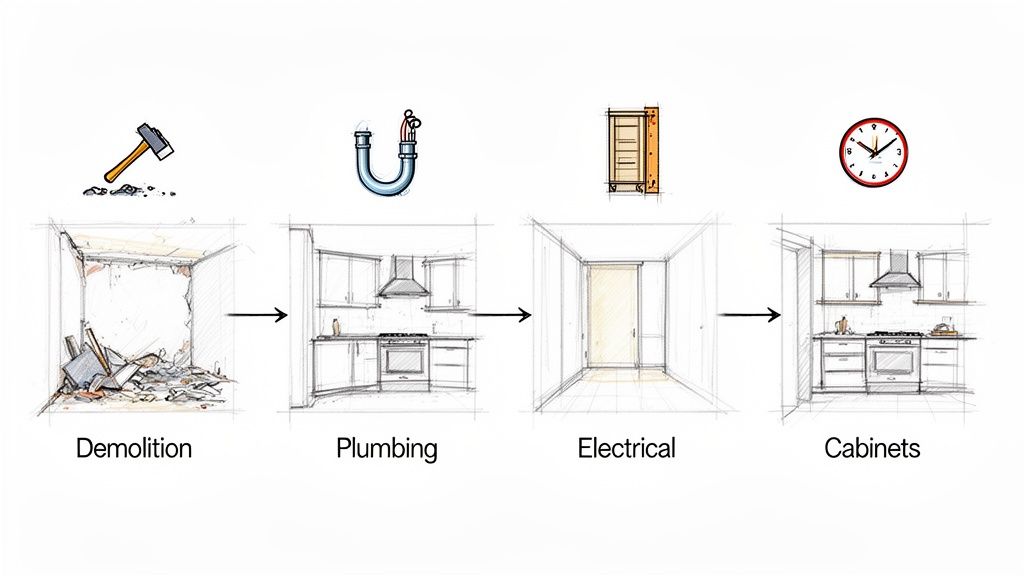
A Real-World Example: The Kitchen Remodel
Let's put this into practice. Imagine you're remodeling your kitchen in Granbury. It seems straightforward, but the sequence of events is critical. Getting it wrong can quickly turn into a homeowner's nightmare.
Here’s how a GC keeps it on track:
Day 1-2 Demolition: The GC's crew comes in and strategically removes the old cabinets, countertops, and appliances without damaging anything else.
Day 3-5 Rough-Ins: The plumber and electrician are scheduled back-to-back. The plumber moves the water lines for the new island sink, and right after, the electrician runs wiring for the new pendant lights. No one is tripping over each other.
Day 6-8 Drywall & Painting: As soon as the rough-in inspections are passed (which the GC scheduled), the drywall team closes everything up. The painters follow immediately after, getting the walls ready before the new floors go in.
Day 9-12 Installation: Now the finish line is in sight. The cabinet installers arrive, followed by the countertop fabricators. Finally, the plumber and electrician return to hook up the new sink, faucet, and light fixtures.
If you were managing this alone, you'd be making a dozen phone calls, desperately trying to get trades to show up in the right order. A GC turns that potential chaos into a seamless flow, delivering a beautiful, finished kitchen.
How General Contractors Structure Their Pricing
Understanding the financial side of your home project is a big deal, and the first step is knowing how a general contractor gets paid. Here in North Texas, you'll almost always run into two main types of contracts. Each one has its pros and cons, depending on what kind of work you're doing.
The most important thing is clarity. You should walk away from a contract signing feeling 100% confident about where your money is going and what the final number covers.
Fixed-Price Contracts
A Fixed-Price contract (sometimes called a Lump Sum) is exactly what it says on the tin. Your contractor provides a single, all-in price for the entire project based on a very detailed scope of work that you've both agreed on beforehand.
This model gives you the most budget certainty, making it a great fit for projects where plans are clear and surprises are unlikely. For example, a straightforward bathroom remodel in a Granbury home is ideal for a fixed-price agreement.
The big win here is that the financial risk is on the contractor. If the cost of lumber suddenly jumps, that’s on them to cover, not you. The trade-off? Less flexibility. If you decide you want to change something, that requires a formal change order, which adds cost and time. You can get a better feel for how that works by reading up on mastering construction change order management.
Cost-Plus Contracts
The other popular model is the Cost-Plus contract. In this setup, you agree to pay for the actual cost of all labor, materials, and subcontractor work. On top of that, you pay the general contractor a pre-agreed fee or percentage to cover their overhead and profit.
This approach is incredibly transparent. You'll see itemized receipts and know exactly where every dollar is going. It's also much more adaptable, which is why it's the go-to for complex, one-of-a-kind projects where you expect to make decisions as you go.
Imagine building a custom home on a tricky, sloping lot out near Glen Rose. You just know you’re going to run into unexpected site conditions. A cost-plus contract is perfect here because it lets you and the builder adapt and collaborate without the friction of renegotiating a fixed price every time something changes.
The flip side is that you don't have a guaranteed final number from the start. Your contractor will provide a detailed estimate, but the final bill can shift based on your material choices or any issues that pop up. This model thrives on a strong foundation of trust between you and your builder.
No matter which route you go, make sure the contract spells everything out in black and white:
A detailed scope of work, listing what's included and what's not.
A clear payment schedule tied to specific project milestones (e.g., foundation poured, framing complete).
The exact process for handling changes or dealing with the unexpected.
A good GC will take the time to explain these options and guide you to the one that makes the most sense for your specific project and protects your investment.
Understanding the Construction Team Roles
Walk onto any job site in North Texas, and you’ll hear terms like contractor, subcontractor, and construction manager flying around. They might sound interchangeable, but they represent very different roles. Getting a handle on this hierarchy is crucial for understanding who’s responsible for what.
Think of your general contractor as the head coach. It's their job to call the plays, manage the entire roster of talent, and ultimately, take responsibility for the final score. The GC is your single point of contact and accountability.
The Players on the Field
A head coach doesn't run the ball themselves; they bring in specialized players for those critical jobs. That’s exactly how a general contractor works with subcontractors.
Subcontractors are the expert players. They're the master electrician from Weatherford who wires your new kitchen, the seasoned roofer from Stephenville who makes sure your home is watertight, or the artisan tile setter who creates that perfect backsplash.
A General Contractor hires, schedules, and manages every single one of these specialists. The GC holds the contracts with each subcontractor, which simplifies everything for you. You only have one person to talk to.
This is why for your Granbury remodel, you hire one GC. They then seamlessly coordinate all the different experts, making sure everyone is working together toward the same end goal.
What About a Construction Manager?
You might also come across the term Construction Manager (CM). While a CM also oversees a project, the role is typically different. A CM often acts more like a consultant or an advisor, especially on huge commercial jobs. They work for the owner but usually don't hold the contracts with the trade partners directly. For most home projects, the GC is the direct, hands-on leader you'll be working with.
General contractors are the linchpins holding complex builds together. Recent data shows that even with market uncertainties, U.S. construction starts climbed 3.1% to $1.26 trillion annually, with residential projects leading the way. For North Texas homeowners, a skilled GC's established network is priceless, especially as projected labor shortages threaten to derail timelines. You can learn more about recent construction market trends and their impact in this report.
The chart below gives you a visual of the two main pricing structures a GC might propose.
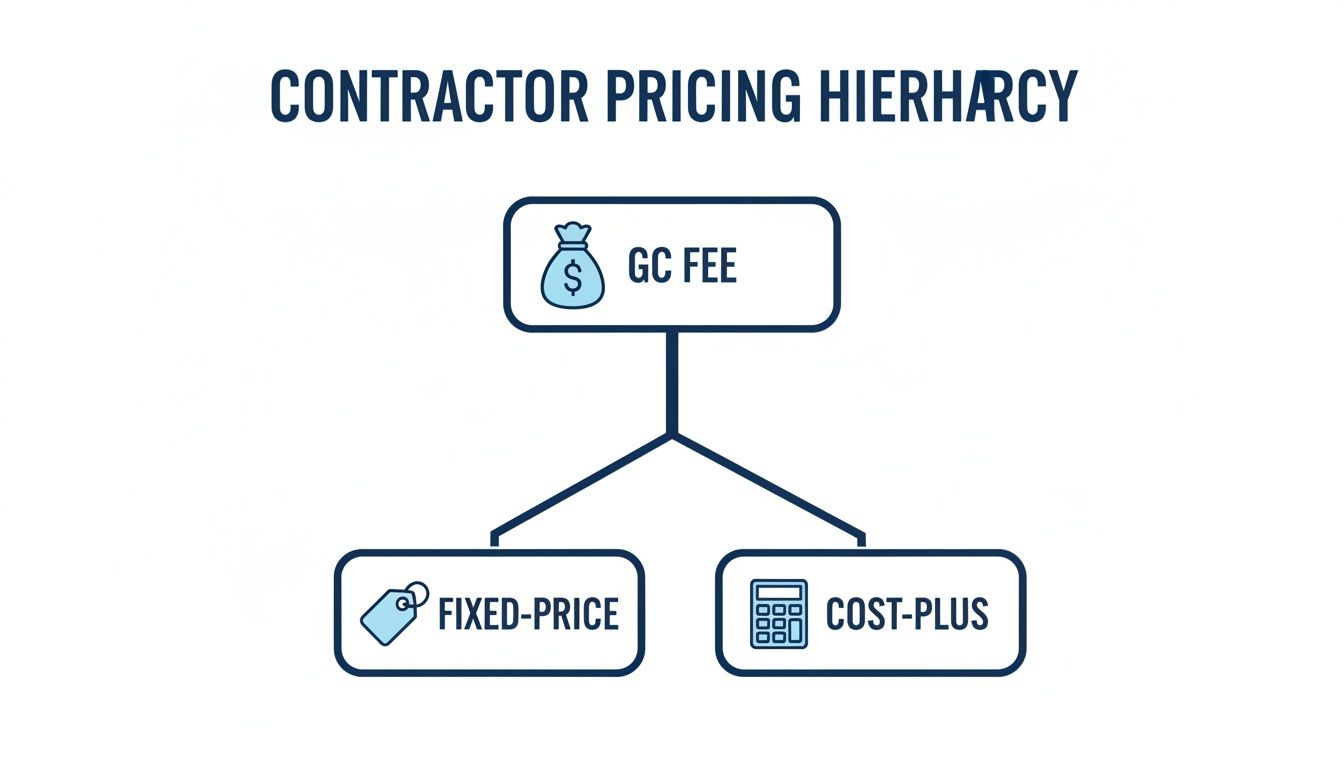
This shows that no matter which model you use—be it a predictable Fixed-Price or a transparent Cost-Plus agreement—the GC's fee is what covers the critical work of managing all these different team roles.
Essential Questions for Hiring a North Texas Contractor
Picking the right general contractor is the most critical decision you'll make for your home project. You're entrusting them with your budget, your timeline, and the final quality of your home. The best way to sort the seasoned pros from the rest is to ask the right questions before you sign anything.
Think of it less like an interview and more like a conversation to gauge their experience, their process, and their character. A great GC will appreciate your detailed questions and give you clear, straightforward answers. If you get rushed, vague, or defensive responses, that’s your first major red flag.
Verifying the Basics
Before you get lost in the exciting details of your project, you have to nail down the non-negotiables. These are the essential legal and professional standards that protect you. Don't feel awkward asking for proof—any reputable builder in Texas will have this information ready.
Are you fully licensed and insured in Texas? Ask for a physical copy of their general liability insurance and workers' compensation policies. This protects you from financial disaster if an accident happens on your property.
Can you provide a list of recent references? A contractor who does good work is proud of it and happy to connect you with past clients. You'll want to talk to people who had projects similar to yours, ideally right here in the Granbury or Weatherford area.
What is your experience with projects like mine? This is huge. If you’re planning a custom barndominium on a rural lot, you need a builder who knows the ins and outs of septic and well systems, not someone whose primary experience is remodeling kitchens in a city subdivision.
Gauging Their Process and Communication
Once you've confirmed they're legit, you need to understand how they work. These questions will tell you a lot about their organizational skills, their communication style, and how they handle the inevitable hiccups that come with any construction project.
The best contractors are proactive communicators who plan for the unexpected. Their goal isn't just to build your project; it's to guide you through the process with minimal stress.
Get specific with your questions:
How do you handle project changes or unexpected issues? Listen for a clear, documented process. They should mention "change orders" that formally outline any adjustments to cost or schedule, which you must approve before work proceeds.
Who will be my main point of contact? Will you be talking to the owner directly, a dedicated project manager, or a site supervisor? Having a single, consistent point of contact is absolutely key to a smooth project.
What does your payment schedule look like? Payments should always be tied to specific, completed milestones—like the foundation being poured or the framing going up. Never pay based on arbitrary calendar dates. A contractor demanding a massive cash deposit upfront is a serious warning sign.
Contractor Vetting Checklist
Verification Item | What to Look For | Potential Red Flag |
|---|---|---|
License & Insurance | Current, valid Texas license. Proof of General Liability & Workers' Comp. | Reluctance to provide documents; expired policies; under-insured. |
Local References | 3-5 recent clients with similar projects in your area. | Vague contacts; only has very old references; no local experience. |
Portfolio Review | High-quality photos/videos of completed work that matches your style. | Limited examples; low-quality work; style doesn't align with your vision. |
Written Contract | A detailed, professional contract outlining scope, timeline, and payment. | A simple handshake deal; vague terms; a "standard" one-page form. |
Change Order Process | A clear, written procedure for handling changes that you must approve. | "We'll figure it out as we go"; verbal agreements for changes. |
Payment Schedule | Payments tied directly to completed project milestones. | Large upfront deposit (>10-15%); payments based on dates, not progress. |
Communication Style | Clear, prompt, and professional responses to your questions. | Hard to reach; dismissive of your concerns; rushed answers. |
Taking the time to thoroughly vet your contractor with these steps isn't being difficult—it's being a smart homeowner. It's the best investment you can make in ensuring your project's success. For an even more detailed list, check out our guide on the top 10 questions to ask custom home builders in North Texas.
Why a Local Granbury-Area Contractor Makes All the Difference
When you're building in North Texas, choosing a local general contractor isn't just a nice-to-have—it's one of the smartest moves you can make. A builder who is truly from the Granbury area brings a depth of on-the-ground knowledge that someone from outside the region simply can't match.
This local insight has a very real impact on your project. They'll understand the unique soil conditions across Hood and Parker counties, which is critical for pouring a stable foundation. They often know the permitting officials in towns like Weatherford and Glen Rose personally, which can make a world of difference in smoothing out bureaucratic hurdles.
Deep Roots in the Community
A local GC has spent years building a trusted network of the best local subcontractors. These are the plumbers, electricians, and masons who live right here, take pride in their craftsmanship, and have a reputation to uphold.
And that’s the most important part: their reputation is everything, and it’s built right here in our community.
Think of it this way: a contractor who has served the Granbury area for years isn't just building a house; they're building for their neighbors. That kind of local accountability offers a peace of mind you won't get from an out-of-town company.
A stable, local partner can navigate supply chain issues and compliance delays far more effectively, keeping your project in Hico or Stephenville on track. You can see more about national construction trends from the U.S. Census Bureau. This hands-on, local expertise translates directly into a smoother building process and higher quality work. For anyone building their forever home or settling into our beautiful area for retirement, that kind of stability is priceless.
Frequently Asked Questions
Even with a clear idea of what a general contractor does, you probably still have a few questions. That's completely normal. Here are the most common ones we hear from homeowners in the Granbury area.
Is a General Contractor the Same as a Custom Home Builder?
Think of it like this: while many talented GCs can build a beautiful custom home, a dedicated custom home builder usually offers a more all-in-one experience from the very start.
A custom builder is often your first call. They might help you find the perfect piece of land, connect you with an architect, and guide the design process before a single nail is hammered. A general contractor, on the other hand, is typically brought in after the blueprints are finalized.
Do I Really Need a GC for a "Small" Project?
The need for a GC isn't about the size of the project, but its complexity.
If your project requires juggling multiple trades—say, framers for an outdoor kitchen structure, an electrician for lighting, and a plumber for a gas line—then yes, a GC is invaluable. They're the conductor making sure the whole orchestra plays in tune. For a simple job involving just one trade (like replacing a fence), you can probably hire that specialist directly.
How Do Contractors Get Paid? What’s the Fee For?
Typically, a GC’s fee is a percentage of the total project cost, usually falling somewhere between 10% and 20%.
But this isn't just pure profit. That percentage is what pays for their expertise and the immense risk they take on.
That fee covers the relentless job of scheduling everyone, managing subcontractors, handling payroll, carrying the right insurance, and ultimately, guaranteeing your project is built to code, on time, and on budget. It’s the cost of having a single point of accountability and a whole lot of peace of mind.
Hopefully, these answers clear things up a bit. At the end of the day, hiring the right professional adds structure and expertise to your vision, turning what could be a stressful ordeal into an exciting and rewarding journey.
If you're ready to discuss your custom home or major remodeling project in the Granbury area, our team is here to answer your questions and help you get started. Get in touch for a free consultation today.
Comments