
Mastering Construction Change Order Management
Building your dream home in places like Granbury or Weatherford is an exciting journey, and sometimes, the path takes an unexpected turn. A change order isn't a problem; it's simply the formal process we use to manage any deviation from your original contract. Think of construction change order management as the system that lets us document, price, and track project changes so there are no budget surprises or frustrating delays down the line.
What a Change Order Means for Your Home Build
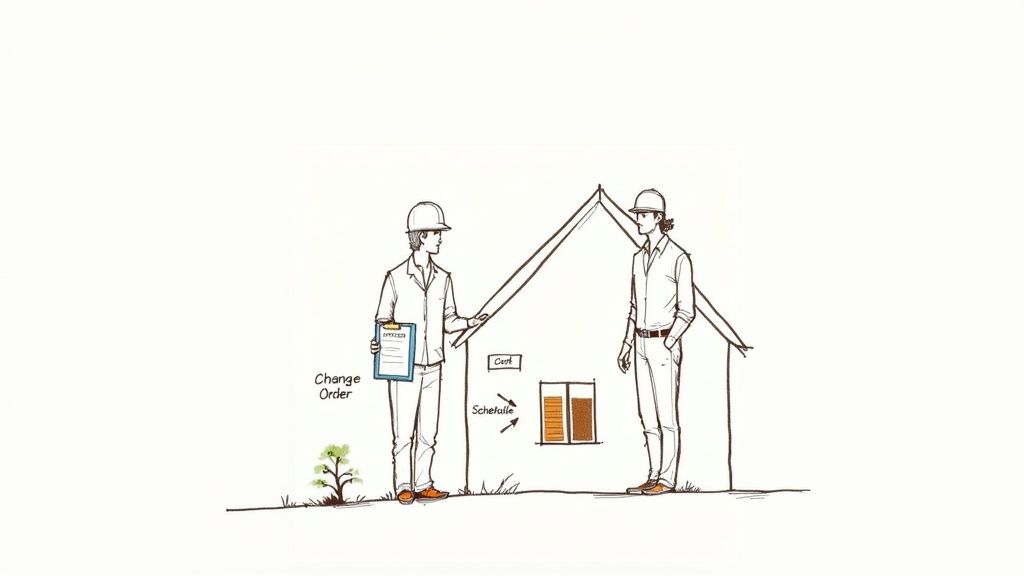
Essentially, a change order is a formal amendment to your construction contract. It’s a vital tool that protects both you and your builder by creating a clear paper trail for any adjustment to the project's scope, cost, or timeline. It ensures those quick on-site agreements don't get lost in translation and lead to disputes later.
These changes can come from either side. You might be touring the project and suddenly decide to upgrade your kitchen countertops after seeing a stunning quartz slab at a supplier in Glen Rose. That's a great idea! But it requires a formal change order to adjust the budget for the new material and any extra labor involved.
Common Reasons for Change Orders
Changes are a normal part of building a custom home. From my experience building across North Texas, many projects encounter at least one. They can pop up for all sorts of reasons:
Homeowner Decisions: You might want to add a window for more light, switch from carpet to hardwood floors, or extend the back patio for bigger family gatherings.
Unforeseen Site Conditions: When building on rural property here in North Texas, it's not uncommon for crews to hit unexpected rock during excavation. This might mean we need a different foundation approach, which requires a formal change to the plan.
Design Adjustments: Sometimes a small oversight in the original plans, like the placement of an electrical outlet, needs to be corrected to make a room truly functional for your family.
Material Availability: Supply chain hiccups can make a specific type of brick unavailable, forcing a switch to a different but comparable option that you approve.
Knowing these things can happen from the get-go helps set realistic expectations for the entire build.
What to Expect in the Document
A professionally prepared change order from your builder should be detailed and completely transparent. To make sure everyone is on the same page, every change order should contain a few key pieces of information.
Here’s a quick breakdown of what you should always see in a formal change order document:
Key Elements of a Formal Change Order
Component | What It Means for Your Project |
|---|---|
Clear Description of the Change | A plain-language explanation of exactly what work is being added or removed. |
Detailed Cost Breakdown | An itemized list of all new costs for materials, labor, and any subcontractor fees. |
Schedule Impact Analysis | A realistic assessment of how this change will affect the project completion date—adding days, weeks, or none at all. |
Original Contract Reference | Links the change back to the initial agreement, showing it’s an official update. |
Signature and Date Lines | Designated spots for both you and your builder to sign, making the change official once approved. |
By including these details, the change order acts as a mini-contract for that specific modification, ensuring total clarity.
A well-managed change order process is a sign of an organized and communicative builder. It’s not about avoiding changes, but about handling them with professionalism and clarity to keep the project on track.
The document will clearly outline any cost adjustments—whether it's an addition or a credit—and, just as importantly, how the change impacts the overall project schedule. For a deeper dive into how these adjustments can affect your project, you can get more info in our homeowner's guide to the timeline of construction. Before you sign anything, you should have a complete picture of the financial and scheduling consequences.
Whether you're a family building a forever home or a retiree planning a peaceful retreat in Weatherford, clear documentation is what ensures your vision is executed precisely as you want it, without costly misunderstandings. The next time you see a change order, view it as a tool for communication and control, not as a setback.
Why Project Changes Happen and How to Plan Ahead
Change orders often get a bad rap, but they're a normal part of building a custom home. The key is understanding why they happen so you can manage them without blowing your budget. While some changes come from new ideas, many of the most common triggers are unavoidable.
Here in North Texas, building on rural land can throw you a curveball. A classic example we see in Parker County is hitting solid rock while digging the foundation. It's nobody's fault; it's just what the land gives you. That discovery requires a change order for the extra equipment and labor needed to prep the site correctly, which is critical for your home's long-term stability.
Unforeseen Issues and Design Oversights
Sometimes, changes pop up from tiny details missed in the original plans. Maybe you're walking through the framing of your new Glen Rose home and realize the kitchen island design doesn't have an electrical outlet. It's a simple enough fix, but it still needs a formal change order to document the new scope and materials.
These little tweaks, along with owner-requested upgrades, are perfectly fine. The goal isn't to eliminate changes entirely. It's to reduce the ones that happen because of incomplete information at the start. In fact, industry research shows that a significant percentage of construction change orders are rooted in the project's earliest stages. This drives home a crucial point: thorough upfront planning is your best defense against budget creep.
Proactive Planning is Your Best Defense
The best way to manage change orders is to prevent the preventable ones. That means putting in the time and effort during the planning phase, long before the first shovel hits the ground. A detailed, well-defined plan gives your builder the information they need to create a more accurate bid and schedule from day one.
A well-thought-out plan is the foundation of a smooth building process. Every decision you finalize before construction begins is one less potential change order you'll have to deal with later.
For families building a home, this means thinking through your daily life. Do you need a drop zone with charging stations right by the garage entry? For retirees designing their forever home, it might mean planning for wider doorways and a curbless shower right from the start.
Here are a few things you can do to get ahead of the game:
Create Detailed Inspiration Boards: Don't just pin a few pretty pictures. Build a visual guide for every single room, covering everything from paint colors and flooring to light fixtures and cabinet hardware. This gives your builder an incredibly clear picture of your vision.
Finalize Selections Upfront: Lock in your major material choices before signing the final contract. This means picking the exact brick for the exterior, the specific tile for the guest bath, and everything in between. It locks in pricing and helps avoid delays due to availability.
Conduct a Thorough Plan Review: Sit down with your builder and go through the blueprints with a fine-tooth comb. This is your last, best chance to catch things like a door that swings into a walkway or a poorly placed light switch before they become expensive fixes on-site.
Ultimately, proactive planning is about making decisions when you're relaxed, not when you're under the pressure of an active construction schedule. Of course, having the right partner is fundamental. If you’re just starting out, our guide on how to choose a home builder in North Texas offers practical advice for finding a team that values detailed planning.
Navigating the Change Order Workflow with Confidence
When you’re building a custom home, change is almost inevitable. A clear, structured process is what protects both you and your builder from confusion and conflict. A well-managed workflow turns a potentially stressful moment into a controlled, transparent decision, whether you're building in Granbury or on a sprawling lot in rural North Texas.
The process kicks off the moment a new idea or an on-site issue arises. Maybe you decide to add built-in bookshelves in the living room, or perhaps your builder discovers an unexpected drainage problem. The most important step is moving from a verbal discussion to a formal, written process.
The Formal Change Order Request
Your builder should promptly create a Change Order Request (COR) for you to review. This is the official document outlining the proposed adjustment. It's not just a quick note with a price tag; a professional COR is a detailed proposal with all the information you need to make a smart decision.
Think of it as a mini-contract for a specific piece of your project. Before you even think about signing, this document must contain three core elements:
A Clear Scope of Work: The COR needs to precisely describe the new work. Vague descriptions like "add patio" are a red flag. A good COR will specify dimensions, materials, and finishes.
A Transparent Cost Breakdown: This is non-negotiable. You should see an itemized list of all material and labor costs. If you’re removing something, this section should clearly show a credit back to your budget.
The Impact on the Timeline: Every change has the potential to affect your move-in date. The COR must state how many days, if any, will be added to or subtracted from the construction schedule.
For instance, let's say you decide to add a covered patio to your home in Aledo. The COR would need to itemize costs for the concrete slab, framing lumber, roofing materials that match the main house, electrical work for a fan and outlets, and the labor for each trade involved. Seeing it all broken down removes any mystery from the final price.
This is all about proactive planning to minimize surprises down the road.
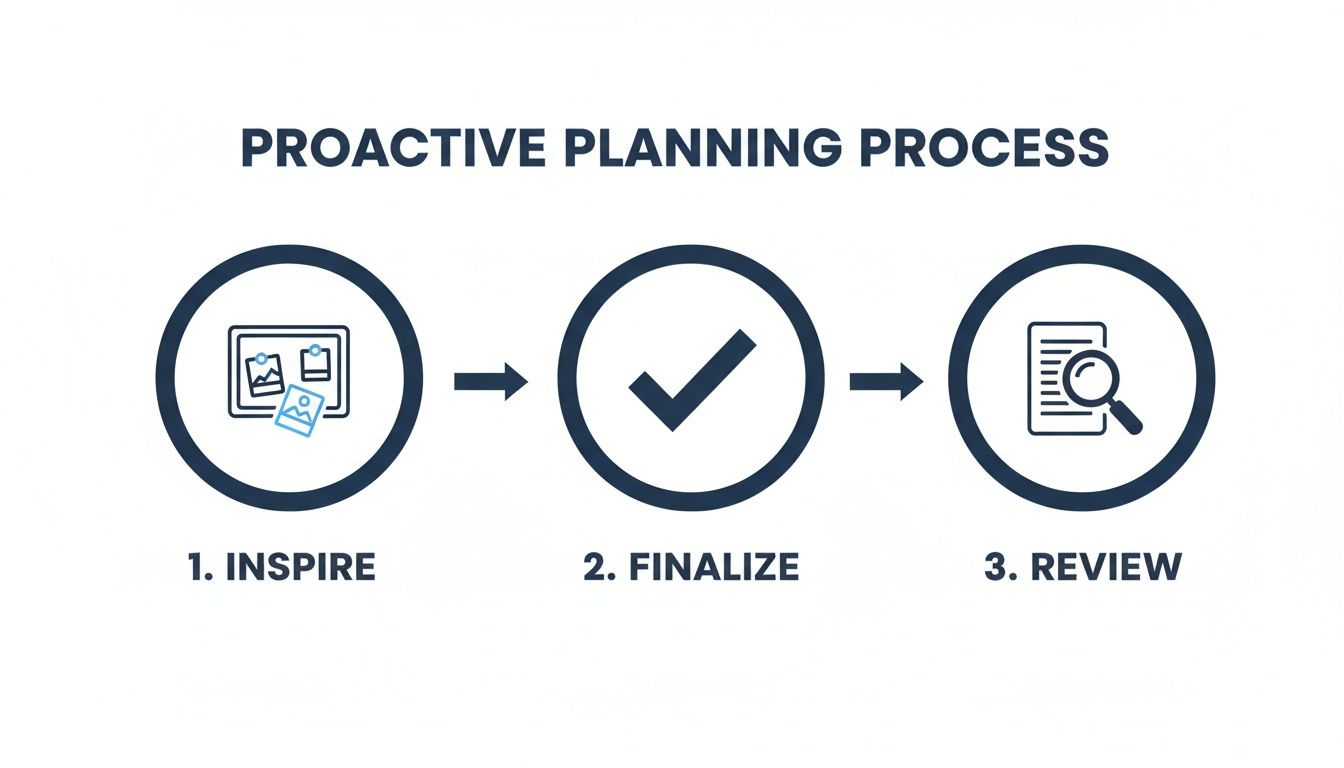
As the visual shows, investing time in the "Inspire" and "Finalize" stages leads directly to a smoother "Review" process, which naturally reduces the need for costly changes once construction is underway.
Your Role in the Approval Process
Once you receive the Change Order Request, the ball is in your court. This is your chance to review every detail without feeling rushed. Don't hesitate to ask questions until you feel 100% comfortable with what's being proposed.
Your signature on a change order makes it a legally binding part of your construction contract. Take the time to understand exactly what you are approving before you sign.
Before you sign off, run through this quick mental checklist:
Does the description match your vision? Read the scope of work carefully. Does it perfectly align with the conversations you had with your builder?
Is the pricing fair and transparent? Compare the costs to any initial estimates if you have them. If a price seems high, ask for clarification. It could be related to a recent spike in material costs or the complexity of integrating the new work.
Do you understand the schedule impact? A two-week delay for a small change might seem like a lot, but it could be due to subcontractor scheduling. Make sure you understand the why behind any extension.
This isn’t about being difficult; it's about being an engaged and informed homeowner. Any good builder will appreciate your attention to detail and be happy to provide the clarity you need.
Tracking the Work to Completion
After you’ve signed the COR, the final phase begins: execution. The approved work gets added to the project plan, materials are ordered, and crews get scheduled. Your role now shifts from decision-maker to observer.
On your regular site visits, make a point to check in on the progress of the changed work. Confirm that the materials being used are the ones specified in the change order and that the craftsmanship meets the high standards set for the rest of your home.
If you see something that doesn't look quite right, bring it to your builder’s attention immediately. Clear and prompt communication at this stage is the best way to ensure the final result is exactly what you envisioned and paid for.
This structured workflow—from initial idea to final inspection—empowers you to manage changes with confidence. It turns potential chaos into a predictable and professional process, keeping your North Texas home build on the right track.
When you're ready to start planning your project, feel free to schedule a free consultation with us to discuss how we manage every detail from day one.
Keeping Communication Clear to Avoid Disputes
When it comes to change orders, the paperwork is important, but it’s the conversation that truly matters. How you and your builder talk through changes is what keeps a custom home project feeling positive and moving forward. I’ve seen it time and again: clear, open, and honest communication is the single best tool for preventing a small hiccup from spiraling into a major dispute.
This is especially true in close-knit communities like Granbury and Stephenville, where a builder's reputation is their most valuable asset. A great building experience almost always comes down to a collaborative relationship built on mutual respect and transparency.
Fostering a Collaborative Relationship
The foundation for good communication is laid long before the first change order ever comes up. It starts with setting clear expectations from the very beginning. For instance, you should agree on a reasonable timeframe for your builder to price a potential change.
A simple question sets a collaborative, no-pressure tone: "If we started exploring the idea of an outdoor kitchen, what's a realistic timeline for you to get us a detailed price?"
It’s also incredibly important to distinguish between just kicking around an idea and formally asking for a change. You can frame it like this:
"We've been thinking about upgrading the windows in the master bedroom. Could you give us a rough idea of the cost and schedule impact? We're just in the brainstorming phase and aren't ready to commit yet."
This kind of language makes it clear you're just gathering information, not giving a green light. It shows you respect the builder's time and prevents them from doing hours of pricing work on something you might not even approve. This thoughtful approach is why we believe great customer service in the construction industry truly matters.
Always Put It in Writing
Here’s a simple rule that will save you a world of headaches: put every single decision in writing.
Even after a great, productive chat on-site at your property in Glen Rose, follow it up with a quick email. It doesn’t need to be a formal contract, just a simple summary of what you discussed and agreed upon.
A quick note like, "Great talking with you today! Just confirming we decided to move forward with pricing the stone fireplace upgrade," creates a clear paper trail. This simple habit ensures that a casual conversation doesn't get forgotten or misinterpreted weeks down the line when memories get fuzzy.
Navigating Common Friction Points
Even with the best communication, disagreements can pop up. They usually center on two things: pricing or schedule extensions. If a change order comes back with a higher price tag than you anticipated, don't just react—ask questions to understand the 'why' behind the numbers.
Ask for a Breakdown: "Can you walk me through the line items on this? I'd like to better understand where the material and labor costs are coming from."
Discuss the Schedule: "I see this adds ten days to the timeline. Can you explain what’s driving that? Is it material lead times or a subcontractor’s availability?"
More often than not, a transparent conversation will uncover factors you hadn’t considered, like a recent spike in lumber prices or a key subcontractor being booked solid. A builder who values the partnership will have no problem providing this context. The goal isn't to be confrontational; it's to be fully informed.
Research from the construction industry backs this up. A study of 334 construction specialists found that change order management performance is directly responsible for 66.5% of project performance variation. This proves that how changes are handled has a massive influence on whether a project succeeds or struggles. You can learn more about these important construction management findingsCO.1943-7862.0002350).
Building a home is a journey, and effective communication is your map. By fostering a relationship built on trust and clarity, you and your builder can navigate any changes that come your way, making sure the process remains exciting and rewarding from start to finish.
How Technology Is Taming the Change Order Chaos
Remember the old days of scribbled notes on a 2x4, misplaced invoices, and trying to recall a verbal "okay" given on a loud, dusty job site? Thankfully, those days are fading. Modern construction change order management has moved from paper trails to digital platforms, and for homeowners in North Texas, this is a huge leap forward in transparency and control.
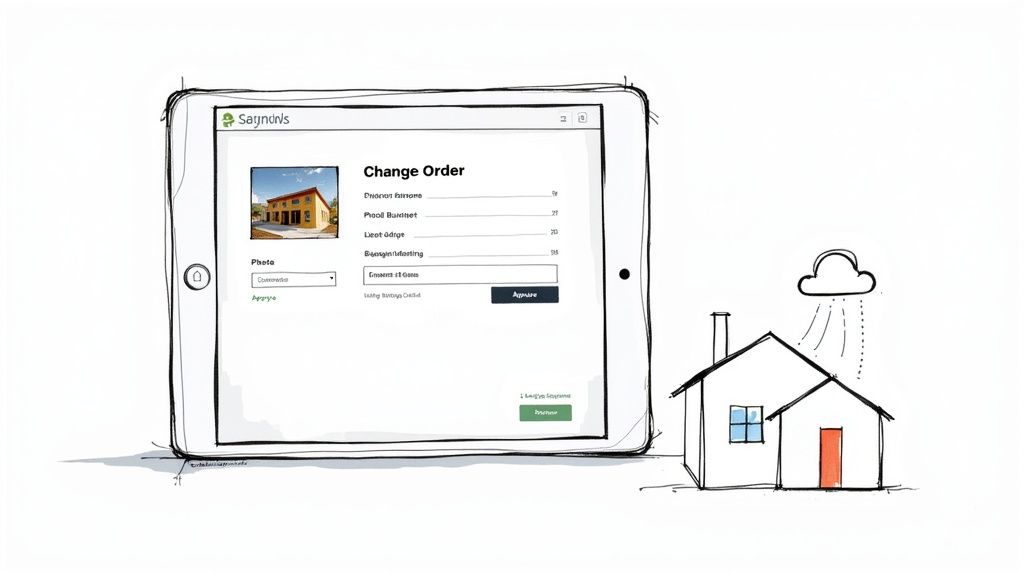
The best builders now use construction management software to keep everything in one place. Instead of a messy chain of emails and texts, these tools create a single, undeniable digital record of every request, cost, and approval.
This isn't just a niche trend; it's the new standard. The market for construction management software hit USD 11.27 billion in 2023 and is climbing steadily. That kind of growth happens for one reason: it works. It cuts down on mistakes and makes for happier clients, and you can learn more about the industry’s expansion and why it's becoming so essential.
How These Tools Actually Work for You
Let’s walk through a real-world example. Imagine your home is being framed out in Weatherford, and you realize you want to swap a standard window for French doors leading to the patio. Instead of a quick phone call that can easily get lost in the shuffle, your builder logs into their system and creates a formal change order.
You'll get a notification and can log into a secure client portal—from your phone or computer—and see everything laid out clearly:
A precise description of the work (e.g., "Install Jeld-Wen Model 72x80 French doors in rear living room wall").
Photos, spec sheets, or even links to the proposed doors.
An itemized cost breakdown for the new materials and the additional labor required.
A realistic look at how this change will affect the completion date.
You can review the details when you have a quiet moment, type any questions directly into the platform for the builder to see, and then approve it with a digital signature. The entire conversation is documented, timestamped, and always there for you to reference. It completely eliminates the "he said, she said" drama.
For families building on acreage out in the country or for those managing a build from another city, this kind of digital access is invaluable. It’s about peace of mind and feeling connected to your project’s progress, no matter where you are.
The Real-World Benefits of Going Digital
Adopting this kind of digital workflow brings very real advantages to your custom home project. It establishes a single source of truth, so there's never any debate down the line about what was agreed upon. It also dramatically speeds up the approval process, which is critical for keeping the project on track and avoiding costly delays.
Ultimately, builders in communities from Granbury to Glen Rose who embrace this technology are demonstrating a commitment to their clients. It shows they value transparency, organization, and clear communication—the cornerstones of any successful building relationship.
When you’re interviewing builders, make it a point to ask what systems they use to manage communication and change orders. Their answer will tell you a lot about how organized and client-focused they really are.
Answering Your Top Questions About Construction Change Orders
Building or remodeling a custom home is an exciting journey, but it’s natural for questions to pop up, especially when project plans need to shift. Feeling confident and in control starts with having clear answers. Here in North Texas, from Granbury to Weatherford, we find homeowners often have the same key concerns about the change order process. Let's tackle them head-on.
What’s a Fair Markup for a Builder to Add to a Change Order?
This is probably the most frequent—and most important—question homeowners ask. When you get a change order, you’ll see the cost is more than just the direct price of materials and labor. Builders add a markup, which is a standard practice to cover overhead and earn a profit.
For a custom home project, a fair and typical markup on a change order usually falls between 15% and 25%. This percentage isn't just profit; it covers the real, behind-the-scenes costs of running a business that aren't tied to a specific task. Think project management time, insurance, office support, and the complex work of coordinating schedules.
So, what determines if the markup is closer to 15% or 25%? A few factors come into play:
The Complexity of the Change: Swapping one light fixture for another is simple, so expect a lower markup. Reconfiguring a wall requires far more coordination and management, justifying a higher percentage.
When You Make the Request: A change made late in the game can cause a ripple effect of disruptions. It might mean re-ordering materials or rescheduling multiple subcontractors, which creates significant administrative work for the builder.
The Risk Involved: If a change means cutting into a finished wall or tying a new system into an existing one, the risk of something going wrong increases. The markup helps cover that potential liability.
Any transparent builder will have their markup percentage clearly stated in your initial contract and should have no problem explaining exactly what it covers.
Can I Refuse to Sign a Change Order?
As a homeowner, you absolutely have rights. But whether you can refuse to sign a change order depends on where the change came from and why. It’s not a simple yes or no.
If the change is something you requested—say, you’ve decided you want a different style of interior doors—you can decline the change order if the price or schedule impact doesn't work for you. In that case, you just stick with the original plan. No harm, no foul.
However, some changes simply aren't optional.
You are typically obligated by your contract to approve change orders that come from unforeseen site conditions or are needed to comply with new building codes. These are essential for the structural integrity and legal standing of your home.
For instance, if the excavation crew on your Glen Rose property hits a thick layer of rock that didn't show up in the soil tests, a change order to deal with it is unavoidable. The same goes if a county inspector mandates an extra safety feature that wasn't in the original plans. That change becomes mandatory.
If you find yourself disagreeing with the cost of a mandatory change order, the best thing to do is talk it out. Ask your builder to walk you through the pricing and explain the numbers. A good building partner will provide all the documentation you need to feel comfortable with the expense.
How Will Change Orders Affect My Construction Loan?
This is a critical financial question. In nearly every case, construction loans are for a fixed amount based on the original contract you and the builder signed. It is incredibly rare for a lender to increase the loan amount mid-project just to cover changes you’ve decided to make.
This means you’ll almost certainly have to pay for change orders out of your own pocket. This is why financial advisors and seasoned builders always recommend setting up a contingency fund. This fund, usually 10% to 15% of your total project cost, is money set aside specifically to handle these kinds of unexpected costs and approved changes.
Here’s how it typically works when a change order is approved:
You pay the builder directly for the full cost of the change.
This payment happens completely outside of your loan’s regular draw schedule.
It's vital that you keep meticulous records of these payments for your own financial tracking.
If a major, truly unforeseen issue dramatically increases the project cost, you can certainly talk to your lender. Just be prepared for a tough conversation with no guarantee they'll approve an increase. For most changes, your contingency fund is the go-to solution.
What’s the Difference Between a Change Order and an Allowance Overage?
People often mix these two up, but they mean very different things in a construction contract. Getting the distinction right is key to managing your budget clearly.
A construction change order is a formal update to your contract that changes the scope of work. It adds something, removes something, or alters a part of the project itself. For example, deciding to add a built-in media center where none was planned is a change in scope, and that requires a change order.
An allowance overage, on the other hand, happens when you pick a finish or material that costs more than the budgeted amount set aside for it in your contract. The scope of work isn't changing—you're still getting tile in the bathroom—but your specific tile choice costs more than the allowance.
Let's look at a real-world North Texas example:
Your contract includes a $5,000 allowance for the primary bathroom floor and wall tile.
You go to a supplier in Weatherford and fall in love with a gorgeous, hand-painted tile that costs $7,000.
That $2,000 difference is an allowance overage. It doesn't trigger a change order because the work itself (tiling the bathroom) hasn't changed. You'll just need to cover that extra cost.
The easy way to remember it: a change order alters what is being done, while an allowance overage is about how much a pre-planned item costs.
Navigating the details of a custom build is a significant undertaking, but you don't have to do it alone. If you're planning a project in the Granbury area and value clear communication and a transparent process, the team at Gemini Homes is here to help. We believe a well-informed client is a happy client. Reach out to us for a free, no-pressure consultation to discuss your vision at https://www.geminihomesgranbury.com.
Comments