
How to Choose a Home Builder in North Texas
Choosing the right home builder is one of the biggest decisions you'll make. It’s not just about finding a contractor; it’s about finding a partner you can trust—one with proven experience who genuinely understands the vision you have for your new home in North Texas. But before you can even think about interviewing builders, you need to do some critical homework first. You have to know exactly what you want.
Laying the Groundwork for Your Custom Home
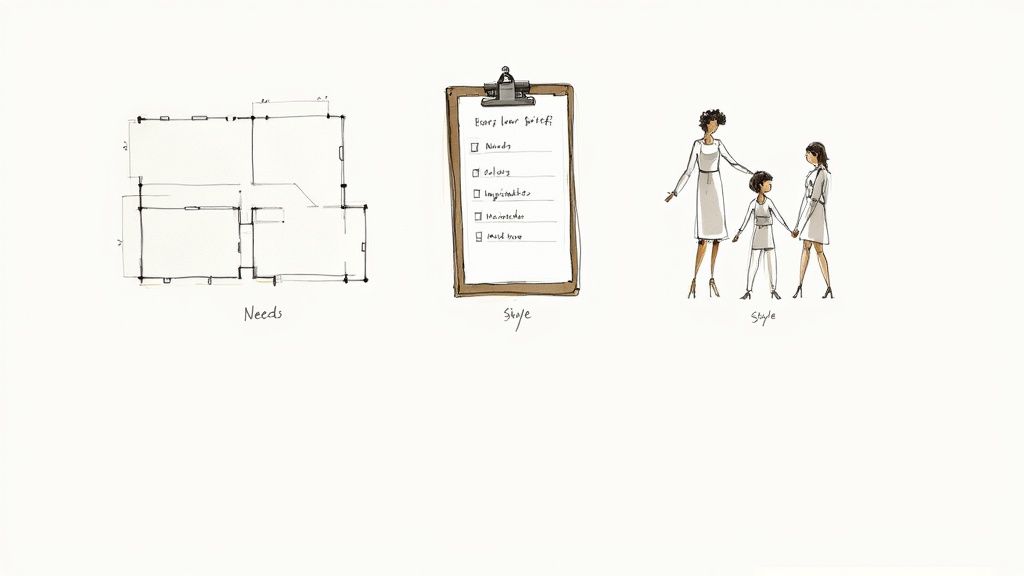
Building a custom home, whether in a growing community like Granbury or out on a piece of land near Weatherford, is a huge undertaking. The success of the entire project hinges on the prep work you do before a single shovel hits the dirt. The first order of business is to create a detailed project brief. Think of it as your master plan, outlining your vision, functional needs, and absolute must-haves.
This brief is the very document that will steer every conversation and decision. It’s how you find a builder who truly gets what you’re trying to create. Without this clarity, you risk miscommunication, budget surprises, and a final home that just doesn't feel right.
Articulate Your Family’s Needs
Before you get lost in tile samples and paint colors, let's talk about function. How does your family really live day-to-day? This is where you get specific about the practical stuff.
Here are a few scenarios we see often in our North Texas builds:
Growing Families: Will you need a flexible bonus room that starts as a playroom but can eventually become a teen hangout? Is a well-designed mudroom non-negotiable for corralling sports gear and backpacks after a day at the fields in Granbury?
Retirees and Aging-in-Place: If this is your forever home, think about what that really means. A primary suite on the ground floor, wider doorways for future accessibility, and a zero-entry shower can make a world of difference for long-term comfort and independence.
Multi-Generational Living: We see this a lot. A family planning to have aging parents live with them might need a ground-floor in-law suite, complete with a private entrance and a small kitchenette to give everyone their own space and autonomy.
Rural Property Owners: Building on acreage near Glen Rose or Weatherford comes with its own set of needs. Think a massive pantry for stocking up between town trips, a durable wraparound porch for Texas sunsets, or the practical considerations for a well and septic system.
Define Your Aesthetic and Style
Once the functional foundation is set, you can start dreaming about style. This is about more than just saying you want a "modern farmhouse." A great builder needs more to go on to truly capture your vision.
The single best thing you can do is create a visual mood board. Use a tool like Pinterest to save images of everything you love—exteriors, kitchen layouts, bathroom vanities, even the small details like cabinet hardware and light fixtures. A picture is worth a thousand words to a builder.
Think about the overall vibe you're going for. Is it open and airy? Cozy and rustic with exposed beams? Sleek and minimalist? Are there certain materials you're drawn to, like classic Texas limestone or the warmth of reclaimed wood? The more specific you can be, the better.
Identify Your Non-Negotiables
Every project has its priorities. Your list of non-negotiables is the short, powerful list of things you absolutely cannot live without.
Maybe a top-of-the-line, energy-efficient HVAC system is a must-have to handle the brutal North Texas heat. Or perhaps you absolutely require a three-car garage for your vehicles and workshop space. Identifying these deal-breakers right from the start saves everyone time and ensures you’re only talking to builders who can deliver on what matters most.
For a deeper look into these early planning stages, our guide on how to build a custom home in North Texas is a great resource.
With a well-defined project brief, you’re not just randomly looking for builders. You're conducting a targeted search for a partner who can bring your specific vision to life.
How to Vet Potential Builders Like a Pro
Once you have a shortlist of builders, the real work begins. This isn't just about a quick Google search; this is about protecting a massive investment and your peace of mind.
You’re not just hiring a contractor; you're choosing a partner. You need someone with a rock-solid reputation, proven financial health, and a track record of happy clients right here in North Texas. This is where the real vetting begins.
Go Beyond the Provided Reference List
Any builder can hand you a list of their three most ecstatic clients. And you should definitely call them. But the real story often comes from talking to people who aren't on that curated list.
When you connect with past clients, skip the generic questions. Get specific and ask things that reveal how the builder really operates under pressure.
Communication: "When you had a question, how long did it take to get a real answer? Who was your main point of contact, and were they readily available?"
Budget Management: "Were there any surprise costs? How did they handle change orders, and was the pricing fair and transparent?"
Timeline: "Did the project finish on time? We all know Texas weather can cause delays, so when things got off track, how did they communicate with you and manage the situation?"
Post-Construction Support: "Did anything come up after you moved in? How was their follow-through on warranty items or small fixes?"
A builder who gets glowing reviews for their communication and problem-solving is a true find. If you're still building your initial list, our guide on finding custom home builders near you in North Texas is a great place to start.
Verify Licenses, Insurance, and Financial Stability
This is the part you absolutely cannot skip. Any legitimate, professional builder will gladly provide you with their credentials. You need to see proof of their general liability insurance and workers' compensation coverage. Without it, you could be on the hook if an accident happens on your property.
Financial stability is just as critical. You need a builder who can navigate supply chain hiccups or economic shifts without your project grinding to a halt.
In the U.S., there are over 456,000 home building businesses, but the industry is heavily influenced by a handful of large firms. Opting for an established local builder with a long track record can seriously reduce your risk of facing delays or, worse, a builder going bust mid-project. To get a better sense of the industry landscape, you can learn more about builder market share and its impact.
Assess Their Local Track Record and Relationships
A builder’s reputation around town is everything. Take a drive through Granbury, Weatherford, or Aledo and look at homes they’ve built. Do they still look great? Good craftsmanship stands the test of time.
Beyond the finished product, consider their network. A builder with deep, long-standing relationships with local subcontractors and suppliers is an incredible advantage. This network is what keeps a project moving smoothly and ensures you get quality work from trusted tradespeople. A builder respected by their subs is usually one who is fair and pays on time—exactly the kind of person you want managing your project.
This due diligence is what gives you the confidence to finally choose the right partner to bring your dream home to life.
The Key Questions to Ask Your Potential Builder
Once you've done your homework and have a shortlist, it's time to sit down with your top candidates. Think of this as an interview where you’re the one doing the hiring. The goal here is to get past the sales pitch and see how they actually operate—their process, their communication style, and their real-world experience building right here in North Texas.
Getting a Feel for Their Process and Communication
A smooth build comes down to a solid, repeatable process. How a builder juggles the hundreds of moving parts, from scheduling subs to ordering materials, tells you everything about their professionalism.
Here’s what to ask to get to the heart of it:
Project Management: "What system or software do you use to keep clients in the loop on progress, schedules, and financials? Can I see a demo of the client portal?" This question immediately tells you if they value transparency and organization.
On-Site Supervision: "Who is my main point of contact on-site, and how often are they physically at the job? What’s your process for quality control at each stage?" With job sites often spread out in areas like Hood and Parker counties, you need to know someone is keeping a close eye on things.
Their Team: "How do you select your subcontractors? Do you have a core group of tradespeople you've worked with for years?" A builder with a loyal, skilled team is worth their weight in gold.
A builder’s process for handling changes is one of the most revealing things you can ask about. A vague answer is a major red flag. You want a clear, step-by-step explanation of how they document the change, present the costs, and get your approval before any work begins.
How They Handle Challenges and Your Money
Building a custom home is complex; unexpected issues will arise. How a builder anticipates and handles those issues is what separates the pros from the pack. This is particularly true when you're dealing with the unique building conditions in North Texas.
Our region, for instance, is known for its expansive clay soil, which can destroy a foundation if it’s not engineered correctly from the start. A seasoned local builder won't blink at this question—they'll have a strategy ready.
Drill down with these crucial questions:
Change Orders: "Can you walk me through your change order process? How do you calculate the cost, and how does it affect the schedule?" A transparent, documented process is non-negotiable.
Delays: "From supply chain hiccups to a week of spring thunderstorms, how do you handle delays? How do you communicate that to me, and what’s the plan to get back on track?"
Local Know-How: "What's your approach to engineering foundations for the expansive soil here? What specific steps do you take to prevent future problems?" Their answer should be detailed and confident, not generic.
Allowances and Budgets: "How do you set the allowances for things like light fixtures and flooring? Are your numbers realistic for the quality we've discussed, or are they set low to make the initial bid look better?" This is a classic tactic that can lead to major budget overages.
Nailing Down Design, Materials, and Warranties
Finally, you need to know how they’ll turn your vision into a reality and what happens after they hand you the keys.
Material Selections: "What’s your process for guiding us through material selections? Do you have preferred local suppliers or showrooms in the Granbury or Weatherford area we would visit?"
The Warranty: "Can I get a copy of your written warranty? What exactly does it cover, and for how long? And what's the process if we need to submit a claim after we move in?"
Asking these tough, specific questions forces a builder to prove their expertise and transparency. By the end of these interviews, you’ll know exactly who has the experience and systems in place to build your home on time, on budget, and to the standard you deserve.
If you're ready to have this conversation, we're happy to walk you through our process and answer every one of these questions. Feel free to schedule a no-obligation consultation to see if we're the right fit for your project.
Comparing Bids and Understanding the True Cost
Getting those first few bids back from builders is an exciting moment. Suddenly, your dream home has numbers attached to it. But this is also where homeowners make their biggest mistake: jumping at the lowest price.
Builder bids are almost never an apples-to-apples comparison. The cheapest quote on paper can quickly become the most expensive one by the end of the project. You have to dig into the details to understand the true cost.
Fixed-Price vs. Cost-Plus Contracts
Here in North Texas, you'll generally encounter two main types of contracts. Neither is inherently better; they just fit different situations and client preferences.
Fixed-Price Contracts: The builder gives you a firm, all-in price to build your home. This offers predictability, and the risk of cost overruns is mostly on the builder. This works well for more straightforward projects, like building in a planned Granbury community where land and infrastructure costs are known.
Cost-Plus Contracts: You pay the actual costs for labor and materials, plus a set fee or percentage to the builder for their management. It's highly transparent and offers more flexibility, making it a great fit for complex custom builds—for example, on a tricky rural lot near Glen Rose where you might run into unexpected rock or utility challenges. A typical cost-plus structure in our area might range from 15-25% of the total project cost.
Understanding this difference is the first step. A low fixed-price bid might be padded with low-quality allowances, while a cost-plus bid gives you more control over the final selections.
Spotting Red Flags in a Builder's Bid
An unusually low bid should make you suspicious, not excited. It often signals that the builder missed a major component in their estimate or plans to nickel-and-dime you with change orders later.
A bid that comes in way under everyone else’s usually means one of three things: the builder missed something huge, they’re using cheap materials, or their allowances are a fantasy. None of those scenarios end well for you.
Pay close attention to the allowances. These are budget placeholders for things you’ll pick out later, like flooring and countertops. If one builder quotes $5,000 for your entire appliance package while others are budgeting $15,000, that low bid isn't a deal—it’s a future overage waiting to happen.
Vague language is another major red flag. Descriptions like "standard fixtures" mean nothing. You need specifics: what brand, what model, what grade?
Comparing Home Builder Bids
Cost Category | Builder A (e.g., Fixed-Price) | Builder B (e.g., Cost-Plus) | Notes & Red Flags |
|---|---|---|---|
Foundation & Framing | Included in total price. | Cost of materials + labor shown. | Ensure both bids account for local soil conditions (e.g., expansive clay). |
Allowances | Appliances: $5,000 Flooring: $8,000 | Appliances: $15,000 Flooring: $15,000 | Red Flag: Builder A's allowances are unrealistically low for a custom home. |
Finishes | "Standard grade tile" | "Daltile, Level 3 porcelain" | Vague terms like "standard" are a warning sign. Demand specific brands/models. |
Exclusions | Landscaping, Fencing | Landscaping, Fencing | What's not included is just as important. Are driveways and septic systems in the bid? |
Laying it all out like this helps you see the true value behind the numbers. It helps you identify where one builder might be cutting corners or another is offering superior quality for a marginally higher cost.
Knowing how to analyze a bid is one piece of the puzzle. The other is understanding how new homes are valued for financing. To get up to speed, take a look at our Texas guide to new construction appraisals.
Contracts, Warranties, and Protecting Your Investment
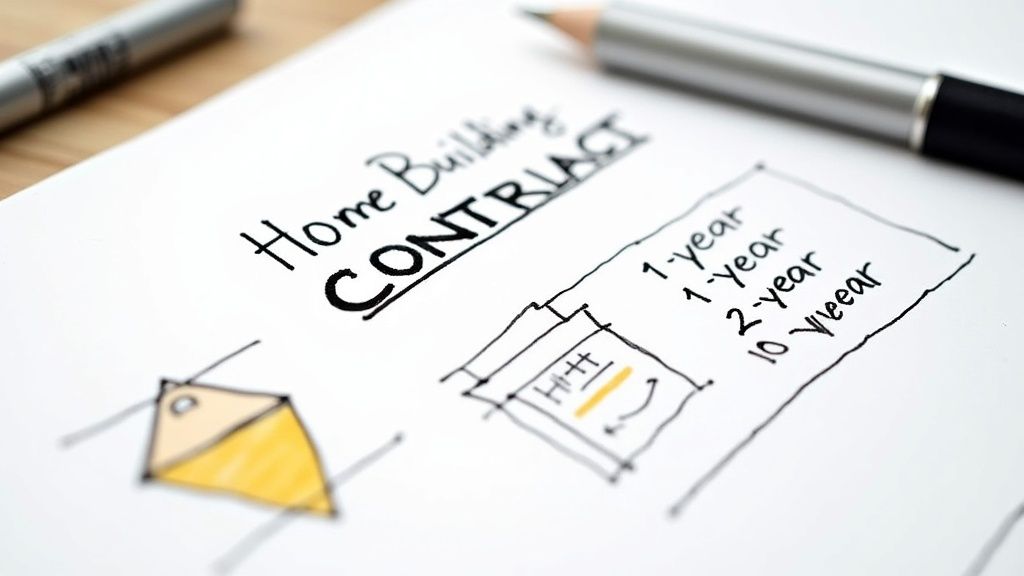
You've done the research, conducted the interviews, and compared the numbers. Now, all those conversations get translated into a legally binding commitment. The contract and warranty are the most critical documents you’ll sign, setting the rules for everything that follows.
This isn’t just paperwork. It’s your single best tool for protecting your investment. Every clause is there to prevent assumptions and misunderstandings. Before you sign, it’s time to scrutinize every detail.
Understanding Key Contract Clauses
A well-drafted construction contract is the official roadmap for your project. It needs to be incredibly detailed, defining clear expectations for both you and your builder. Pay close attention to these areas:
Payment Schedule: This clause spells out when and how your builder gets paid. Payments should be tied to completing specific stages of construction—like the foundation pour or framing inspection—not arbitrary dates. Never agree to a massive upfront payment beyond a reasonable deposit.
Detailed Scope of Work: This is the heart of the agreement. It should be an exhaustive list of everything included in your home, referencing your plans and specifications. If you see vague descriptions like "builder-grade fixtures," that's a red flag. Insist on specific brand names and model numbers.
Completion Date: Your contract needs a projected completion date. Just as important, it should outline what happens if there are delays, differentiating between unavoidable hold-ups (like a North Texas ice storm) and delays that are the builder's responsibility.
Dispute Resolution: A good contract pre-plans for disagreements. It will define a clear process, like mediation or arbitration, to solve conflicts without immediately heading to court.
Here’s the best piece of advice you’ll get: Never sign a contract you don’t fully understand. If a clause feels confusing or something seems off, stop. Do not move forward until you have a crystal-clear answer.
The Importance of a Legal Review
Before your pen ever touches that paper, make one of the smartest investments of your entire build: have a local real estate attorney review the contract. It’s a small upfront cost that can save you from catastrophic financial and legal headaches later.
An attorney specializing in Texas construction law will instantly spot ambiguous language or missing protections. This isn't about being distrustful of your builder; it’s just good business. In fact, a quality builder will welcome it, as a fair contract protects them, too.
Decoding Your Home Warranty
After your home is built, the warranty becomes your safety net. Builder warranties in Texas are generally standardized, but the devil is in the details. You must get a copy of the full written warranty and read it carefully.
Most warranties here follow a tiered "2-10" structure:
1-Year Workmanship: This is your bumper-to-bumper coverage for defects in labor and materials like drywall, paint, and trim.
2-Year Systems: This tier covers the guts of your home—the major mechanical systems like plumbing, electrical, and HVAC.
10-Year Structural: This is the big one. It protects you against major structural failures, like problems with your foundation. Given the challenging soil conditions around Granbury and Weatherford, this coverage is non-negotiable.
Make sure you understand the process for making a claim and what the builder’s responsibilities are for fixing any issues. A robust warranty reflects a builder’s confidence in their work.
Once you’re confident in the contract and clear on the warranty, it’s time to move forward. Our team is always happy to provide sample documents and answer your questions. Contact us to schedule a consultation and see how our transparent process protects your dream home.
Making Your Final Decision with Confidence
You’ve done the research, the interviews, and the deep dive into the paperwork. Now, you’re ready to make the final call. This last step is about pulling everything together—the hard data from bids, the feedback from past clients, and that all-important gut feeling.
Building a home in Granbury or on a rural lot near Glen Rose is a marathon. The builder you choose will be your partner for a year or more, so this decision boils down to one question: Who do you trust?
Balancing Logic with Intuition
Beyond the spreadsheets and legal documents, there's a human element that's just as crucial. A home build is a deeply personal journey, and having a solid rapport with your builder can make all the difference.
Think back on your conversations. Who listened more than they talked? Who answered your toughest questions with calm confidence, rather than getting defensive? This isn't about picking the builder you'd want to have a beer with; it's about choosing the professional you believe will handle challenges with integrity and respect.
Ultimately, you’re looking for a partnership built on mutual trust. The best builder for you is the one who not only demonstrates technical expertise but also makes you feel heard, respected, and confident in the path forward.
Your Final Decision Checklist
Before you make that final phone call, run through this one last mental checklist. It’s a great way to ground your gut feeling in the facts you’ve gathered.
Communication Style: Does their approach work for you? If you prefer a weekly email update and they’re more of a sporadic phone call person, is that a gap you can bridge?
Proven Quality: When you walked through their finished homes, did the craftsmanship truly meet your standards? Were the details—trim, tile work, paint lines—executed with care?
Transparency: Were they upfront about their process, especially on tricky subjects like change orders and allowances? Did you get a clear, detailed bid, or were there vague areas?
Overall Rapport: Do you feel a sense of confidence and ease when speaking with them? Building a home is stressful enough without having an adversarial relationship with the person in charge.
Setting Up for Success from Day One
Once you’ve made your choice and signed the contract, the real work begins. A great way to kick off the project on the right foot is to immediately establish how you’ll work together.
Start by defining your communication plan. Agree on a schedule for regular check-ins—maybe a standing 30-minute call every Friday morning—and confirm the best way to handle urgent questions. It's also smart to ask for a high-level overview of the first 30-60 days, covering milestones like permit approvals, site prep, and groundbreaking. This clarity gets everyone aligned and excited to move forward together.
Choosing your builder is the single most important decision in this process. By combining diligent research with your intuition, you can move forward with confidence, knowing you have the right partner to bring your North Texas dream home to life.
Ready to build with a team that values craftsmanship and clear communication? Gemini Homes has been a trusted partner for families across Granbury, Weatherford, and North Texas since 2006. We would be honored to discuss your vision and show you how we can bring it to life. To start the conversation, visit us at https://www.geminihomesgranbury.com and schedule your free consultation.
Comments