
Your Guide to Built Green Custom Homes in North Texas
Building a green custom home is about creating a holistic system—a home that performs better for your family, your wallet, and our local environment. It all comes down to making smarter choices from the ground up to lock in significant energy savings, healthier indoor air, and a more comfortable, durable home built to handle the unique challenges of the North Texas climate.
First Things First: Defining Your Green Home Vision
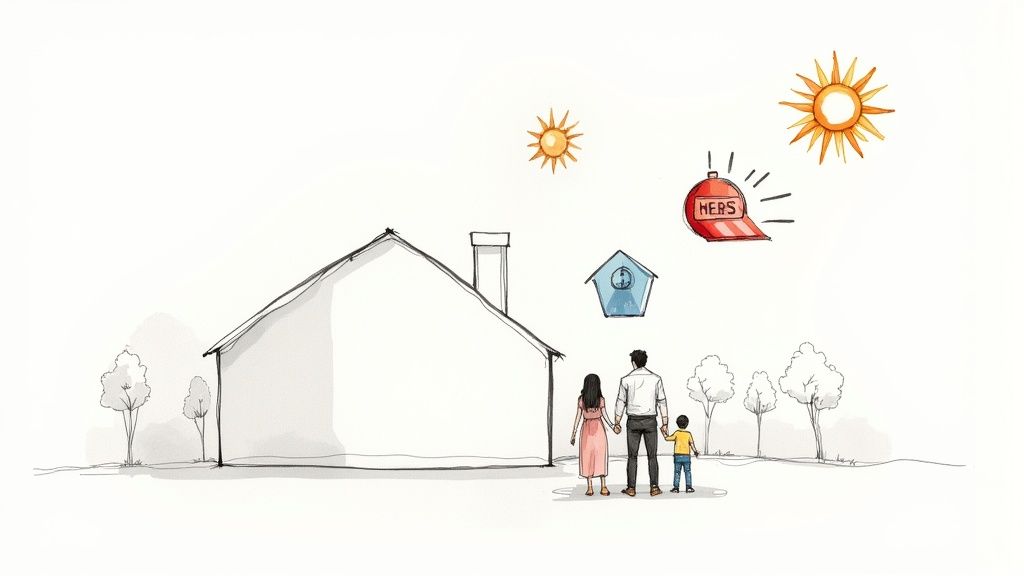
Long before the first shovel hits the dirt on your lot in Granbury or Weatherford, the most critical work happens through conversation and careful planning. A truly high-performance home begins with a crystal-clear vision shared between you and your builder. This is where you decide what "green" and "custom" really mean for your family.
This process is about setting real, measurable performance targets. What’s driving you? Is it the dream of slashing your monthly energy bills? Or is your top priority creating a non-toxic, healthy space for your kids to grow up in? Maybe it's about building a home that sits lightly on your piece of the beautiful Texas landscape.
The good news is that these goals often overlap. Figuring out your priorities early on will guide every decision down the road, from the orientation of the house on the lot to the type of insulation tucked into the walls.
From Vague Ideas to Tangible Goals
Simply saying, "I want an energy-efficient home," is a great start, but it doesn't give your build team much to work with. It’s far more effective to set specific, meaningful targets.
For instance, a couple planning their retirement home in Glen Rose will likely prioritize predictable, low operating costs for the long haul. A concrete goal for them might be: "We want our home to use 40% less energy than a typical new home."
Now that's a target. It gives your builder a clear benchmark to design and build toward, turning a wish into an actionable blueprint.
Here are a few key performance areas North Texas homeowners often focus on:
Energy Efficiency: This is the big one for most people. It's all about designing a tight building envelope and choosing smart systems to slash the energy needed for heating, cooling, and lighting.
Water Conservation: In a region that knows drought, managing water is just plain smart. This can mean anything from low-flow fixtures and rainwater harvesting to landscaping with native, drought-tolerant plants.
Indoor Air Quality: This is about the health of your family. It involves choosing materials with low or zero VOCs (volatile organic compounds) and installing advanced ventilation systems to keep the air you breathe fresh and clean.
Resource Conservation: This goal focuses on the bigger picture, prioritizing the use of sustainable, recycled, or locally sourced materials to reduce the home’s overall environmental footprint.
A Powerful Tool: The HERS Index
So, how do you measure energy efficiency? One of the best tools in the industry is the Home Energy Rating System (HERS) Index. Think of it as a miles-per-gallon (MPG) rating for your house—the lower the score, the better the performance.
A standard, code-built new home typically scores a HERS Index of 100. For a high-performance green build, you might set a target HERS score of 50 or lower. This tells your builder you want a home that’s at least 50% more efficient than a standard new build.
Bringing a target HERS score to your initial meetings creates a common language for performance. It’s a concrete number that defines success and keeps the entire project on track. This push for measurable results is a huge trend; the global green buildings market is projected to hit USD 1,374.23 billion by 2034, with an incredible 84% of custom homeowners now asking for green features.
To help you clarify your own priorities, think about which of these goals resonate most with you. This table breaks down what each target means for your home in our specific climate.
Defining Your Green Home Performance Targets
Performance Goal | What It Means For Your Home | Key Considerations in North Texas |
|---|---|---|
Lower Utility Bills | A home designed to minimize energy and water consumption month after month. | Focus on superior insulation, a high-efficiency HVAC system, and strategic window placement to combat intense summer heat. |
Healthier Indoor Air | Using non-toxic materials and advanced ventilation to reduce allergens, dust, and chemicals. | A tight home requires excellent mechanical ventilation (like an ERV) to manage humidity and keep air fresh without losing efficiency. |
Increased Comfort | A home with no drafts, consistent temperatures between rooms, and better humidity control. | Air sealing is critical. It eliminates hot and cold spots, making the entire home more comfortable year-round. |
Environmental Stewardship | Reducing your home's overall impact through sustainable materials and lower resource use. | Consider recycled materials, local sourcing to reduce transport emissions, and designing for a smaller footprint. |
Deciding on these targets upfront makes the design and construction process so much smoother. It ensures everyone is working toward the same, well-defined outcome.
We recently worked with a family on a rural property near Stephenville whose main goal was resilience. They wanted minimal utility bills and the ability to weather power outages. We set a target HERS score of 45 and designed the home with passive solar principles, a geothermal HVAC system, and meticulous air sealing. The result? Their energy bills are consistently 60% lower than their previous, smaller home.
This vision-setting phase is the foundation of your entire project. Taking the time now to define what truly matters will ensure your finished home isn't just beautiful, but a smart, healthy, and lasting investment.
For a broader look at the entire building journey, check out our practical guide on how to build a custom home in North Texas.
Designing for the North Texas Climate
A high-performance home in North Texas has to be designed to work with our climate, not constantly fight against it. Between the blistering summer sun, thick humidity, and those surprising winter freezes, a smarter approach is needed right from the start. Instead of just throwing a bigger HVAC system at the problem, a well-designed home uses the environment to its advantage to stay comfortable and efficient all year.
It all starts with one of the most basic, yet powerful, decisions you'll make: how the house sits on your lot. Proper home orientation is all about using the sun's natural path to your advantage. By positioning the long axis of your home to run from east to west, you can make sure your main living areas get the most southern exposure.
This simple move pays off big time during our cooler months. The low-angled winter sun streams right through those south-facing windows, giving you free, natural heat and light. Then in the summer, when the sun is high overhead, those same windows are much easier to shade.
Taming the Texas Sun
For any home in Granbury, Weatherford, or anywhere else in our region, controlling solar heat gain is enemy number one. Unprotected windows, especially on the east and west sides, can act like giant radiators, forcing your air conditioner to run nonstop.
The best defense is a layered one, using smart design to block the sun before it even hits the glass.
Deep Roof Overhangs: A well-calculated overhang can completely shade south-facing windows from the high summer sun but still let the low winter sun in to warm the home. We often start with a 2- to 3-foot overhang and adjust from there based on the home's specific design.
Covered Porches and Patios: Think of these as more than just outdoor living spaces—they're essential shading structures. A deep porch on the south or west side of your home can make a huge difference in your indoor temperatures.
Strategic Window Placement: This is a big one. We try to minimize windows on the west-facing side of the house as much as possible, since that’s where the harshest afternoon sun hits. If a western window is unavoidable for a great view, we plan for exterior shading solutions right from the beginning.
We recently built a home on a rural lot in Weatherford where the owners wanted tons of natural light without the heat penalty. We faced the main living spaces south with precisely sized overhangs and used high-performance, low-e coated windows. Just that simple passive design strategy cut their projected winter heating needs by over 30%.
The Power of a Superior Building Envelope
Beyond orientation and shading, the home's "skin"—what we call the building envelope—is your main line of defense against the elements. It’s the combination of your foundation, walls, roof, windows, and doors, and how they all work together to seal the inside from the outside. A leaky, poorly insulated envelope is the biggest source of energy waste and discomfort, period.
Getting a high-performance envelope right comes down to three key things working together:
Continuous Insulation: This means creating an unbroken thermal blanket around the entire home. We use techniques like adding rigid foam insulation on the exterior of the wall sheathing to prevent thermal bridging—that's when heat sneaks through the wood studs, bypassing the insulation in the walls. It creates a much more stable and comfortable indoor environment.
High-Performance Windows: Windows are almost always the weakest link in the chain. You should be looking for double- or even triple-pane windows with a low U-factor (which measures heat loss) and a low Solar Heat Gain Coefficient (SHGC) to block unwanted summer heat. For our climate, an SHGC of 0.25 or lower is the target.
Meticulous Air Sealing: This is absolutely non-negotiable. It’s the painstaking process of sealing every tiny crack, gap, and hole in the building envelope with the right caulk, foam, or tape. A tight home doesn't just keep your conditioned air from leaking out; it also stops drafts, dust, and pollen from getting in.
Landscaping as a Cooling System
Finally, don’t forget about your landscaping. Thoughtful planting can act as a natural extension of your home's climate control.
Planting deciduous trees (like a native Cedar Elm or Red Oak) on the south and west sides is a classic move for a reason. They provide dense shade in the summer but let the warming sunlight through in the winter after their leaves have fallen.
Using native, drought-tolerant plants like Texas Sage and Blackfoot Daisy also cuts way down on your watering needs, which is critical for conserving our water resources. This approach, often called xeriscaping, doesn't just save you money—it creates a beautiful landscape that’s naturally built to handle our hot, dry summers.
Choosing the Right Materials and Systems
With the architectural plans in hand, it’s time to get into the nuts and bolts of your home—the materials and systems that make it run. These aren't just details; they are the very core of a high-performance home, directly influencing your monthly bills, indoor air quality, and overall comfort.
For built green custom homes in North Texas, this means picking durable, sustainable products that can stand up to our wild weather swings.
Think beyond surface-level aesthetics. Of course, reclaimed wood from an old Texas barn or locally quarried stone looks incredible, but their true value is in their longevity and smaller environmental footprint. Sourcing materials from our region cuts down on transportation emissions and supports local economies, which is a big part of what "building green" is all about.
High-Performance Systems for Our Climate
In any home, the heating, ventilation, and air conditioning (HVAC) system does the heavy lifting. Here in North Texas, where cooling makes up the lion’s share of our energy bills, this decision is absolutely critical. There's no one-size-fits-all answer; the right system really depends on your property and what you want to achieve.
Have some acreage? A geothermal heat pump is a phenomenal choice. It uses the earth's constant underground temperature to cool and heat your home with incredible efficiency—often 30-60% more efficient than standard systems.
On a more typical suburban lot in a place like Granbury, a high-efficiency variable-speed air conditioner is a more practical, yet still powerful, option. They are whisper-quiet and sip energy compared to the clunky, old single-stage units.
The biggest mistake I see is installing an oversized HVAC system. It sounds powerful, but it cycles on and off so quickly that it never gets a chance to properly dehumidify the air. That leaves you with that cold, clammy feeling, which is a major comfort problem in our humid climate.
Proper installation is just as important as the equipment itself. Even the most expensive unit will fail to perform if it's connected to leaky or poorly designed ductwork. For a deep dive into this, check out our North Texas guide to insulating HVAC ducts, which explains how to lock in comfort and savings.
The chart below shows how smart, passive design choices—like insulation and ventilation—can drastically reduce the workload on your mechanical systems from the very start.
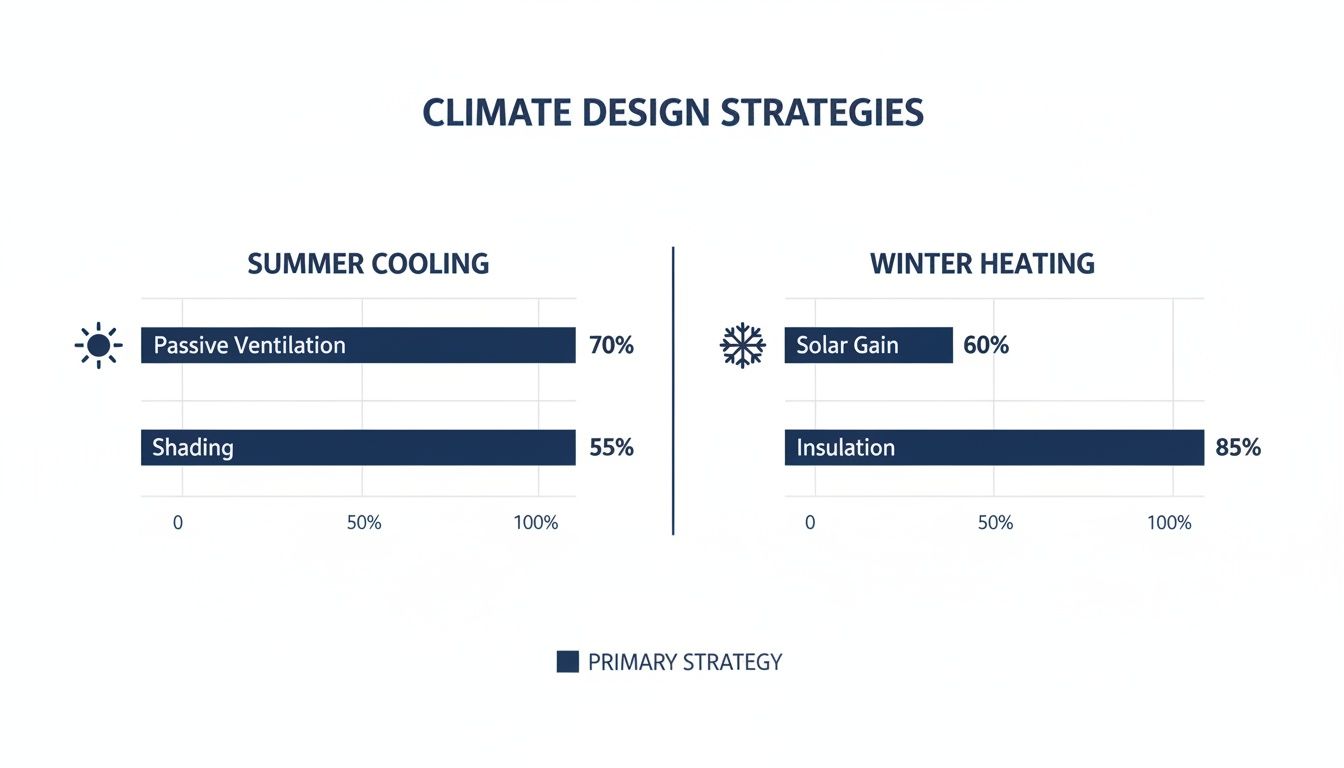
When insulation handles 85% of your winter heating needs, your furnace barely has to break a sweat.
Smart Water Management Strategies
Water is just as precious as energy, especially in Texas. By integrating efficient plumbing and smart water heating, you can significantly cut your home's water use and the energy costs associated with it.
Low-Flow Fixtures: Forget the weak dribble of the past. Modern fixtures with the WaterSense label are certified to use at least 20% less water than standard models without you even noticing a difference in performance.
Tankless Water Heaters: Why keep a giant tank of water hot 24/7? On-demand systems heat water the second you need it, which can slash your water heating energy costs by 24% to 34%. That adds up fast for a busy family.
Whole-Home Filtration: If you're on a well, common on properties around Glen Rose or Stephenville, a whole-home filtration system is a must. It delivers clean, safe water to every faucet and protects your pipes and appliances from sediment damage.
Key Green Building Systems Comparison
Navigating the options for high-performance systems can feel overwhelming. To help clarify, here's a breakdown of some common choices, their main benefits, and what to expect in terms of cost and return on investment.
System Type | Primary Benefit | Upfront Cost Factor | Long-Term Savings |
|---|---|---|---|
Geothermal Heat Pump | Unmatched energy efficiency & comfort | High | Highest |
High-Efficiency HVAC | Excellent performance & wide availability | Moderate | High |
Tankless Water Heater | Endless hot water & energy savings | Moderate | High |
Rainwater Harvesting | Water conservation & drought resilience | Moderate to High | Moderate |
Solar Panels (PV) | Generates free electricity & energy independence | High | Highest |
This table gives you a starting point. The best combination for your home will depend on your specific site, budget, and long-term goals.
A Practical Example: Rainwater Harvesting
Let's put this into a real-world context. Imagine a rainwater harvesting system on a one-acre lot in Parker County. If you capture the runoff from a 2,500-square-foot roof, you could collect over 30,000 gallons of water a year based on our local rainfall patterns.
That water is perfect for keeping your landscape green, which can save a bundle on your water bill, especially when summer watering restrictions kick in.
Upfront Cost: A good-quality system with a large cistern, pump, and basic filtration might run $8,000 to $12,000.
Annual Savings: If you're replacing city water for irrigation at around $10 per 1,000 gallons, you could easily save $300 or more each year.
Long-Term Value: Over ten years, that’s $3,000 to $4,000 back in your pocket, not to mention the peace of mind that comes with having a backup water source during a drought.
Finding this balance—weighing the upfront investment against long-term savings, comfort, and resilience—is what building a truly smart, green home is all about.
Green Certifications and Local Incentives: What Are They Worth?
At first glance, third-party green building certifications can seem like a lot of extra paperwork. But they offer something you can’t get any other way: independent proof that your home performs as designed.
Think of programs like ENERGY STAR or LEED for Homes as a report card for your house. They verify that it meets rigorous standards for efficiency, health, and sustainability. This isn't just about a plaque for the wall; it’s about making sure you get the high-performance home you’re paying for.
Deciding to go for a certification is a conversation you'll want to have with your builder right from the start. It's not something you can just tack on at the end. The process shapes parts of the design and requires specific inspections and documentation along the way, so it has to be baked in from day one.
While it adds a layer of coordination, the payoff is a home that's been put through its paces and proven to work.
So, Which Certification Program Makes Sense?
These programs aren’t one-size-fits-all. Each one has a different emphasis, so the right choice really comes down to your priorities for your North Texas home.
For homeowners building in areas like Granbury, Weatherford, or Glen Rose, a couple of programs consistently stand out for their practicality and market recognition.
ENERGY STAR® for Homes: This is the big one. If you’ve ever bought an appliance, you know the name. An ENERGY STAR certified home is independently verified to be at least 10% more efficient than a home built to standard code, though in my experience, the real-world savings are often much higher. Its focus is laser-sharp: a complete thermal envelope (no drafts!), high-efficiency HVAC, and smart water management to protect your home's structure.
LEED for Homes: Think of LEED (Leadership in Energy and Environmental Design) as ENERGY STAR plus a whole lot more. Energy is a huge piece of the puzzle, but LEED also gives you credit for things like smart site selection, water-saving fixtures, sustainable materials, and healthy indoor air quality. A LEED-certified home isn't just efficient; it's a holistically designed, healthier living space.
Here’s the simplest way to think about it: Every LEED home is an incredibly energy-efficient home. But it has also met high standards in several other key areas of sustainable design that go beyond just your utility bills.
The Financial Side of Building Green
Certifications aren't just about a feel-good philosophy; they deliver tangible financial benefits that you'll see both now and in the future.
A built green custom home simply performs better on the market. We've seen it time and again. National studies back this up, showing that certified homes can command a higher resale value—often appraising for 3% to 5% more than similar, non-certified homes.
But you don't have to wait until you sell to see the financial upside.
Federal and local incentives can take a real bite out of the upfront investment. The federal government, for example, offers some pretty substantial tax credits for homeowners who install renewable energy. The Residential Clean Energy Credit can cover a significant percentage of the cost for systems like:
Solar panels
Geothermal heat pumps
Solar water heaters
Don't forget to look closer to home, either. Local utility companies in North Texas often have their own rebate programs for building an efficient home or installing specific high-performance equipment, like a top-of-the-line heat pump. These programs can change from year to year, so it's always smart to check with your local electric co-op to see what’s currently on the table.
Bringing this up with your builder is easy. In your very first meeting, just ask: "What's your experience with green building certifications?" and "Are you up to speed on the current federal tax credits and local rebates we could use?"
Their answers will immediately tell you how deep their expertise runs in this part of the industry.
Finding the Right Green Home Builder
Let's be blunt: your builder is the single most important partner you’ll choose on this journey. This isn't just about hiring a contractor; it's about finding someone who can translate your vision for a built green custom home into a high-performing reality.
Finding a builder with genuine expertise in green building isn’t a nice-to-have, it’s a necessity. Anyone can claim to build "green," but a true expert understands building science—the idea that your home is one big, interconnected system. Everything from the foundation to the roof vents has to work in harmony, especially in our unique North Texas climate.
You Need to Ask Better Questions
When you start interviewing builders, you have to dig deeper than the standard questions. Generic inquiries about timelines and past projects won't reveal their true capabilities in high-performance construction. You need to get specific.
Here are the kinds of questions that separate the seasoned pros from those just paying lip service to green building:
"Can you show me the HERS scores from some of your recent custom homes?" A builder who is proud of their energy-efficient work will have this data on hand. It's the clearest proof they can deliver on their promises.
"Walk me through your process for air sealing." Listen for specifics. Their answer should include materials like fluid-applied barriers or high-quality tapes and must end with a final blower door test to prove the home is tight.
"How do you handle HVAC commissioning?" A great builder doesn’t just install the unit and walk away. They ensure it's tested, balanced, and calibrated to perform exactly as designed for your home's specific needs.
"Do you or your key team members hold credentials like Certified Green Professional (CGP)?" While not a deal-breaker, it shows a real commitment to staying current in a fast-evolving field.
These questions shift the conversation from what a builder says they can do to what they have actually done. For an even deeper dive, check out our guide on the top questions to ask custom home builders in North Texas.
Reading Between the Lines of a Portfolio
When a builder shows you their portfolio, don't get distracted by the beautiful kitchens and spa-like bathrooms. Train your eye to look for the hallmarks of a high-performance home.
Look for thick walls designed for extra insulation or deep roof overhangs positioned for passive solar shading. A portfolio that highlights these less-glamorous—but absolutely critical—details is a huge indicator that the builder prioritizes performance over purely cosmetic features.
We recently worked with a Granbury family whose high-performance windows were hit with a major supply chain delay. An inexperienced builder might have pressured them to use a standard, in-stock window to keep the schedule moving. Because we had a transparent process from day one, we worked together to re-sequence the build, protecting the home's building envelope until the correct windows arrived. That's the difference a true partner makes.
This is the kind of collaboration you're looking for. It’s about finding a builder who is just as invested in your home's performance goals as you are.
Building a Strong Partnership from Day One
A successful build is built on a foundation of clear communication and shared expectations. Before you ever sign a contract, make sure you’re aligned on the process.
Communication Plan: How often will you meet? Who is your main point of contact? A regular, structured communication rhythm prevents small issues from becoming big problems.
Warranties: What, exactly, is covered? A reputable builder provides a comprehensive warranty that covers not just structural elements but the performance of your home’s key systems.
Change Orders: What happens when you want to make a change? A clear, transparent process for pricing and approving changes is crucial for keeping your project on time and on budget.
Remember, your builder will be a major part of your life for the better part of a year. Finding a team you trust and communicate well with is just as important as their technical expertise.
Living In and Maintaining Your Green Home
Getting the keys is a fantastic moment, but it’s not the end of the story. Now you get to experience what all that careful planning was for—a built green custom home that delivers on its promises of lower bills, healthier air, and undeniable comfort.
Before we hand over those keys, we perform one last critical check. We run a final blower door test to get a hard number on the home's air-tightness. This isn't just for show; it’s the ultimate proof that we hit the performance targets we laid out together way back in the design phase.
This final verification confirms your home's envelope is sealed up tight, ready to perform at its peak for years and years.
Your North Texas Green Home Maintenance Plan
You might think a high-performance home is complicated to live in, but it’s actually quite simple. It just requires a slightly different approach. Because your home is so well-sealed, the mechanical systems are the heroes, working quietly to manage your air quality and comfort.
A little routine care goes a very long way. Here’s a straightforward maintenance list we give our homeowners, specifically for our climate here in Granbury and across North Texas:
HVAC Filter Changes: This one is non-negotiable. Get in the habit of checking your air filters every 30-60 days. Clogged filters make your system work harder and dirty your air. Clean filters mean lower bills and healthier breathing.
Energy Recovery Ventilator (ERV) Care: Think of the ERV as your home’s lungs. It’s constantly exchanging stale indoor air with fresh outdoor air. To keep it working efficiently, you’ll want to clean its filters every 1-2 months.
Check Window and Door Seals: Once a year, take a quick walk around and inspect the weatherstripping on your windows and exterior doors. The Texas sun is relentless and can wear down seals over time. Catching a problem early stops drafts before they start.
Clean Gutters and Downspouts: This is all about water management. Clogged gutters can cause water to overflow and run down your walls, which can lead to serious issues with your foundation and siding. A quick cleanout in the spring and fall is all it takes.
The real payoff starts the day you move in. You'll feel the consistent temperatures from room to room, and you'll definitely see the difference in your utility bills—often 40-60% lower than a typical new home. This is the return on investment you worked so hard for.
Tracking Your Home’s Performance
One of the coolest parts of owning a high-performance home is watching it work. Many of our clients get a kick out of tracking their home's energy use through their smart thermostat or utility company's online portal.
This data is incredibly empowering. You can see exactly how your home is performing, spot trends, and make small tweaks to your daily habits that can save even more money. It’s a great way to stay connected to your home and appreciate the smart choices you made from the very beginning.
Living in a home built for efficiency, health, and comfort is a game-changer. By staying on top of these simple tasks, you’ll ensure your investment continues to pay you back for decades to come.
If you're ready to start planning a high-performance home that’s built to last in North Texas, our team would be honored to help bring your vision to life. Let’s talk about what a smarter, more comfortable home could look like for you.
Comments