
What Is a Custom Home? A North Texas Homeowner's Guide
So, what exactly is a custom home? In short, it’s a one-of-a-kind house designed and built from scratch for a specific client on their own land. Unlike a pre-existing model you can tweak, a custom home is a true partnership between you, your designer, and your builder. It's an opportunity to create a home that perfectly reflects your lifestyle, taste, and the unique character of your North Texas property.
Defining the Dream of a Custom Home in North Texas
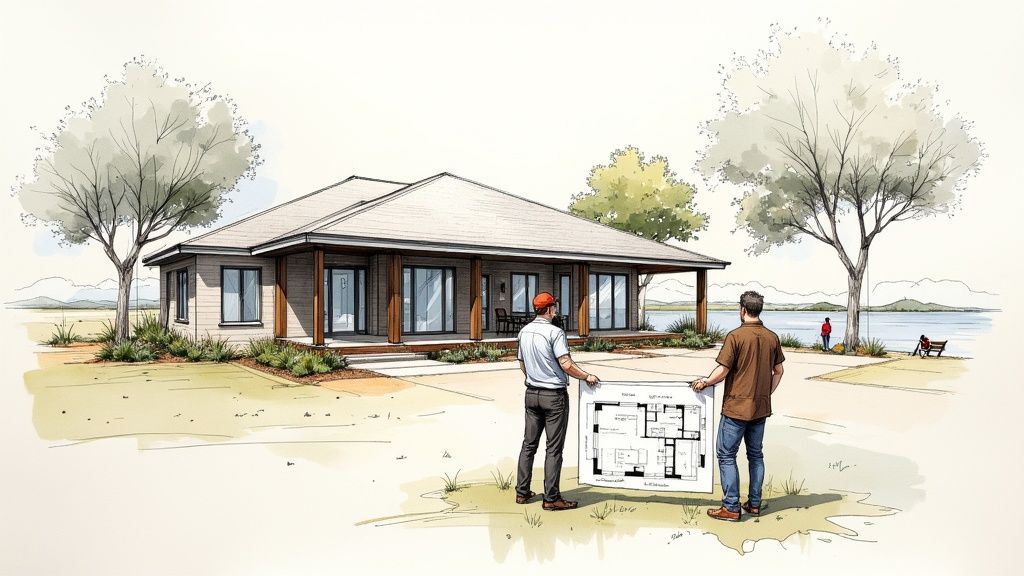
Think about the difference between buying a suit off the rack versus having one custom-tailored. The off-the-rack suit might fit okay, but the tailored one is crafted for your exact measurements, your choice of fabric, and your personal style. A custom home is that tailored experience, giving you complete control over every detail.
The process starts with a blank slate—just your ideas and your plot of land in places like Granbury, Weatherford, or Glen Rose. You aren't restricted to a builder’s portfolio of floor plans or pre-selected finish packages. Instead, you get to work directly with an architect and builder to map out a layout that genuinely works for your family's daily life.
The Core Elements of a True Custom Build
What truly sets a custom home apart? It comes down to a few key elements that offer total creative freedom.
Unique Design: Every element, from the foundation to the roofline, is designed just for you. For example, a Granbury family who loves to entertain might design a kitchen that flows seamlessly into a sprawling outdoor living space with a fireplace. A retiree might need a single-story layout with wide doorways for future accessibility. A custom build makes these specific needs possible.
Site-Specific Planning: The home's design is tailored to your specific lot. This means placing windows to capture the best sunset views over Lake Granbury, angling the house to take advantage of natural light and breezes, or carefully preserving the mature oak trees on your Weatherford property.
Unlimited Material Selection: You have the final say on every material and finish. This includes the flooring, countertops, light fixtures, siding, and even the type of insulation used in the walls—ensuring the quality and aesthetic are exactly what you expect.
The desire for this kind of personalization is growing. According to the National Association of Home Builders (NAHB), there were 54,000 custom home starts in the second quarter of 2025 alone, showing steady demand. You can dig into more data on custom home building trends from the NAHB.
A custom home isn’t just about picking out finishes. It’s about creating a space that functions perfectly for your family, reflects your personality, and connects seamlessly with the North Texas land you’ve chosen to call home.
This deep level of personalization means the house you end up with is a direct reflection of your vision, built to a standard of quality that you help set. It’s more than just a house; it’s a long-term investment in a home that will serve your family for generations.
If you’re starting to picture what’s possible on your land, our team can help you explore the first steps in a no-pressure conversation.
Comparing Your North Texas Home Building Options
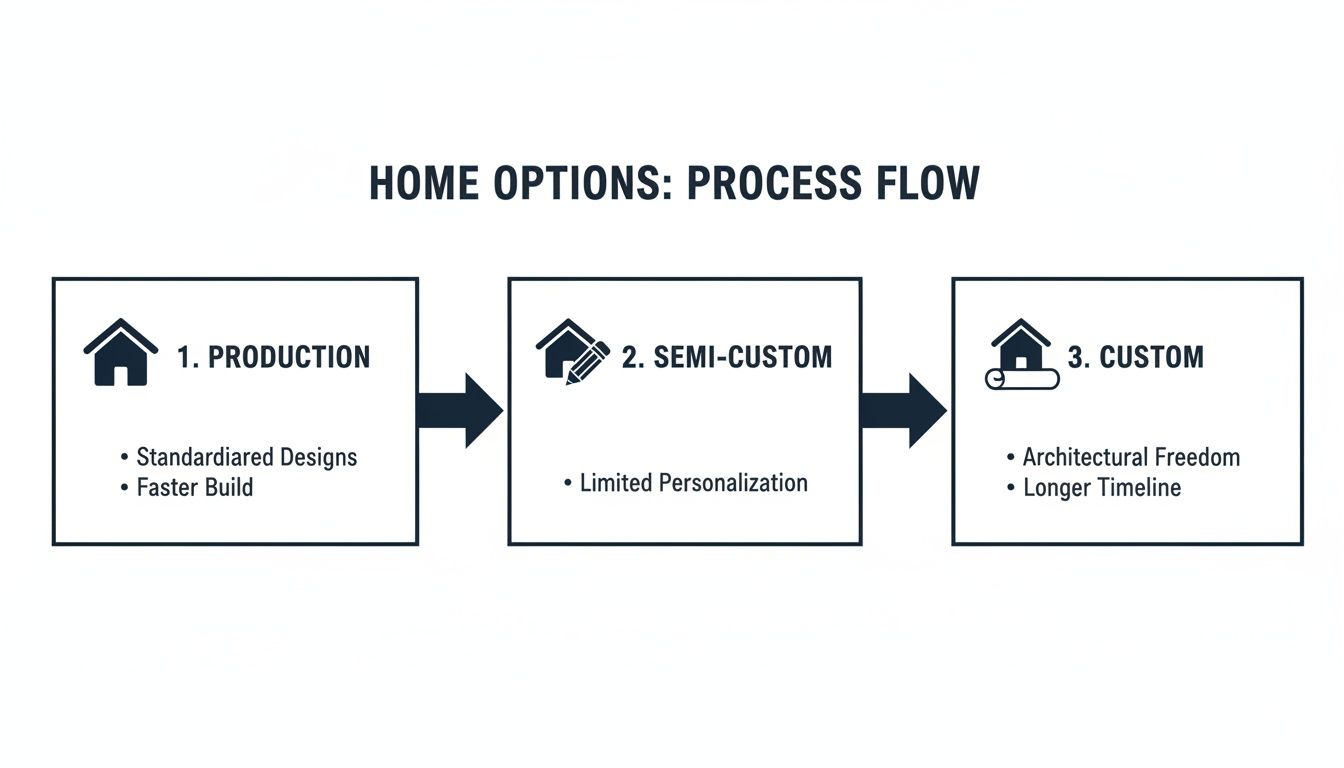
Deciding to build a new home in North Texas is an exciting first step, but it immediately opens up a big question: what’s the best way to do it? “New construction” isn’t a one-size-fits-all term. It covers everything from production neighborhood homes to one-of-a-kind architectural marvels, each with its own trade-offs in terms of cost, time, and personalization.
Understanding these differences is key to making a choice you’ll be happy with for years to come. Let's walk through the main ways people build homes around here, from Granbury to Weatherford, so you can get the full picture.
Production Homes (Spec Homes)
Think of a production home—often called a spec home—like buying a car off the lot. A developer buys a large piece of land, divides it into a neighborhood, and builds houses based on a handful of pre-approved floor plans. You pick the model you like, and that’s pretty much what you get.
The biggest draws here are speed and affordability. Because the builder is putting up dozens of similar homes and buying materials in bulk, they can keep costs down and get you moved in quickly. The trade-off is choice. You’ll likely have a few pre-set packages for cabinets, flooring, and paint, but that’s about it.
Production homes are a great fit for first-time buyers or anyone on a strict timeline who wants the predictability of a new build without the complexities of a custom project.
Semi-Custom Homes
A semi-custom home is a happy medium. It’s like buying that same car but being able to pick the engine, the interior color, and add the premium sound system. The builder starts with a portfolio of proven floor plans, but you get much more say in the final product.
For instance, you might be able to bump out the back patio for a larger covered porch, add a third bay to the garage for a workshop, or combine two small bedrooms into a larger guest suite. You’re still working within the builder's general blueprint, but you have the freedom to make significant structural tweaks and select from a much wider range of finishes. This is a fantastic option for families who like an existing layout but want to personalize it to fit their lifestyle.
Barndominiums
The barndominium is a uniquely Texas phenomenon that has taken off across North Texas. At its core, it’s a durable, efficient metal building shell with a completely finished home inside. What started as a practical housing solution for rural and agricultural properties has become a style statement.
"Barndos" are perfect for rural lots in places like Glen Rose or on acreage outside of Stephenville. They are loved for their wide-open living spaces, incredible durability, and often lower cost per square foot for the exterior shell. The interior can be finished just like any traditional home. Keep in mind that building one can come with unique considerations, like finding lenders familiar with steel-frame construction. The end result is a tough, low-maintenance home with a ton of character.
The True Custom Home
This brings us back to the true custom home. If a production home is buying off the lot, a custom home is sitting down with a team of designers to create your dream home from a completely blank slate.
This is where you get total control. Every detail is up to you, from how the house is angled on the lot to catch the morning sun to the exact height of the kitchen island. It’s a deeply collaborative journey with your architect and builder to bring a vision to life. A custom home is for the family that needs a dedicated workshop, the retiree designing their forever home with specific accessibility needs, or anyone whose dream simply doesn't fit into a pre-drawn box.
Home Building Options Compared
This quick breakdown can help you compare the different paths at a glance.
Feature | Custom Home | Semi-Custom Home | Production/Spec Home | Barndominium |
|---|---|---|---|---|
Design Freedom | Unlimited | Moderate | Very Limited | High (within shell) |
Land | You own the lot | Builder owns the lot | Builder owns the lot | You own the lot |
Cost Per Sq. Ft. | Highest | Moderate | Lowest | Low to Moderate |
Timeline | Longest (12-18+ months) | Medium (6-12 months) | Shortest (4-6 months) | Varies |
Best For | Total personalization | Balanced choice | Speed & budget | Unique style & value |
Ultimately, there’s no single "best" option—only the one that’s best for you, your budget, and your timeline. Understanding what each path involves is the first step toward building with confidence.
If you’re leaning toward a more personalized approach, our team is happy to schedule a free consultation to explore the possibilities for your property.
Your Custom Home Journey: From Dream to Doorstep
Building a custom home is a significant project, but the process is a clear, step-by-step journey rather than a chaotic free-for-all. Think of it as a roadmap where each stage logically builds on the one before it, taking your initial idea from a napkin sketch to a finished home.
It’s a true partnership between you and your builder, with your vision leading the way. Let's walk through the typical path for building a custom home here in North Texas so you know what to expect.
Phase 1: Laying the Groundwork
Long before any dirt is moved, the most critical work begins. This is the planning phase, where we define the "what" and "why" behind your home.
This stage boils down to two key things:
Defining Your Vision and Budget: This is where you gather inspiration, make wish lists, and decide what you truly need your home to do. Do you need a huge kitchen for holiday gatherings in Granbury? A dedicated home office with great natural light? An accessible, single-story layout for aging in place? This is also the time to establish a realistic budget, which will serve as a guidepost for all future decisions.
Building Your Team and Finding Land: You can't build a dream home without a dream team. This means choosing a builder, an architect or designer, and a lender who understands construction loans. If you don’t have land yet, your builder can be your best ally, helping you evaluate properties in areas like Weatherford or Glen Rose to understand site prep costs and identify potential issues before you buy.
Phase 2: From Blueprints to Building Permits
Once your vision is clear and your team is assembled, we move from ideas to actual plans. This is where your home takes shape on paper, with every detail mapped out before construction begins.
Here's what happens in this second phase:
Designing the House: You'll work hand-in-hand with your designer to turn that wish list into a complete set of architectural plans. It’s a collaborative process of refining the floor plan, figuring out where every outlet and light switch will go, and finalizing the home's exterior look.
Getting the Green Light: With the blueprints finalized, your builder submits them to the local authorities—whether that’s in Hood or Parker County—for permits. While waiting on approval, we can often get a head start on clearing the land, grading the property, and staking out the foundation.
Phase 3: The House Takes Shape
Now for the exciting part. This is when you see tangible progress every day as your home literally rises from the ground.
For most homeowners, the framing stage is a highlight. In just a few days, the floor plan you’ve been studying on paper becomes a 3D structure you can walk through. It's the first time you get a true feel for the size, flow, and spirit of your new home.
The major construction milestones include:
Foundation: We pour the slab or build the pier and beam foundation, which is the base for everything to come.
Framing: The skeleton of the house goes up—walls, floors, and the roof structure—defining all the rooms.
Mechanicals (MEP): This is when we install the "guts" of the home: HVAC ductwork, electrical wiring, and plumbing.
Insulation and Drywall: We insulate the walls for energy efficiency, then hang drywall, which officially turns the open framing into actual rooms.
To see these stages broken down even further, take a look at our complete guide on how to build a custom home in North Texas.
Phase 4: Finishes, Final Touches, and Keys in Hand
With the heavy lifting done, the focus shifts to the details that make a house your home. This is where your personal style shines through in the fixtures, colors, and finishes you've selected.
The final stretch involves:
Exterior and Interior Finishes: Outside, we finish the siding, brick, or stone and install the roof. Inside is a flurry of activity: flooring goes down, cabinets and countertops are installed, and the walls get their final coats of paint.
Final Walk-Through and Move-In Day: Your builder will walk you through the finished home to inspect every last detail and create a "punch list" of any small items that need tweaking. Once you’re completely happy, you get the keys. It’s time to move in.
Understanding this roadmap from the start helps you feel confident and in control every step of the way, making the experience just as rewarding as the final result.
What Does It Really Cost to Build a Custom Home?
When people start dreaming about a custom home, the first question is always the same: "So, what's it going to cost me?" While it would be nice to have a simple price-per-square-foot number, the truth is that it's nearly always misleading for a custom project.
Building a custom home in North Texas isn't about buying a product with a fixed price tag. The final cost is shaped by the hundreds of individual choices you make. Think of it like commissioning a custom-built truck: the final price depends on whether you choose the standard engine or the high-output diesel, a basic interior or hand-stitched leather. Your home is the same, just on a much bigger scale.
Breaking Down the Major Cost Drivers
To understand where the money goes, it helps to look at the main components of the budget.
Land and Site Prep: Before construction begins, we have to get your land ready. For a rural lot near Glen Rose, that could mean clearing dense cedar, grading for proper drainage, or drilling a well and installing a septic system. These steps alone can range from $15,000 to over $40,000, depending on the property's needs.
Architectural and Engineering Fees: The blueprint for your home is a critical investment. These fees cover the architect or designer who creates your plans and the structural engineer who ensures the home is safe and sound. You can typically expect these professional services to be about 5% to 15% of your total construction cost.
Foundation and Structure: These are the "bones" of your house. This includes the concrete foundation, all the lumber for framing, roofing materials, and exterior sheathing. Building on the expansive clay soils we often see around Weatherford, for example, might require a more robust, engineered foundation that costs more than a simple slab on stable ground.
Finishes and Fixtures: Where Your Style Drives the Budget
Once the home’s structure is up, the finishes and fixtures you choose become the main driver of the cost. This is where you have the most control, and it's where the budget can swing dramatically.
A common mistake is underestimating how quickly "small" upgrades add up. That one beautiful faucet doesn't seem like much, but when you multiply that by hundreds of similar choices in lighting, hardware, and tile, you can easily add tens of thousands of dollars to the final cost.
Let’s look at a few practical examples:
Windows and Doors: A standard package of vinyl windows for a 2,500-square-foot home might cost around $15,000. Upgrading to premium, energy-efficient wood or aluminum-clad windows could easily jump to $40,000 or more.
Cabinetry and Countertops: In the kitchen, quality stock or semi-custom cabinets might cost $10,000, but fully custom, handcrafted cabinetry from a local Hood County woodworker could be $30,000+. It’s the same with countertops—laminate is worlds away in price from a high-grade slab of quartzite.
Flooring: The cost difference here can be huge. Installing luxury vinyl plank might run $5-7 per square foot, while opting for wide-plank, nail-down hardwoods could be $15-20 per square foot. Across an entire house, that difference is substantial.
The custom home market is a good indicator of economic confidence, currently making up about 18-19% of all new single-family houses being built. You can read more about the current state of the US custom building market.
A transparent builder will walk you through these costs line by line, helping you make informed decisions that honor both your vision and your budget.
If you’re ready to talk through your ideas and get a real sense of what your dream home might cost, we'd be happy to sit down for a no-obligation consultation.
Key Considerations for Building in North Texas
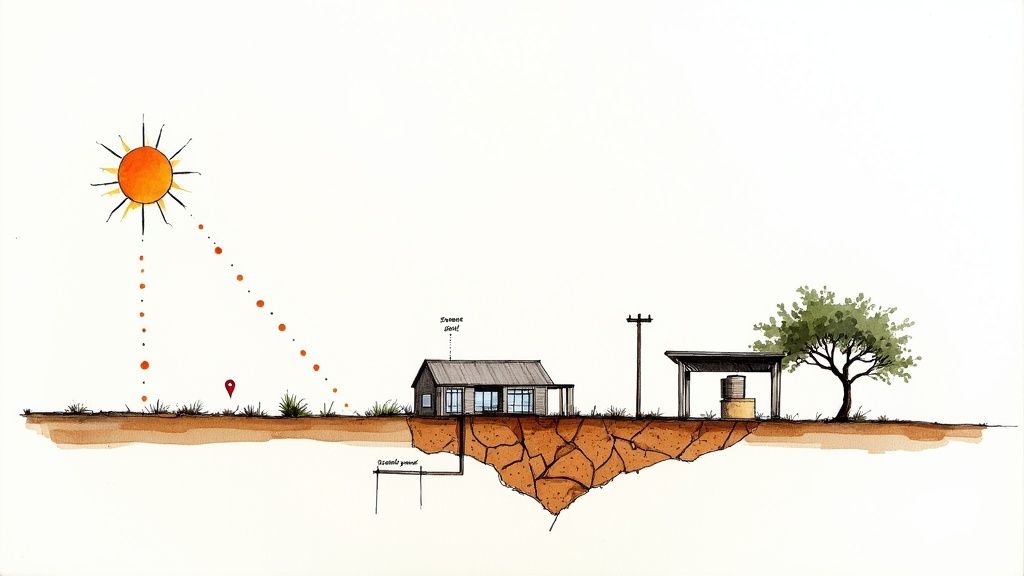
Building a custom home in North Texas is more than just picking a floor plan; it’s about creating a home that can handle our unique environment. From our tricky soil to the relentless summer sun, our region has a personality all its own, and your home’s design needs to respect that from day one.
Taming Our Infamous Clay Soil
The foundation is everything, and in North Texas, that means confronting our expansive clay soil. This soil swells dramatically when wet and shrinks when dry. That constant movement can wreck a foundation that isn't built for it, causing cracks and structural issues.
A builder who knows the soils in Hood and Parker counties will engineer the right foundation for your specific lot, which might mean:
Post-tensioned slabs reinforced with high-strength steel cables.
Pier and beam foundations that lift the home off the ground, allowing the soil to move without taking your house with it.
Cutting corners on the foundation is a surefire way to invite expensive problems down the road.
Designing for the Texas Heat
Our summer heat is no joke. A thoughtfully designed custom home should work with our climate, not against it.
Smart design means thinking about the sun before a single wall goes up. For example, we might suggest placing fewer windows on the west-facing side of your home—where the afternoon sun is most intense—and incorporating deep porch overhangs to provide natural shade.
Here are a few other strategies that create a cool, energy-efficient Texas home:
High-performance windows with low-E coatings to reflect heat.
Spray foam insulation to seal the home's "envelope" and prevent cool air from leaking out.
Radiant barrier roof decking to block solar heat from entering the attic.
Proper attic ventilation to let hot air escape.
Rural Property Essentials
Building on acreage in a place like Glen Rose or Stephenville brings another set of considerations. When you're not in a subdivision, you are responsible for your own utilities.
You and your builder need a solid plan for:
Water Wells: Finding the best spot to drill for a reliable water source.
Septic Systems: Your land will need a soil evaluation (a "perc test") to determine the right type of septic system.
Zoning and Deed Restrictions: Every county has different rules. Understanding local regulations ahead of time ensures your plans for a workshop or guest house don't get shut down by red tape.
Partnering with a builder who has deep roots in North Texas means you’re gaining an ally who knows how to turn these regional challenges into strengths, ensuring your home is a perfect fit for the land you love.
If you have questions about a piece of land you own or are considering, Let's schedule a time to talk.
Your Custom Home Questions, Answered
Starting the custom home process naturally brings up a lot of questions. That’s a good thing. Below, we’ve tackled some of the most common questions we get from families right here in North Texas.
How Long Does It Typically Take to Build a Custom Home?
While every project is unique, a good ballpark for a custom build in our area is 12 to 18 months from the initial design to move-in day.
What causes that range? A complex architectural design will take longer than a simpler one. The permitting process can vary between counties like Hood and Parker. And, of course, North Texas weather can cause delays during outdoor phases like pouring the foundation.
Here’s a general breakdown of the timeline:
3-6 months for upfront work: design, selections, engineering, and permitting.
9-12 months for the actual construction of your home.
A trustworthy builder will provide a detailed schedule and keep you updated throughout the process.
What Kind of Financing Do I Need for a Custom Build?
Financing a home you’re building from scratch requires a construction-to-permanent loan. This is a two-in-one loan: it starts by paying for the construction costs in stages (or "draws") as milestones are met, and once the house is finished, it converts into a regular mortgage.
It’s important to work with a lender experienced in these loans. We advise clients to get pre-qualified for their construction loan early in the process. This helps establish a clear, comfortable budget before you fall in love with a design.
How Involved Can I Be in the Building Process?
You can be as involved as you want to be! This is your home, and being part of its creation is one of the most rewarding aspects of building custom. We view it as a true partnership.
You’ll make all the key design decisions, from the layout down to the doorknobs. Once we break ground, we’ll schedule regular site meetings and walk-throughs to show you the progress, answer your questions, and ensure everything is aligning with your vision. Our job is to manage the day-to-day complexities of the build; your job is to provide the feedback we need to get it perfect.
Your voice is the most important one in the room. A great builder listens first, guiding your vision with practical expertise to create a home that is both beautiful and functional for your specific lifestyle.
How Do I Choose the Right Builder for My Project?
This is the most important decision you'll make. You're not just hiring a contractor; you're choosing a partner for a major life event. Start by looking for builders whose portfolios match the style and quality you envision.
Ask to speak directly with past clients about their experience with communication, budgets, and deadlines. Verify that they are fully licensed and insured in Texas. Above all, choose a team you trust and can have an open, honest conversation with. That relationship is the foundation of a successful build.
For more helpful advice, take a look at our guide on the top 10 questions to ask custom home builders.
Ready to Start Your Custom Home Conversation?
Choosing to build a custom home is a huge step, and the right building partner makes all the difference in turning that decision into a great experience. We hope this guide has given you a clearer picture of what the journey looks like.
When you're ready to explore what’s possible for your family here in Granbury, Weatherford, or anywhere in North Texas, our team at Gemini Homes is here to listen. The process of finding custom home builders near you should feel supportive and transparent right from the start.
Let's talk about your vision. No pressure, no strings attached—just a straightforward conversation with practical advice to help you figure out your next steps.
Let's build your vision together. Schedule a free, no-obligation consultation with Gemini Homes by visiting geminihomesgranbury.com.
Comments