
How to Estimate House Building Cost in North Texas
When you first start thinking about building a custom home, the big question is always, "What's this going to cost?" The simplest and most common place to start is with a price per square foot.
Here in North Texas, you'll hear numbers anywhere from $180 to over $250 per square foot for the house itself. But it's critical to understand that this figure is just a starting point—a useful baseline, but definitely not the final number you'll write on the check.
Your Starting Point: Understanding Per-Square-Foot Costs
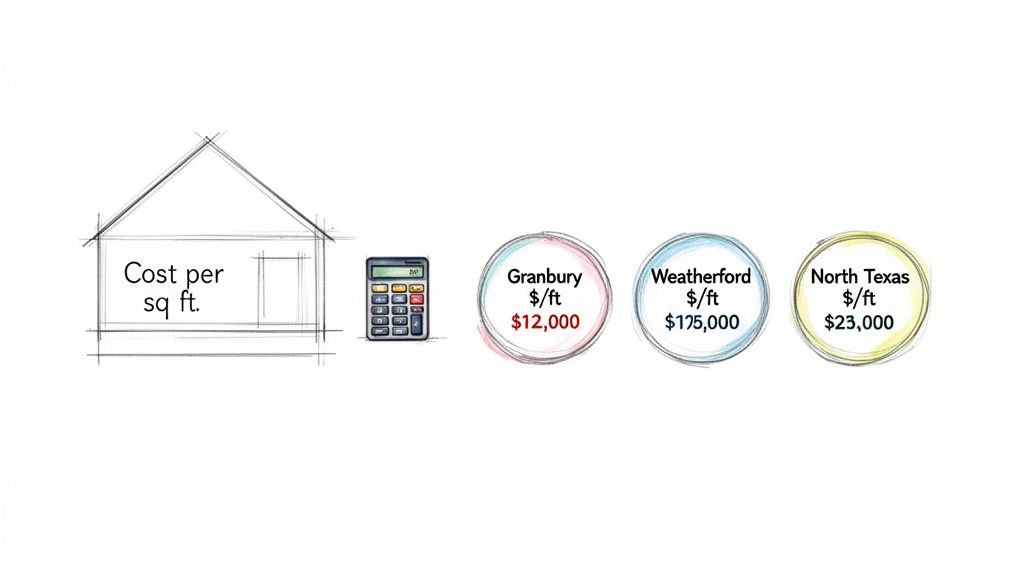
When a builder gives you a per-square-foot price, they're providing a high-level estimate for the heated and cooled living space. It’s a quick way to see if your vision and your budget are in the same ballpark before you spend time and money on detailed plans.
Think of it as the cost for the "box"—the foundation, framing, roofing, basic electrical and plumbing, and a standard level of finishes. It's an incredibly useful tool for initial planning, but it rarely reflects the final, all-in cost of building your dream home in Granbury or Weatherford.
What's Really Behind the Per-Square-Foot Number?
That per-square-foot figure is an average. It blends the high-cost areas of a home (think kitchens and bathrooms packed with expensive fixtures, appliances, and cabinetry) with the lower-cost areas like hallways and bedrooms. This is why a complex 2,000-square-foot home with custom everything can easily cost more per square foot than a straightforward 3,500-square-foot home with more standard materials.
Several key factors will push this initial number up or down:
Design Complexity: A simple rectangular footprint is always more cost-effective. The more corners, gables, and complex rooflines you add, the higher the cost climbs.
Level of Finishes: This is a huge factor. There's a world of difference between standard laminate countertops and imported quartzite, or between basic vinyl flooring and hand-scraped hardwoods. For families with kids and pets, a durable luxury vinyl plank (LVP) can be a smart, budget-friendly choice, while retirees might opt for the timeless look of hardwoods.
Home Size: Interestingly, smaller homes often have a higher cost per square foot. That's because the big-ticket items—kitchens, bathrooms, utility hookups—are spread across fewer square feet, concentrating the cost.
To help you understand what's usually baked into that initial number, here’s a quick breakdown.
What's Included in a Base Per-Square-Foot Estimate
Typically Included | Often Excluded (Addressed Later) |
|---|---|
Foundation (standard slab) | Land purchase cost |
Framing and structural components | Site work (grading, clearing, excavation) |
Basic roofing and siding | Utility connections (water well, septic, electric) |
Standard windows and doors | Landscaping, driveways, and sidewalks |
Insulation and drywall | Fencing and exterior structures |
Basic plumbing and electrical | Swimming pools or outdoor kitchens |
HVAC system | High-end appliances and fixtures |
Builder-grade finishes (flooring, paint, cabinets) | Architectural and engineering fees |
Basic light fixtures | Permits and impact fees |
This table shows why the per-square-foot cost is truly just for the structure. All the other critical elements of your project need to be accounted for separately.
National Trends vs. Local North Texas Reality
Nationally, building a new home averaged around $180 to $220 per square foot in the mid-2020s. According to the NAHB's 2024 survey, construction costs rose to a record 64.4% of a home's total sales price.
For us here in North Texas, this gives us context. If you're building on rural acreage near Glen Rose or Tolar, your base bids might start at the lower end of that range. But start adding the features that make a house a home—a gunite pool, a big outdoor living space, or a barndominium-style workshop—and you can expect to add a 5-20% premium to that base cost.
Key Takeaway: The per-square-foot estimate is your entry point. It’s for the structure itself. It almost never includes the land, site preparation, landscaping, pools, or bringing utilities to the property.
Why This Number is Never the Final Price
Simply multiplying your desired square footage by a builder's average rate gives you a ballpark figure, not a real-world budget. That calculation doesn't factor in the cost of drilling a water well on your Stephenville property or installing a septic system—both are essential but completely separate line items.
A professional builder uses the per-square-foot number as a preliminary tool. From there, we work with you to create a detailed, itemized budget that reflects your specific plans, your unique property, and your personal tastes.
Breaking Down Your Hard Costs From Foundation to Finishes
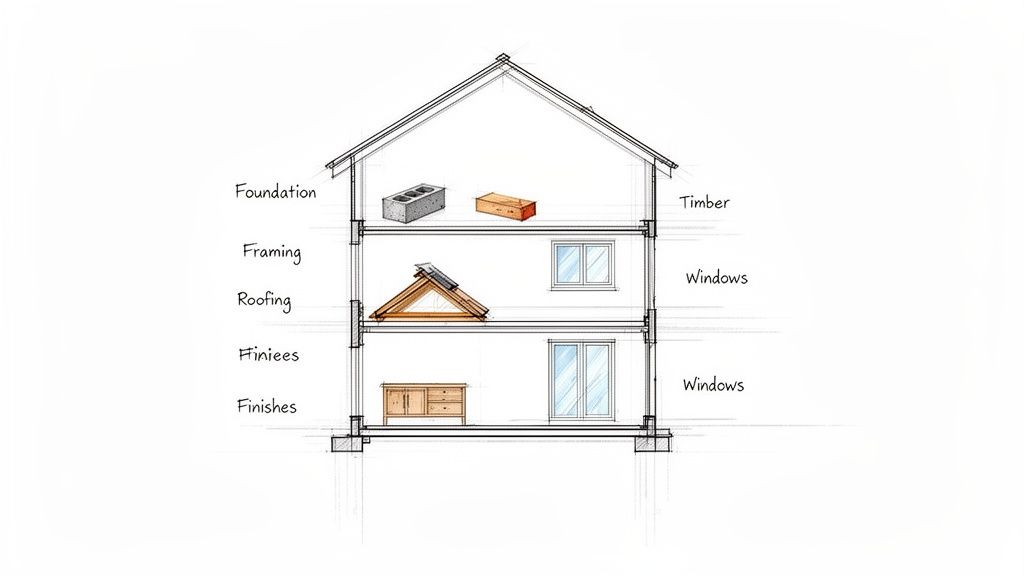
While a per-square-foot average is a great starting point, the real budgeting begins when we get into the details of your hard costs. These are the tangible, physical expenses of building your home—every 2x4, every shingle, and every doorknob. Breaking these down is the only way to build an accurate budget and see exactly where your money is going.
Hard costs typically eat up over 60% of a new home's total price tag. We organize it into two main buckets: the structural build and the finishes. Both have countless spots where you can save a little or decide to splurge.
The Structural Core: Your Home's Skeleton
This first phase covers everything needed to get your home "dried in," which is builder-speak for getting it framed, wrapped, and sealed against the elements. These are the non-negotiable expenses that dictate the strength and longevity of your house.
Foundation: Here in North Texas, a standard slab-on-grade foundation is the go-to for stable soil. But if you're building on the expansive clay common around Weatherford, or in an area that needs a pier and beam foundation, your costs can jump significantly right from the start.
Framing: This is the lumber package that gives your home its shape. A clean, rectangular floor plan uses far less lumber and labor than a sprawling home with multiple wings, intricate rooflines, and dramatic, high ceilings.
Exterior Walls and Roofing: This includes siding and roofing materials. Deciding between durable fiber cement siding and timeless Texas brick, or between standard architectural shingles and a sleek standing-seam metal roof, will make a real difference in your budget. For a modern farmhouse near Stephenville, a metal roof is a fantastic look, but it comes with a higher upfront cost than shingles.
Windows and Exterior Doors: In the Texas heat, energy-efficient windows are one of the smartest investments you can make. The total cost depends entirely on the number, size, and style you choose. A wall of glass to capture that perfect view of Lake Granbury is going to be a much bigger ticket item than standard windows in a more traditional layout.
MEP Systems: The Nerves and Arteries
Tucked away behind the drywall are the workhorses of your home: the Mechanical, Electrical, and Plumbing (MEP) systems. These aren't the places to cut corners. A problem down the road is a massive headache you want to avoid.
The cost here is mostly driven by the size of your home and the complexity you want. A high-efficiency HVAC with multiple zones for a large home in Godley will naturally cost more than a single-unit system for a smaller footprint. Likewise, a gourmet kitchen with two sinks and a pot filler will have a bigger MEP budget than a standard setup.
Expert Insight: When planning your MEP, think five or ten years ahead. Will you eventually want an EV charger in the garage? Thinking about retiring here and might need wider doorways or an accessible shower later on? It’s always cheaper to plan for these things now than to retrofit them later.
Finishes: Where Your Personal Style Shines
This is the fun part for most people, but it’s also where budgets can go off the rails. Your choices in finishes define the character of your home and have the biggest impact on how it feels to live there.
Think about these key areas:
Drywall, Trim, and Paint: The quality of the drywall finish (from a basic texture to a perfectly smooth Level 5) and the complexity of your trim work, like crown molding or custom built-ins, directly affect labor costs.
Flooring: The price gap between flooring materials is huge. Luxury vinyl plank (LVP) is a popular, tough, and budget-friendly choice for families, while engineered hardwoods or natural stone tile are a higher-end investment.
Cabinetry and Countertops: Fully custom cabinets give you endless options but at a premium price compared to semi-custom choices. For countertops, laminate is the most affordable, while granite, quartz, and quartzite can range from reasonable to very expensive. On a recent project in Glen Rose, we used locally sourced pecan for custom built-ins, a unique touch that was planned for in the budget from day one.
Fixtures and Appliances: This covers everything from faucets and light fixtures to your entire kitchen suite. It’s incredibly easy to add $10,000 to $30,000+ to your budget with high-end selections in this category alone.
By carefully walking through each of these hard cost categories, you can work with your builder to make smart decisions that bring your vision to life without breaking the bank.
Uncovering Soft Costs: The Hidden Expenses of Building
If hard costs are the bricks and mortar of your home, soft costs are all the essential services and fees that make the project happen. For many first-time builders in North Texas, overlooking these items is one of the easiest ways to blow a budget. These costs cover everything from the initial designs to the final inspections.
From Blueprints to Building Permits
Before you can break ground, you need a solid plan and the official green light. This is where your first major soft costs pop up, and they can vary depending on project complexity and location, whether it's in Hood County or over in Parker County.
Architectural and Design Fees: This is the cost to turn your vision into buildable blueprints. You might spend a few thousand for modified stock plans, but a fully custom design from an architect can easily run 5-15% of the total construction cost.
Engineering Fees: A structural engineer must sign off on your foundation and framing plans, which is especially important with the tricky soils we have around Weatherford and Granbury. You might also need a civil engineer to map out site drainage.
Permits and Impact Fees: Every city and county has its own fee schedule. You’ll have the main building permit, but also separate permits for electrical, plumbing, and septic systems. Faster-growing communities also tack on impact fees to help pay for new roads and schools.
A perfect example we see on rural properties near Glen Rose is the need for a detailed land survey and a soil test before a permit can be pulled. These are crucial preliminary soft costs that dictate the engineering and foundation design, saving you from expensive surprises down the road.
Site Evaluation and Preparation Costs
Long before the concrete truck shows up, you have to know what you're building on. This is especially true if you’re planning a home on a large, undeveloped piece of land in North Texas.
Land Survey: You'll need a surveyor to officially mark your property lines, identify easements, and create a topographic map. This is non-negotiable if you want to place the home correctly.
Soil Testing: A geotechnical engineer will take soil samples to determine stability. The results dictate what kind of foundation your home needs—it could be a standard slab or a much more complex and expensive engineered foundation.
Utility Connection Fees: This is a big one that catches people by surprise. In a city like Cleburne, you'll pay tap fees to connect to the city's water and sewer. On a rural lot, you could be looking at thousands to get a co-op to run a water line to your property, or you'll need to budget for drilling a well. The same goes for electricity; the cost depends on how far the utility provider has to run new lines.
Financing and Insurance During Construction
Getting the money and protecting your investment while the house is being built also comes with its own price tags.
A construction loan isn't like a regular mortgage; it involves fees for appraisals, progress inspections, and loan origination. The interest paid during construction is another soft cost you must factor into your budget. You'll also need a Builder's Risk Insurance policy, which protects your growing investment from theft, vandalism, or a classic Texas thunderstorm. By getting a handle on these soft costs, you move from a rough guess to a much more accurate financial plan.
How Your Property Shapes the Final Price Tag
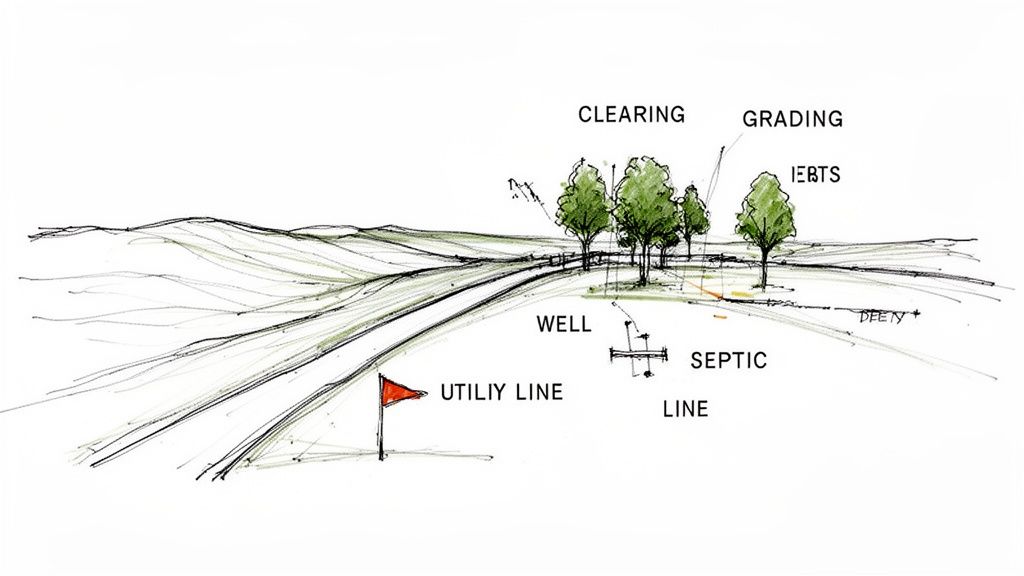
Your house plans tell one part of the story, but the land itself tells the rest. No two pieces of property are the same, and these site-specific variables can have a massive impact on your budget.
Here in North Texas, we see everything from flat pastureland to lots with rolling hills and dense oak groves. The costs to turn that raw land into a build-ready homesite are real, and they have to be part of your estimate from day one.
Getting the Land Ready: From Raw to Homesite
Preparing your land is the true first phase of any custom build. For homeowners building on acreage, especially those who bought a few raw acres outside Granbury or Weatherford, this can be an eye-opener.
Each step comes with its own price tag:
Land Clearing: Removing trees, brush, and rocks from the building envelope. A lightly wooded lot might only run a few thousand dollars to clear, but a densely forested property could easily push past $10,000.
Grading and Excavation: We reshape the land to create a stable, level pad for your foundation and to ensure water drains away from the house. A sloped lot will always require more extensive grading than a flat one.
Drainage Solutions: Around here, managing water is non-negotiable. This might mean installing culverts under the driveway or digging swales to direct runoff, which must be factored into the site prep budget.
A Real-World Scenario: We worked with a family building on a gorgeous, sloped lot overlooking the Paluxy River near Glen Rose. The steep grade required extensive excavation and a hefty retaining wall just to create a stable building pad. That necessary site work added nearly $30,000 to the project cost before any concrete was poured. It's a perfect example of why evaluating the site is so critical.
The Challenge of Bringing Utilities to Your Lot
If you're in a planned subdivision, utilities are usually at the edge of your property. But when building on your own land out in the country, you're responsible for getting power, water, and septic services to your homesite.
Water Source: If you're close enough to a co-op or city line, you can pay a fee to tap in. If not, you’re looking at drilling a well. In North Texas, a water well can run anywhere from $8,000 to $15,000+, depending on the required depth.
Wastewater Management: No city sewer? You'll need a septic system. A conventional system might be in the $7,000 to $12,000 range, but if you have poor soil, you might need an aerobic system, which can jump to $15,000 to $25,000.
Electricity: The cost depends on the distance from your house to the nearest utility pole. If power is already at your property line, the cost is minimal. But if the electric company has to run new lines and set several poles, that bill can easily climb into the thousands.
We cover this process in more detail in our guide on how home builders build on your lot in North Texas.
Access, Soil, and Those Hidden Surprises
Beyond clearing and utilities, the soil itself is a huge factor. Much of North Texas is notorious for its expansive clay soil, which swells and shrinks with moisture.
Building on that kind of soil often requires a more robust—and more expensive—engineered foundation with piers drilled deep for stability. A professional soil test is the only way to know what you're dealing with. The results could easily add $10,000 to $30,000 or more to your foundation cost compared to a standard slab.
Finally, don't forget about actually getting to your house. If your homesite is set back from the main road, you'll need a long driveway. The cost difference between a simple gravel drive and a paved concrete one is substantial.
Planning for Your Builder’s Fee and a Solid Contingency Fund
Once you’ve tallied up the hard costs, soft costs, and site work, two crucial pieces remain: the builder’s fee and your contingency fund. A transparent budget doesn't just list materials and labor; it accounts for expert management and a financial safety net.
What You're Really Paying for with a Builder's Fee
A builder's fee is the cost of having a professional manage every detail of your build. It pays for the expertise, relationships, and daily problem-solving required to turn plans into a high-quality home.
This hands-on management includes:
Expert Project Management: Juggling schedules to prevent costly delays.
Vetting Subcontractors: Tapping into a proven network of insured, reliable local tradespeople in the Granbury and Weatherford areas.
Constant Quality Control: Being on-site daily to inspect workmanship and catch small issues before they become big problems.
Financial Oversight: Managing invoices, payments, and lien waivers to keep the project on track and protect you financially.
Choosing the right person for this role is arguably the biggest decision you'll make. For a deeper dive, check out our guide on how to choose a home builder in North Texas.
Why a Contingency Fund Isn’t Optional
If the builder’s fee covers the knowns, your contingency fund covers the unknowns. This is a critical part of your budget—we recommend setting aside 5-10% of your total construction cost—specifically for surprises. It’s a strategic tool that protects your budget, timeline, and sanity.
We are firm with every client on this point: a contingency fund is non-negotiable. It’s what turns a potential crisis into a manageable bump in the road.
For instance, on a recent project on a rural lot near Tolar, our excavation crew hit a massive shelf of solid rock the initial soil report didn't catch. The contingency fund covered the heavy equipment needed, preventing a budget panic and keeping the project moving.
Another family building in Stephenville got caught by a sudden spike in lumber prices mid-build. Their contingency fund absorbed that increase, so construction never missed a beat. This fund also gives you flexibility for homeowner-driven changes, like upgrading countertops or adding a window.
Bringing It All Together for an Accurate Estimate
Now it's time to put all the puzzle pieces together into a budget that actually works. This isn't just totaling up numbers; it's creating a clear financial roadmap for your custom home in North Texas.
Think of this final budget as your project's command center. It organizes every expense, making it a powerful tool for decision-making and for comparing bids from different builders. A professional estimate will always break down the core components: the total project cost, the builder's management fee, and a dedicated contingency fund.
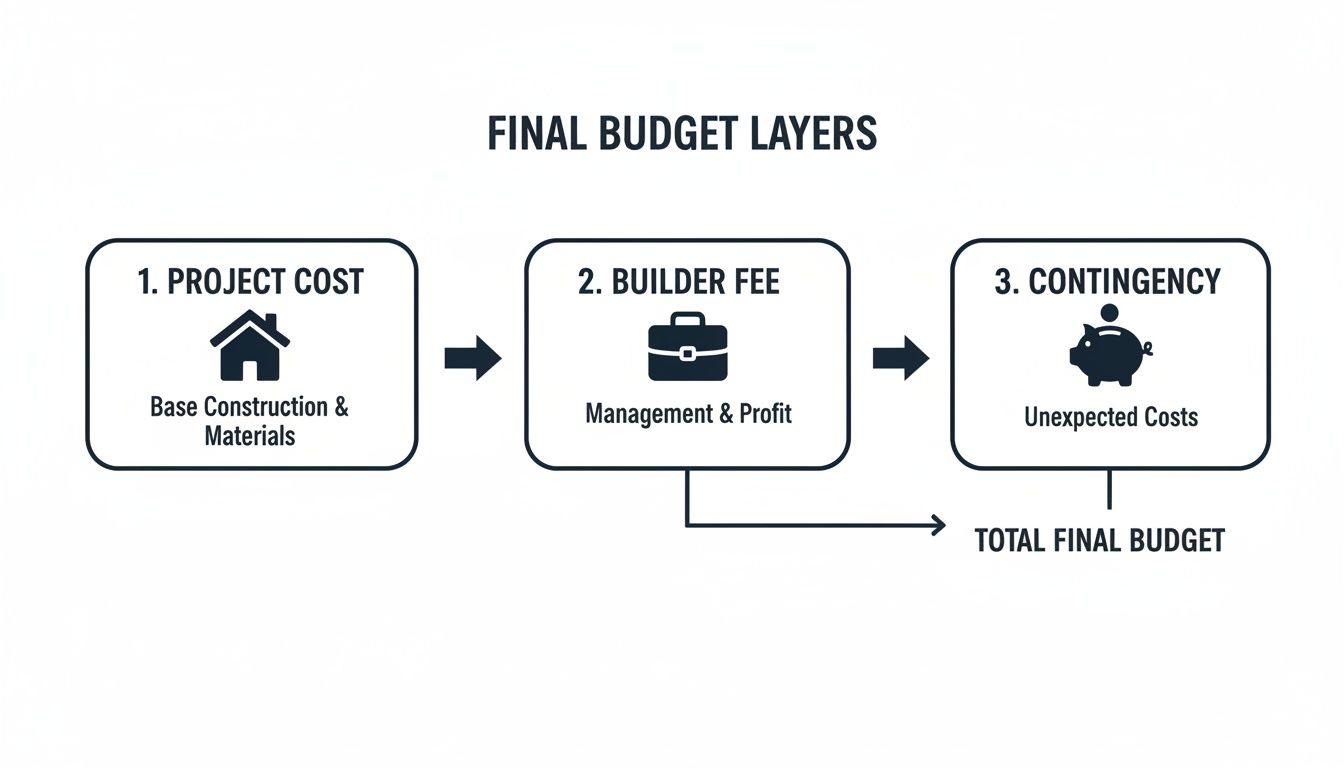
This visual clarifies how the builder’s fee and contingency are added on top of all other project costs. It's a transparent structure that gives you a complete financial picture.
Comparing Builder Bids Intelligently
When you start getting proposals, you'll see they aren't all created equal. Your job is to dig deeper than just the bottom-line number.
Here's what to look for in an honest, transparent bid:
Detailed Line Items: A trustworthy bid breaks costs down by category—foundation, framing, plumbing, etc. A vague, one-page estimate is a huge red flag.
Clear Allowances: For finishes like flooring and countertops, the bid should specify a dollar amount called an "allowance." Ask how they came up with that number to ensure it's realistic for the quality you're envisioning.
Exclusions Spelled Out: The proposal must clearly state what is not included. Landscaping, pools, septic systems, and long driveways are common exclusions.
Key Takeaway: A detailed, transparent bid is the hallmark of a professional builder. If a builder hesitates to provide a full breakdown, you might be in for hidden costs and markups later.
A Final Checklist for Your Budget
Before you sign on the dotted line, run through one last mental checklist. Did you account for the cost of bringing electricity from the main road to your homesite in Aledo? Have you budgeted for the specific type of septic system your soil requires out near Godley? Is your contingency fund healthy enough to absorb an unexpected jump in lumber prices?
Having a detailed budget does more than just prepare you financially—it gives you a working roadmap for the entire build. Understanding this process also helps you better appreciate your North Texas house construction timeline and how each step connects. That knowledge lets you ask the right questions and move forward with confidence.
Common Questions We Hear About Building Costs
As folks around Granbury and Weatherford start dreaming up their new homes, a lot of the same questions pop up. Here are a few of the most common things we get asked, along with some straight-ahead answers.
Can I Save Money by Being My Own General Contractor?
This is probably the number one question we hear. On the surface, cutting out the builder's fee sounds like a guaranteed win. The reality? It can often end up costing you more in both dollars and sanity.
A professional builder brings a network of vetted, reliable subcontractors they've worked with for years. We know who does quality work and who shows up on time. We also get access to trade pricing on materials that isn't available to the public. Without that network and experience, you risk major delays, shoddy work that needs to be redone, and failed inspections—all of which can blow your budget.
How Much Should We Really Budget for Finishes?
This is where the house truly becomes your home—the flooring, cabinets, and light fixtures. This category can eat up anywhere from 15% to 35% of your total hard costs.
For a quality build with nice, but not extravagant, selections, setting aside 20-25% is a good, safe number.
If your vision includes custom cabinetry and professional-grade appliances, you should be thinking more in the 30-35% range.
The best approach is to have an honest conversation with your builder about what's most important. If a chef's kitchen is your must-have, we can help you shift allowance dollars to where they matter most.
Our Advice: Figure out your "splurges" early. Whether it's a massive stone fireplace for the family room or a dream master bathroom for retirement, identifying where you want to invest lets you be more strategic in other areas.
Is My Per-Square-Foot Estimate Realistic?
A price-per-square-foot number is just a starting point. It needs to be rooted in the realities of our North Texas market. If a builder throws out a number that seems too good to be true (like under $170/sq ft), it almost certainly is.
For a quality custom home around here, a realistic estimate will generally land in the $180 to $250+ per square foot range. Be cautious of suspiciously low numbers. They often leave out crucial costs or assume builder-grade-everything, leading to expensive change orders down the road. Always ask what their price includes and, more importantly, what it doesn't.
What’s the Biggest Unexpected Cost People Face in North Texas?
Hands down, the biggest budget surprises come from the land itself, particularly on rural lots. There are two main culprits:
The Soil: Our expansive clay soil is no joke. Finding out you need a heavily engineered foundation with dozens of concrete piers can add $10,000 to $30,000+ to the project. A geotechnical soil test is one of the smartest investments you can make upfront.
Getting Utilities to the House: Landowners are often surprised by the cost of drilling a deep water well or installing an aerobic septic system. The same goes for trenching and running electricity a few hundred yards from the main road back to your build site.
These are true site costs, completely separate from the house itself, and the biggest reason why a simple per-square-foot estimate never tells the whole story.
Thinking through these things now will help you build a much more realistic financial plan. When you're ready to move from ballpark numbers to a real estimate for your project in the Granbury, Weatherford, or greater North Texas area, we'd be happy to sit down with you. Schedule a free consultation to talk through your vision and get your questions answered.
Comments