
Cost to Build a House in Texas: Your 2025 North Texas Guide
Trying to pin down the real cost to build a house in Texas can feel like nailing jelly to a wall. It all starts with the price per square foot, but that number is a moving target. Generally, you should plan on investing anywhere from $145 to over $400 per square foot. Where you land in that range depends entirely on your location in North Texas, your home’s design, and the quality of finishes you choose.
The Real Cost to Build a House in North Texas
Building a custom home in North Texas presents a unique financial picture. The explosive growth around communities like Weatherford and Granbury puts a premium on both skilled labor and materials, which directly impacts your budget. Understanding the local market is the first and most crucial step in setting a realistic budget that won’t lead to surprises.
For 2025, the average cost to build a standard new home in Texas falls between $145 and $210 per square foot. That number bumps up to $185-$250 for a mid-range build and can easily sail past $250-$400+ for a high-end custom home. We're seeing a 6%-12% year-over-year increase, driven by rising material and labor costs. This trend is especially noticeable in North Texas, where high demand for quality tradespeople in booming areas pushes costs higher.
What to Expect Per Square Foot
To make this more tangible, let's break down those numbers into three common categories. Think of these as conversation starters with your builder, not as locked-in quotes.
This quick reference table helps visualize how costs can shift based on the level of finishes for your new home.
Estimated Cost Per Square Foot to Build in North Texas
Finish Level | Average Cost Per Square Foot | Example 2,500 sq. ft. Home Cost |
|---|---|---|
Standard | $145 - $210 | $362,500 - $525,000 |
Mid-Range / Semi-Custom | $185 - $250 | $462,500 - $625,000 |
High-End Custom | $250 - $400+ | $625,000 - $1,000,000+ |
As you can see, the final price for the same size home can vary dramatically. It all comes down to the details.
Standard Finishes ($145 - $210/sq. ft.): This gets you a solid, well-built home using builder-grade materials. The layouts are typically straightforward with simpler architectural designs. It’s a fantastic choice if your priority is functionality and getting a quality home without all the luxury upgrades.
Mid-Range or "Semi-Custom" Finishes ($185 - $250/sq. ft.): This is the sweet spot for many families. It involves a smart mix of high-quality and standard materials. For instance, a family building in Glen Rose might splurge on beautiful quartz countertops in the kitchen but choose more budget-friendly tile for the guest bathrooms to achieve a personalized home that also makes financial sense.
High-End Custom Finishes ($250 - $400+/sq. ft.): This is the world of premium materials, intricate architectural details, and luxury appointments. We're talking top-of-the-line appliances, fully custom cabinetry, unique ceiling treatments, and extensive trim work. This is where your dream of a one-of-a-kind home truly becomes a reality.
The biggest mistake homeowners make is underestimating the cost of finishes. The structure of a 2,500-square-foot home is relatively fixed, but the difference between laminate and marble countertops can add tens of thousands of dollars to the final price tag.
The per-square-foot number is just one piece of a much larger puzzle. Land preparation, utility connections, and your specific design will all play a huge role in your total investment. For a much deeper dive, check out our guide on how to estimate house building costs in North Texas.
Deconstructing Your Custom Home Budget
When thinking about the cost to build a house in Texas, it’s easy to focus on a single price-per-square-foot number. In reality, a custom home budget is a detailed map of your entire investment, breaking down every dollar from lumber and concrete to permits and design work.
The best way to approach your budget is to split it into two main buckets: hard costs and soft costs. Hard costs are the tangible items—the physical materials that make up your home. Soft costs are the essential services and fees, like architectural plans and city permits.
For anyone building on acreage in places like Stephenville or Tolar, a third major category comes into play: site work. This covers everything needed to get your land ready for construction, and its cost can vary wildly from one property to the next.
This visual helps show how your choices in finishes can shift the overall cost of a new home here in North Texas.
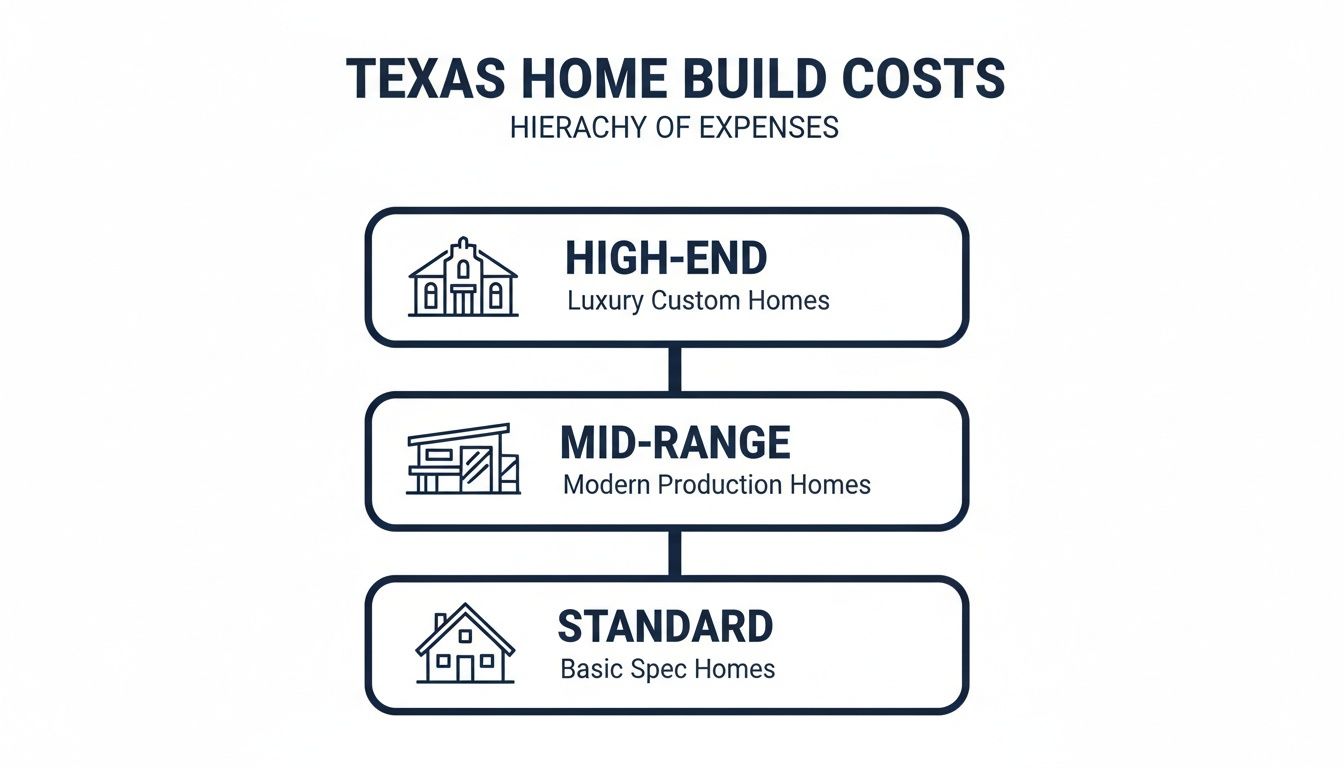
Jumping from standard-grade materials to high-end, luxury finishes dramatically changes the budget, clearly illustrating the premium that comes with truly custom details.
Hard Costs: The Structure and Finishes
Hard costs represent the largest portion of your budget. This is the "sticks and bricks" part of building your home.
Foundation: This is literally the bedrock of your house. The soil in North Texas often requires engineered post-tension or pier-and-beam foundations. They’re more robust than a simple slab, but that strength comes with a higher price tag.
Framing: The lumber package that creates your home’s skeleton is a major line item. The more complex your design, with features like vaulted ceilings or multiple roof gables, the more this cost will climb.
Exterior Finishes: This includes big-ticket choices like roofing (basic composition shingles versus a standing-seam metal roof), siding (brick, stone, stucco, or HardiePlank), and the quality of your windows and doors.
Interior Finishes: This is where budgets can go in a million different directions. A simple decision, like choosing quartz over laminate countertops, can easily swing your budget by thousands. This category includes everything from drywall and paint to flooring, cabinets, countertops, and light fixtures.
Mechanical, Electrical, & Plumbing (MEP): This covers your HVAC system, wiring, and every pipe in the house. Opting for high-efficiency HVAC units or a specialized lighting plan will naturally increase these costs.
Soft Costs: The Planning and Paperwork
While less tangible than a stone fireplace, soft costs are the crucial framework that allows construction to begin.
It's easy to get wrapped up in exciting details like kitchen islands. A common—and costly—mistake is forgetting to budget for unglamorous essentials like soil testing, land surveys, and architectural fees. These upfront investments ensure your home is built correctly and legally.
Your key soft costs will include:
Architectural and Engineering Fees: The cost to design your dream home and ensure the plans are structurally sound.
Permits and Impact Fees: Fees paid to the local city or county (like in Hood or Parker County) for the legal right to build.
Surveys and Soil Testing: These evaluations are critical for understanding your land's topography and soil stability, which directly informs foundation engineering.
Nationally, the raw construction cost now makes up a whopping 64.4% of a new home's price in 2024. For families in North Texas planning custom homes or barndominiums, this highlights the need for a builder who can keep the project on budget. Add the cost of land, which now accounts for 20.4% of the final price, and you can see how totals get inflated in our growing suburbs.
Site Work: Preparing Your Texas Land
If you're not building in an established subdivision, site work will be a major part of your budget. Buying raw land means you’re responsible for bringing in all the infrastructure.
This often includes:
Land Clearing and Grading: Removing trees, brush, and rocks, and leveling the ground for your homesite.
Driveway Installation: A long gravel or paved driveway adds up.
Utility Connections: Running power poles, lines, and sometimes gas lines from the nearest service point.
Well and Septic Systems: If you’re outside city limits, you’ll need to install your own systems for water and wastewater.
This table shows how a typical custom home budget might be allocated, giving you a solid idea of where the money goes.
Sample Custom Home Budget Allocation
Cost Category | Percentage of Total Budget | Key Items Included |
|---|---|---|
Site Work | 10% - 15% | Land clearing, grading, driveway, well, septic, utility hookups |
Foundation | 10% - 12% | Concrete, rebar, labor, engineered post-tension or slab |
Framing | 15% - 20% | Lumber, trusses, sheathing, labor, structural hardware |
Exterior Finishes | 12% - 15% | Siding (brick/stone), roofing, windows, exterior doors |
Major Systems (MEP) | 10% - 15% | HVAC, electrical wiring, plumbing lines, fixtures |
Interior Finishes | 15% - 25% | Drywall, paint, flooring, cabinets, countertops, lighting, tile |
Soft Costs & Fees | 5% - 10% | Permits, architectural design, engineering, surveys |
Contingency Fund | 5% - 10% | Reserved for unexpected costs or change orders |
Understanding these three budget pillars—hard costs, soft costs, and site work—is the first step toward a successful building journey. For a more personalized look at your potential numbers, our guide also works as a North Texas custom home construction cost calculator.
What Really Drives the Final Cost of Your New Home?
Ever wondered why two houses of the exact same size can have vastly different price tags? The answer is always in the details. The choices you make, both big and small, are what ultimately shape your final investment. Understanding these key cost drivers is the best way to keep your budget grounded in reality.
Three things consistently have the biggest impact on your final number: design complexity, finish quality, and the local labor market.
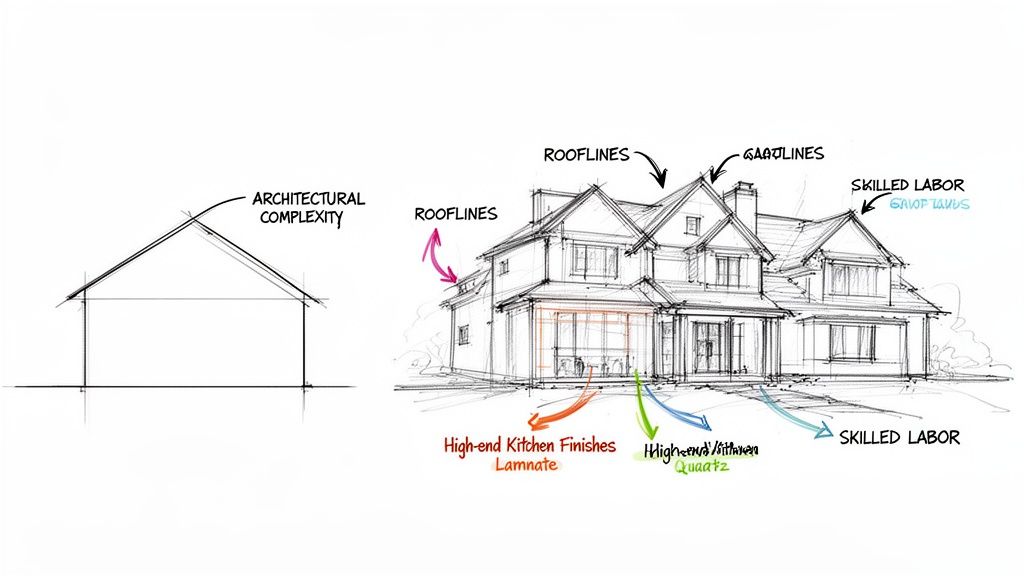
Architectural Complexity
Building a simple, rectangular home with a straightforward roofline is efficient. Now, picture a home with multiple gables, intricate rooflines, custom arches, and unique angles. This kind of complexity demands more materials, more precise cuts, and more hours from your framing and roofing crews. Every extra corner, roof valley, and architectural flair adds to the cost.
For many families and retirees, the goal is to maximize living space without letting the budget spiral. Sticking to a simpler, more efficient footprint is often the smartest way to achieve that.
Interior Finishes: The Great Differentiator
This is where your home’s personality shines—and where your budget can easily get away from you. The quality of finishes you choose is the single biggest variable in your per-square-foot cost.
Let's look at a kitchen. A standard kitchen might include:
Laminate countertops
Builder-grade cabinets
A standard appliance package
Vinyl or basic tile flooring
Now, swap those for high-end selections in the same space:
Quartz or natural stone countertops
Fully custom, solid wood cabinetry
High-end, panel-ready appliances
Engineered hardwood or premium tile
The price difference between those two kitchens could easily be $30,000 to $50,000 or more. That same principle applies to every room, from bathroom fixtures and flooring to the light switches on the wall.
Labor Costs and Local Demand
You can't build a house without skilled craftspeople, and their availability is a huge piece of the cost puzzle. In booming communities like Godley and Cresson, the demand for experienced electricians, plumbers, framers, and masons is high, which drives up labor rates.
A persistent skilled labor shortage across Texas has caused residential construction costs to swell. Inflation-adjusted hourly earnings for construction workers surged over 20% in just five years, a rate nearly four times higher than the state's overall private-sector wage growth.
This trend began after the Great Recession when many left the trades, and the industry has been playing catch-up ever since. This means securing a team of top-quality, reliable subcontractors simply costs more.
This is where working with an established local builder with deep roots in the Granbury area pays off. They can secure the best crews and manage schedules to avoid costly delays. You can learn more about the permits needed to build a house in North Texas in our guide.
By thinking through these three elements—design, finishes, and the realities of the local labor market—you can make smart, informed decisions that keep your project on track and on budget.
Budgeting for Outdoor Living and Additional Structures
In Texas, the dream home rarely stops at the back door. Features like covered patios, pools, and guest houses are often as important as the kitchen. Planning for these additions from the beginning ensures they feel like a natural extension of your home rather than an expensive afterthought.
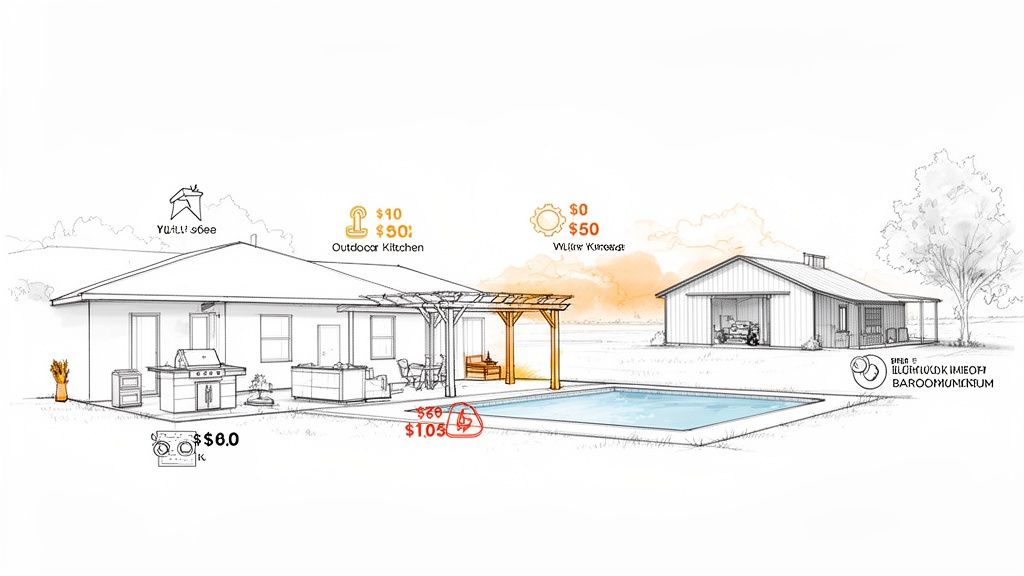
When we design these elements into the initial plans, it's a game-changer. Your builder can run plumbing, electrical, and gas lines seamlessly during the main construction phase, saving money and headaches compared to retrofitting everything later.
Creating Your Ideal Outdoor Oasis
For families and retirees, a great outdoor living space is a signature feature of life in North Texas. The costs can vary dramatically based on your vision.
Custom Pergolas and Covered Patios: A basic covered patio might add $8,000 - $15,000. An elaborate space with a stone fireplace, built-in lighting, and ceiling fans can climb to $25,000 - $40,000+.
Outdoor Kitchens: A simple setup with a built-in grill and counter space starts around $7,000. A full kitchen with a fridge, sink, and premium finishes will push the budget to $20,000 or more.
Gunite Pools: A custom gunite pool is a major investment, but it adds incredible value. Expect to budget anywhere from $70,000 to over $150,000, depending on size, depth, and extras like waterfalls or an attached spa.
These additions integrate best when included in the initial custom plans, often accounting for 10-15% of the total build costs but securing long-term value. You can find more information on Texas construction cost trends on texasestimate.com.
Budgeting for Structures on Your Acreage
For those with land in rural areas like Bluffdale, Millsap, or Stephenville, the budget often needs to stretch beyond just the main house.
A common mistake we see rural property owners make is focusing solely on the house budget and forgetting to account for the workshop or guest house until later. Integrating these structures into the main construction loan and site plan is far more efficient and cost-effective.
Consider these popular additions:
Workshops and Garages: A detached metal workshop can range from $30 to $50 per square foot for a basic shell. Adding insulation, electrical, plumbing, and interior finishes can increase that to $70 - $120 per square foot.
Guest Houses or "Casitas": These small, fully-finished homes often have a higher per-square-foot cost—think $180 - $275+—because you're packing a full kitchen and bathroom into a smaller footprint.
Barndominiums: While the shell of a barndo can be economical, remember that the interior finish-out cost is very similar to a traditional home. The "all-in" price often lands in a comparable range once you factor in high-quality insulation, framing, and finishes.
Planning for these outdoor and secondary structures from day one allows for a more accurate total budget and a more cohesive property design.
Practical Tips for Managing Your Construction Budget
Knowing the numbers is one thing; keeping them from running away is the art of building a custom home. Managing your budget isn’t about cutting costs; it’s about smart planning, strategic choices, and open communication with your builder.
A well-managed budget keeps your project moving and ensures the final home is the one you’ve been dreaming of. It comes down to intentional trade-offs—knowing where to invest for lasting value and where you can save now to upgrade later.
Invest Where It Counts Most
Some parts of your home are difficult and costly to change later, so it's best to get them right from day one.
Foundation and Structure: A solid, well-engineered foundation is non-negotiable, especially with the soil conditions in North Texas. Along with high-quality framing, it forms the skeleton of your home. Cutting corners here is a mistake you’ll pay for many times over.
Energy Efficiency: Spending more upfront on better windows, comprehensive insulation, and a high-efficiency HVAC system will pay you back every month in lower utility bills.
Key "Wet" Areas: Focus on getting the core elements of your kitchen and primary bathroom right, such as plumbing placement and quality cabinetry that you'll use every day.
Conversely, cosmetic items like light fixtures, paint, and certain types of flooring are relatively easy and affordable to change later. Opting for stylish but budget-conscious finishes in these areas frees up funds for the home’s critical systems.
Embrace the Contingency Fund
Nearly every custom build has at least one surprise. You might hit unexpected rock when excavating your lot in Weatherford or see a feature you decide you have to have. This is what a contingency fund is for.
We always advise clients to set aside 10-15% of their total construction cost for a contingency. Think of it as your project’s built-in insurance policy. It gives you the flexibility to handle the unexpected without derailing your finances or compromising on quality.
This fund isn't "extra" money to be spent casually; it's a vital part of a realistic budget. If you don't need it, you’ve got a fantastic bonus for landscaping or furniture.
Prioritize Builder Communication
The single most effective tool for managing your budget is a strong partnership with a transparent builder. You want someone who provides meticulous estimates, gives you regular updates, and can clearly explain any cost adjustments.
This is especially critical in our booming communities. Whether it's retirees building an accessible forever home in Granbury or a ranch owner adding new structures, there's immense value in working with local builders who have trusted teams. The area's strong job growth continues to drive demand, making builder transparency more important than ever. You can learn more about statewide Texas housing trends at the Comptroller's office.
When you and your builder are on the same page, there are no surprises—only collaborative solutions.
Finding the Right North Texas Builder
Once you have a handle on the numbers, the next step is finding the right partner. This is the single most important decision in your home-building journey. The budget might seem daunting, but with a trusted guide who knows the ins and outs of building in North Texas, a well-planned project is completely within reach.
Your builder is more than a contractor; they're your project manager, financial watchdog, and creative collaborator. Choosing a team with deep roots in places like Granbury, Weatherford, and Stephenville gives you a massive advantage. You're getting a builder with solid relationships with the best local trades, an understanding of county permits, and the experience to build a home that will stand up to our Texas weather.
From Blueprint to Keys in Hand
So, what does this process look like? Building a custom home is a marathon, not a sprint. Every project is unique, but most follow a similar path.
Months 1-3: Design & Planning: The creative phase where we finalize blueprints, lock in key material selections, and submit plans to the county for permits.
Months 4-5: Site Work & Foundation: Once permits are approved, we break ground. This involves clearing and grading the land and pouring the engineered foundation.
Months 6-9: Framing & "Dry-In": This is when your home takes shape. Walls go up, the roof goes on, and windows are installed, protecting the interior from the elements.
Months 9-12: The Finishing Touches: Your home’s personality comes to life. We install plumbing, electrical, and HVAC, followed by drywall, flooring, cabinets, paint, and fixtures.
The Final Month: Walkthrough & Handover: We’re on the home stretch. We’ll do final walkthroughs, take care of any punch-list items, and perform a deep clean before handing you the keys.
A great builder is your advocate. They make sure every dollar is spent wisely and that the home you walk into is even better than you imagined. Their job is to turn your vision into a physical reality, on time and on budget.
Figuring out the cost to build a house in Texas feels less overwhelming with an experienced partner in your corner. You can move forward with confidence, knowing every detail is handled with care.
A Few Common Questions About Building a Home in Texas
Taking the leap to build a custom home is a huge decision, and you’re bound to have questions. Here are answers to a few of the most common ones we hear.
How Long Does It Take to Build a Custom Home in North Texas?
A realistic timeframe, from breaking ground to getting your keys, is anywhere from 9 to 18 months. The window is wide because no two custom projects are ever the same.
A few things can impact the timeline:
Design Complexity: A sprawling, single-story ranch with complex rooflines will take more time than a traditional two-story home with a simpler layout.
Permit Process: Getting plans approved can be quick in one county and slow in another. A builder who knows the local municipalities—whether it's Parker or Hood County—can navigate this process efficiently.
Weather: North Texas weather is unpredictable. Heavy spring rain can turn a job site into a mud pit, halting foundation work, while a brutal summer heatwave can slow progress for crew safety.
Can I Save Money by Being My Own General Contractor?
On paper, cutting out the builder's fee seems like an easy way to save money. In reality, acting as your own general contractor (GC) is a massive gamble that can backfire spectacularly.
Managing a home build is a full-time, high-stress job that demands deep construction knowledge, a network of reliable tradespeople, and the logistical skills of an air traffic controller. A professional builder serves as your quality control, scheduler, and problem-solver, with long-standing relationships that ensure quality work and fair pricing.
What’s the Cost Difference Between Building in a Rural Area Versus a Suburb?
Where you decide to build has a massive impact on your total cost to build a house in Texas. Choosing between a rural lot in Glen Rose and a developed lot in a Weatherford suburb presents a classic trade-off.
Essentially, you can pay more for a suburban lot that's ready to go, or pay less for rural land and spend that saved money on bringing in the basic infrastructure yourself.
Here's the breakdown:
Rural Property (e.g., Glen Rose, Tolar): The land price is often lower, but you'll be responsible for bringing in every utility. This means budgeting for a water well, a septic system, and running electricity to your build site. These costs can easily add $30,000 to $60,000+ to your budget before you've even poured the foundation.
Suburban Lot (e.g., Granbury, Aledo): You'll almost certainly pay more for the land, but it typically comes with city water, sewer, and electricity already at the property line. This simplifies site preparation and makes your budget more predictable from the start.
Getting a handle on these key details is the first step toward a smooth and successful build. When you’re ready to talk through your vision with a team that puts craftsmanship and clarity first, we're here to help. Schedule a helpful, no-pressure consultation and let’s start the conversation about building your dream home.
Comments