
Permits Needed to Build a House in North Texas: Your Guide
Building your dream home in Granbury or Weatherford is an incredible journey, but before the foundation is poured, there's the paperwork. Tackling the permits needed to build a house might seem like a bureaucratic hoop, but it’s a crucial first step that ensures your family's safety and protects your home's long-term value. With an experienced local builder leading the way, this process is far less daunting than it sounds.
Why Building Permits Are Your First Big Step
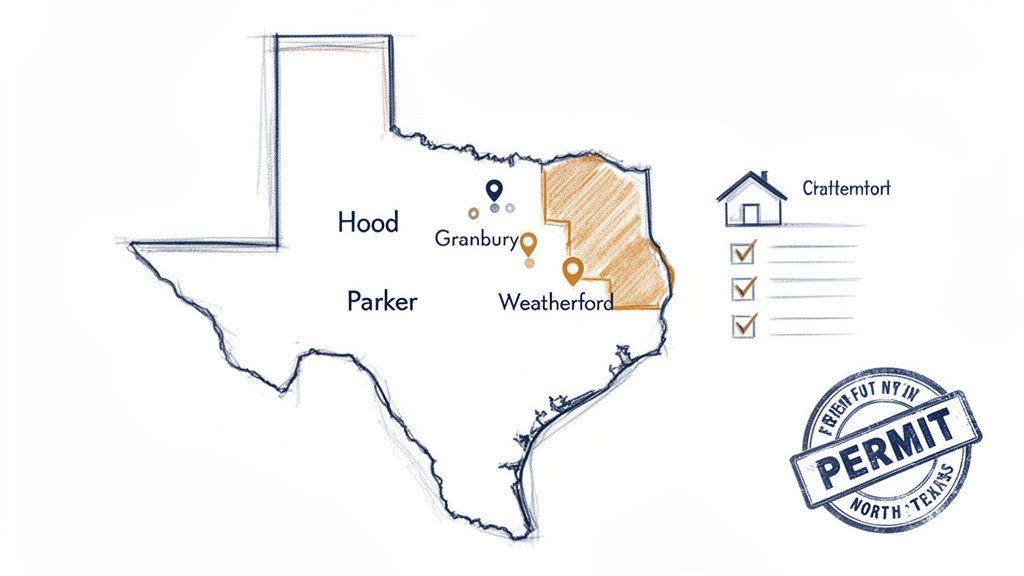
Before any dirt moves on your North Texas land, your project needs the official green light from local authorities. A building permit is more than a permission slip; it’s a formal confirmation that your architectural plans comply with local building codes, zoning regulations, and safety standards. These rules are in place to protect you, your investment, and the community.
Think of it as the official kickoff for your build. City or county officials meticulously review your blueprints to ensure every detail, from foundation depth to roof pitch, is safe and structurally sound. Trying to build without these approvals can lead to stop-work orders, hefty fines, or even being forced to demolish completed work. For anyone building their forever home, getting the proper permits provides ultimate peace of mind.
Navigating the North Texas Permitting Landscape
The road to securing all necessary permits can feel overwhelming. Nationally, building trends have seen some shifts; in the first four months of 2025, the U.S. saw 320,259 single-family home building permits issued, a 4.7% dip from the previous year, influenced by interest rates and material costs. You can explore the latest permit activity trends at the National Association of Home Builders.
Here in North Texas, families building in Hood, Parker, or Erath County must navigate specific local requirements. For custom homes, this often means submitting detailed site plans, soil analysis reports, and septic designs, which can add 4-8 weeks to the pre-construction timeline.
In rural areas like Glen Rose and Stephenville, the permitting process goes beyond the house structure. Officials will want to see detailed plans for your septic system, water well, and even driveway access to ensure everything meets county health and safety codes.
For a complete overview of the entire building process, check out our practical guide on how to build a custom home in North Texas.
The key to a smooth start is partnering with a builder who knows the Granbury area inside and out. A builder with deep local roots understands each jurisdiction's nuances, handles the paperwork, coordinates inspections, and ensures every detail is covered. This frees you to focus on the fun decisions that will turn a house into your home.
The 11 Key Permits for Your Custom Home Build
Each permit for a custom home has an important job. Think of them as a series of official check-ins, with each one confirming that a specific part of your new home meets the highest safety and quality standards. This isn't just about checking a box for the county; it's about protecting your family and your investment for the long haul.
Let's walk through the 11 most common permits you’ll encounter when building a custom home in places like Granbury, Weatherford, or Glen Rose. Understanding what each one covers will give you a clearer picture of how all the pieces of your home come together.
1. The Building Permit
This is the master permit that officially kicks off the entire construction process. The building permit is a comprehensive approval based on your complete set of architectural and structural plans. Before issuing it, officials in Parker or Hood County will scrutinize every detail, from room layouts to the materials you plan to use, ensuring the design follows all local building codes.
Getting this permit is a huge milestone. It’s the official confirmation that your home's design is structurally sound, safe, and meets all zoning rules for your property, whether that’s a lakefront lot near Granbury or a few acres out in Stephenville.
2. Foundation and Grading Permit
You can't build up until you've prepped the ground. A foundation and grading permit gives the green light for all initial earthwork, like clearing the land, leveling the site, and digging for the foundation. This is critical here in North Texas, where our expansive clay soils can cause major problems if not handled correctly.
This permit ensures:
Proper Drainage: The land is sloped to guide rainwater away from your house, preventing future water damage.
Soil Stability: Your builder has a plan to address any soil issues from the geotechnical report before concrete is poured.
Foundation Integrity: The footings and slab are engineered to support the full weight of the house.
For example, on a sloped lot in Bluffdale, this permit is absolutely critical to ensure retaining walls and the foundation design are tough enough to prevent shifting down the road.
3. Electrical Permit
Your home’s electrical system is its central nervous system, and mistakes can have dangerous consequences. An electrical permit is required for the entire installation—wiring, circuits, outlets, and the main electrical panel.
Your builder will coordinate with a licensed electrician to pull this permit. During the build, an inspector will visit at key moments—like the “rough-in” phase before drywall—to check that all wiring is installed safely and up to the National Electrical Code (NEC) standards.
4. Plumbing Permit
From sinks to the main sewer line, all pipes must be installed perfectly to prevent leaks and ensure reliable water access. The plumbing permit covers the installation of all water supply lines, drainpipes, sewer connections, and gas lines.
Like electrical work, this is inspected at the rough-in stage and again at the end to ensure every connection is tight and leak-free. This permit guarantees your showers have great pressure and your toilets work flawlessly.
5. Mechanical or HVAC Permit
Staying comfortable through a blazing Texas summer or a surprise winter freeze depends on your HVAC system. A mechanical permit is needed to install your heating, ventilation, and air conditioning systems.
This permit ensures the furnace, air conditioner, and ductwork are installed correctly for efficiency and safety. An inspector will verify the unit is sized correctly for your home and that all ducts are sealed tight to prevent air leaks.
In North Texas, a properly permitted and installed HVAC system isn't a luxury; it's a necessity. It guarantees your home will be a comfortable retreat year-round while keeping energy bills in check.
6. Septic or Sewer Permit
Handling wastewater is a major piece of the puzzle, especially on rural properties. If your lot is in a more developed part of Weatherford, you'll likely need a sewer tap permit to connect to the city's system.
For most custom homes on acreage in places like Tolar or Santo, you'll need a septic system permit. This is a more involved process requiring a professional site evaluation, soil testing, and a complete system design from a licensed specialist. The permit confirms your septic system is designed and located correctly to protect groundwater.
7. Driveway Permit
Even your driveway needs a permit. A driveway permit, sometimes called a curb cut permit, is usually required to ensure your connection to the public road is safe. The county or city wants to confirm the entrance has proper visibility for traffic and allows for safe entry and exit, including for emergency vehicles.
8. Erosion Control or Floodplain Permit
If your property is near water, like Lake Granbury or the Brazos River, you might need extra permits. An erosion control permit ensures measures are in place during construction to keep soil and sediment from washing into waterways.
A floodplain development permit is mandatory if any part of your property falls within a designated floodplain. This ensures your home is elevated and constructed to specific standards to reduce flood risk—a critical step in protecting your investment.
9. Swimming Pool Permit
Planning a backyard oasis? A gunite pool requires its own separate swimming pool permit. The process is a mini-version of the main home permit, involving a review of the pool's structural design, plumbing, and electrical plans to ensure everything is up to code and safe.
10. Roofing Permit
While often rolled into the main building permit, some jurisdictions might require a separate roofing permit. This ensures the materials and installation meet local codes, which is especially important in North Texas where we see high winds and hail.
11. Certificate of Occupancy (CO)
This is the final and most exciting permit. The Certificate of Occupancy (CO) is issued only after your home has passed every final inspection: building, electrical, plumbing, and mechanical. It's the city or county's official stamp of approval, declaring your new home safe and ready for move-in. You legally cannot live in the house without it.
Getting your CO is the moment all the planning, paperwork, and construction finally pay off. It’s the green light to start your new life in the custom home you worked so hard to create.
Navigating these permits takes deep local knowledge and strong relationships with county officials. If you’re feeling overwhelmed, that’s perfectly normal. Let's schedule a free consultation to discuss your specific property and how we can manage the entire permitting process for you, ensuring a smooth and successful start to your build.
How to Navigate the Permitting Process
Getting from architectural plans to an official, stamped permit is a journey. It's a detailed review process designed to ensure your future home in Granbury or Weatherford is safe, compliant, and built to last.
The process kicks off when your builder submits the complete plan set to the local permitting office—whether that's Hood County, Parker County, or a specific city. This is an extensive package with everything from structural engineering reports to the site plan showing exactly where the house will sit. From there, it goes into review, where officials comb through every detail.
From Submission to Approval
The path from submitting your plans to having a permit in hand has several critical checkpoints. A proactive builder knows these steps and prepares for them, which is essential for keeping your project on track.
Initial Submission: Your builder hands over the full set of construction documents. A common mistake causing delays is an incomplete submission. A seasoned builder ensures every required report—from soil analysis to septic design—is included from the start.
Plan Review: This is the waiting period. A team of city or county reviewers pores over the plans, checking for compliance with structural, zoning, electrical, and plumbing codes. If they spot an issue, they'll send back "redlines" or a list of required corrections.
Revisions and Resubmission: Your builder and design team address any required changes and resubmit the corrected plans. This back-and-forth can happen more than once, especially on complex custom homes.
This flowchart gives you a bird's-eye view of the major milestones in the permitting and inspection process.
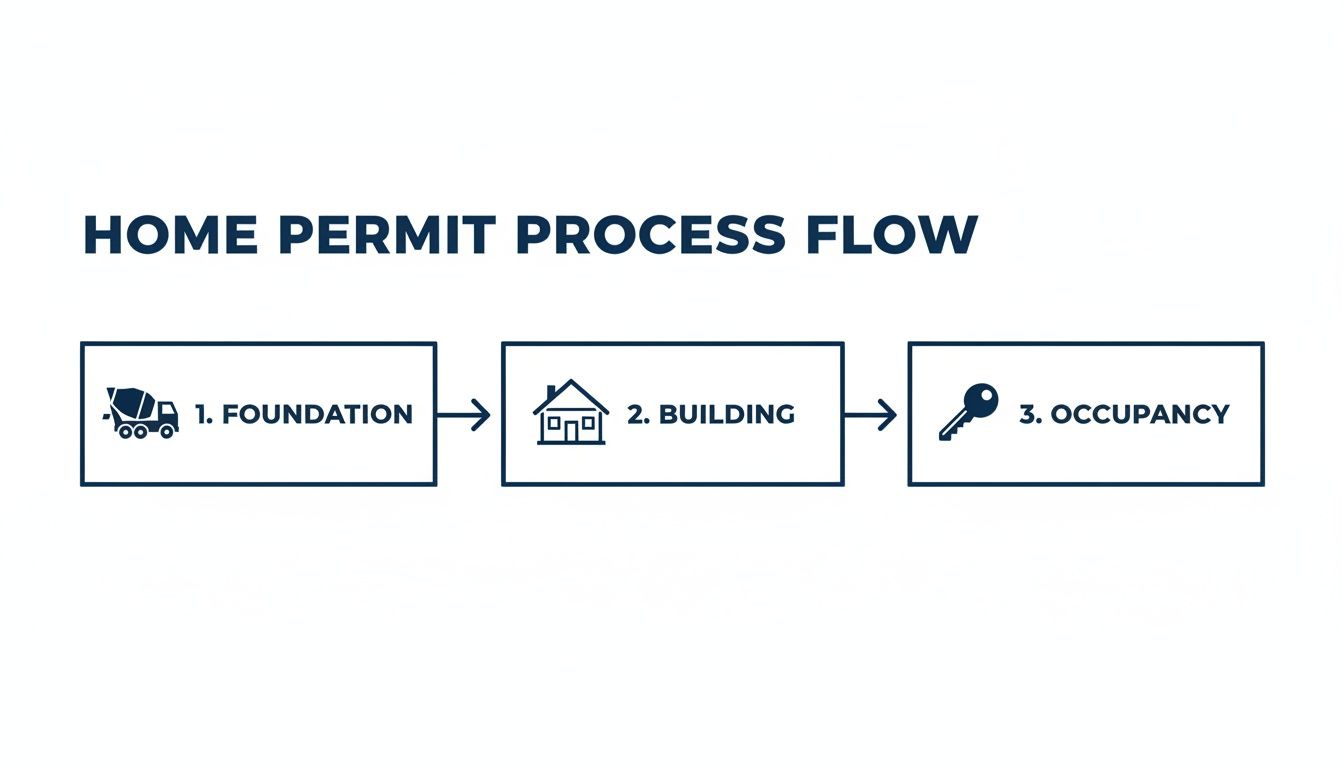
Each icon represents a crucial phase where a permit and subsequent inspections are required before work can move to the next stage.
Understanding Timelines and Avoiding Delays
How long does this take? It depends. A simple project in an unincorporated area might get a permit in a few weeks. But a complex custom build on acreage near Glen Rose could easily take two to three months or longer, depending on the jurisdiction's workload and your project's specifics.
Permits are the gatekeepers of construction. Recent data from Trading Economics shows a dynamic environment; by October 2025, U.S. building permits saw a slight dip, with single-family authorizations settling around 878,000. Locally, for our clients building barndominiums or doing post-storm roof replacements in Hico or Santo, permits in Somervell or Erath Counties often require engineering stamps. Those can cost $1,000-$3,000 and take up to 45 days due to engineer backlogs. For rural property owners in Tolar, we see that nearly 35% of permits involve detailed septic and well reviews.
The single biggest cause of permit delays is an incomplete application. Forgetting the septic design, missing an engineering letter for the foundation, or not having a proper drainage plan can send your submission back to square one, costing you weeks of precious time.
This is where an experienced builder makes all the difference. They don't just submit paperwork; they manage the entire process. They know the people at local permitting offices, anticipate common questions, and follow up relentlessly to keep things moving. Their expertise turns a frustrating bureaucratic maze into a well-managed part of your home-building journey.
Understanding Permit Costs in North Central Texas
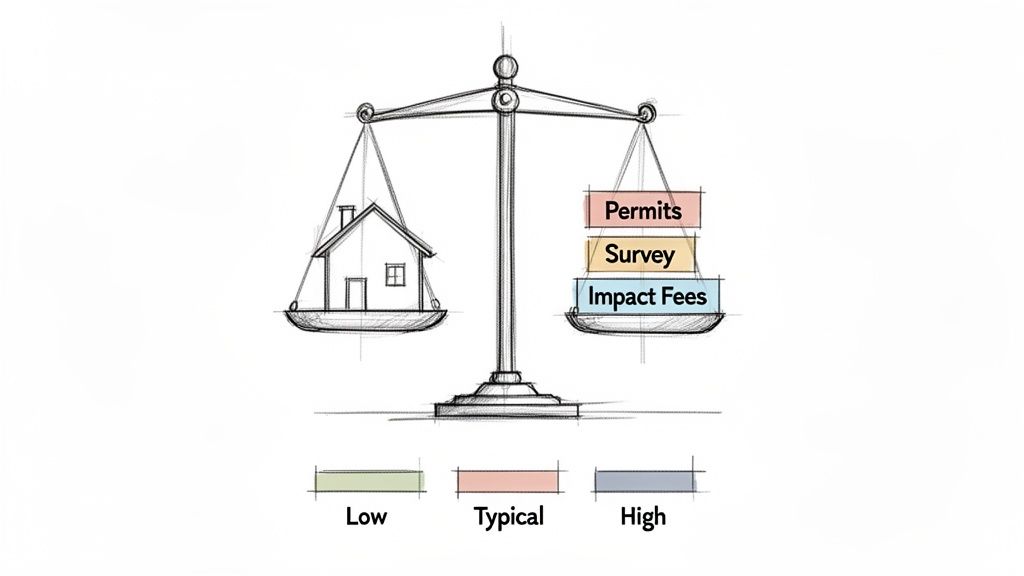
One of the first questions future homeowners ask is, "What will all this cost?" When it comes to the permits needed to build a house, there isn't one simple answer. These costs are a crucial part of your project's "soft costs"—expenses outside of labor and materials—and they vary widely depending on where and what you're building in North Texas.
Think of permit fees as an investment in quality control. The money funds the plan reviewers and inspectors whose job is to ensure your home is built to be safe and sound. The final tally is driven by a few key factors unique to your project.
What Drives Permit Fees
The final price for your permits is calculated based on a few main things. While jurisdictions like Granbury, Stephenville, or Weatherford have their own fee schedules, they generally look at the same variables.
Total Construction Value: This is a primary factor. The higher the estimated value of your new home, the higher the permit fees will likely be.
Square Footage: The size of your house, including the garage and covered porches, directly influences the cost. A larger home is more complex and requires a more in-depth review.
Impact Fees: In fast-growing areas, you’ll often encounter impact fees. These are one-time charges that help the community absorb the costs of new development by funding roads, schools, and public utilities.
For a typical custom home build in the Granbury and North Central Texas area, the full package of building permits can realistically run anywhere from $5,000 to over $15,000. This wide range reflects differences in home size, value, and the specific fees charged by each city or county.
Budgeting for More Than Just the Permit Itself
The fees you pay directly to the city or county are just one piece of the puzzle. Before you can even submit your application, you need a stack of professional reports and plans. It's essential to budget for these related expenses. For a better sense of how these numbers fit into the big picture, it’s worth learning more about how to estimate house building costs in North Texas.
Here are the key related costs you’ll see:
Land Surveyor Fees: You need a surveyor to create a precise site plan showing property lines, easements, and where your house will sit.
Geotechnical Engineer Fees: This pays for the soil report that informs your foundation design—a non-negotiable step in our region.
Structural Engineer Fees: An engineer must review and stamp your architectural plans, verifying the home’s design is structurally sound.
Septic Designer Fees: If you’re building on rural acreage around Glen Rose, you’ll need a licensed professional to design your wastewater system.
Understanding these interconnected costs gives you a more transparent and realistic view of your budget. Planning for both direct permit fees and the professional services leading up to them eliminates potential surprises and lets you move forward with confidence.
Your Role vs. Your Builder's Role in Permitting
A common question from clients is, "Who's supposed to do what?" when it comes to permits. Sorting out roles is crucial for a smooth process. When you work with a seasoned custom home builder, you play a supporting role while they handle the technical work.
Think of your builder as the quarterback of the permitting team. They are the one communicating with officials in Granbury or Weatherford, submitting complex blueprints, and lining up every inspection. Their experience is what prevents frustrating and expensive delays.
What Your Builder Handles
A great custom home builder owns the entire permitting process. Their knowledge of local building codes and established relationships with county inspectors are invaluable.
Here’s what your builder will typically take care of:
All Permit Applications: They fill out and file the paperwork for the primary building permit, plus all electrical, plumbing, and other trade permits.
Coordinating Professionals: They orchestrate the team of surveyors, engineers, and septic designers to ensure every required report is done correctly.
Managing Plan Reviews: If the county reviewer sends back corrections, your builder works directly with the architect to get them fixed and resubmitted quickly.
Scheduling and Attending Inspections: From the foundation check to the final walkthrough, they are on-site, meeting inspectors and ensuring everything passes.
Your builder is essentially your professional representative. They translate technical jargon from inspectors and city officials into plain English, so you’re always in the loop without being bogged down in bureaucracy.
What You're Responsible For
While your builder handles the heavy lifting, your job is to provide critical documents and make key decisions. Being organized and responsive is the best way you can help keep the project on schedule.
Your main tasks usually include:
Providing Property Documents: Have key documents ready, like your property survey and proof of ownership.
Getting HOA Approval: If your lot is in a community like Pecan Plantation with a Homeowners Association, you are responsible for getting the architectural review board's approval. This must happen before your builder can apply for county permits.
Making Timely Decisions: Your builder can’t finalize plans without your sign-off on design elements. The sooner you make those calls, the sooner they can submit for permits.
To make this crystal clear, here’s a simple breakdown of who handles what.
Permitting Responsibilities: A Clear Comparison
This table outlines the typical division of labor during the permitting phase.
Task | Homeowner's Responsibility | Builder's Responsibility |
|---|---|---|
Proof of Ownership | Provide the deed or title documents. | Review documents to ensure they are correct for submission. |
Property Survey | Provide an existing survey or authorize a new one. | Order and coordinate with the surveyor if a new one is needed. |
HOA Approval | Submit plans to the HOA committee and secure approval letter. | Provide necessary plans and documents for the HOA submission. |
Permit Applications | Sign documents as the official applicant/owner when required. | Complete, compile, and submit all required permit applications. |
Plan Revisions | Make final decisions on any design changes needed. | Work with architects/engineers to revise plans and resubmit. |
Fee Payments | Provide funds for permit fees. | Pay the fees at the counter and manage receipts for the budget. |
Scheduling Inspections | N/A | Coordinate all on-site inspections with the county/city. |
Meeting Inspectors | N/A | Be present on-site to walk through with inspectors. |
This partnership ensures nothing falls through the cracks. For a deeper dive into what a general contractor brings to the table, check out our guide on what a general contractor does for your North Texas home.
By having these roles clearly defined, you can relax and focus on the exciting parts of building your dream home, knowing the technical details are in expert hands.
Got Questions About Building Permits? We’ve Got Answers.
The permitting process can feel like a maze. To cut through the confusion, here are straight answers to the questions we hear most often from folks in the Granbury and Weatherford areas.
How Long Are Building Permits Good For in Texas?
In most North Texas counties, including Hood and Parker, your main building permit is typically valid for 180 days from the issue date.
This doesn't mean you have to finish your house in six months. The permit stays active as long as construction progresses and you’re passing inspections. However, if work stops for more than 180 days, your permit can expire, requiring a renewal process with extra fees. This is why having a builder who sticks to a reliable schedule is so important.
Can I Start Clearing My Land in Granbury Before I Have a Permit?
It’s tempting to get a jump on things, but it's best to wait. Some jurisdictions might allow basic clearing with a separate grading permit, but most require the full building permit to be in hand.
Starting too early can lead to a stop-work order and serious fines. For rural acreage, you might also have to navigate environmental rules, like protecting specific trees. The safest bet is to wait for the green light from both your builder and the local permitting office before breaking ground.
Building without the right permits is a gamble not worth taking. The potential consequences—from fines to demolition orders—far outweigh any time you might think you're saving. It creates serious title and insurance problems down the road, making it much more costly than doing it right the first time.
What Happens If I Build Without the Right Permits?
Building without proper permits is a high-stakes gamble. Local authorities can issue a stop-work order, bringing construction to a halt. They can also impose hefty fines and, in the worst-case scenario, force you to tear down what you've built.
Even if you get away with it initially, problems will surface later. Unpermitted work can void your homeowner's insurance and create title issues, making the house nearly impossible to sell.
Are Permits Different for a Barndominium vs. a Traditional Home?
For the most part, no. Permitting a barndominium in a place like Glen Rose or Stephenville follows the same path as a traditional custom home. You’ll need the same core permits needed to build a house: building, electrical, plumbing, septic, and mechanical.
The main difference often lies in the structural engineering plans. The plans for a barndo must be tailored to its steel frame construction to prove it meets residential building codes. A builder experienced with this style will ensure the plans are spot-on, making the approval process as smooth as any other home.
Starting Your North Texas Home Build on the Right Foot
Thinking about building permits can feel like diving into a pile of paperwork. But getting this right is the most important first step toward building a home your family will love for years. Think of each permit—from foundation to final occupancy—as a critical quality check ensuring your home is safe, solid, and built to last.
Understanding the main permits needed to build a house and knowing who handles what clears up much of the confusion. This is where a good local builder, especially one who knows the Granbury area, is invaluable. They don't just fill out forms; they know the specific quirks of Hood County versus Parker County and can spot potential roadblocks before they become expensive delays.
Their experience turns a potential headache into a smooth, managed process.
This builder-homeowner partnership keeps your project moving forward. It means your build starts on solid ground—literally and legally—so you can focus on the fun stuff, like picking out finishes and designing the kitchen. Whether you’re building on a few acres in Glen Rose or a lake lot in Weatherford, sorting out permits from day one makes all the difference.
Your dream home is a huge investment of your time, money, and heart. The smartest way to protect that investment is to work with an expert who truly understands the local permitting maze, ensuring your build starts strong and compliant from the get-go.
If you're planning a build in the Granbury area and have questions about your specific property, the team at Gemini Homes is here to help guide you. Let's talk about turning your vision into a reality, the right way. Schedule your free consultation today.
Comments