
Your North Texas Custom Home Construction Cost Calculator
A custom home construction cost calculator is a fantastic starting point for anyone trying to wrap their head around a project budget. You plug in key details—like the square footage you're aiming for, how many bedrooms you need, and the level of finishes you envision—and it gives you a ballpark figure. It's the first, most realistic step toward planning your dream home in places like Granbury, Weatherford, or Glen Rose.
What It Really Costs to Build Your Dream Home in North Texas
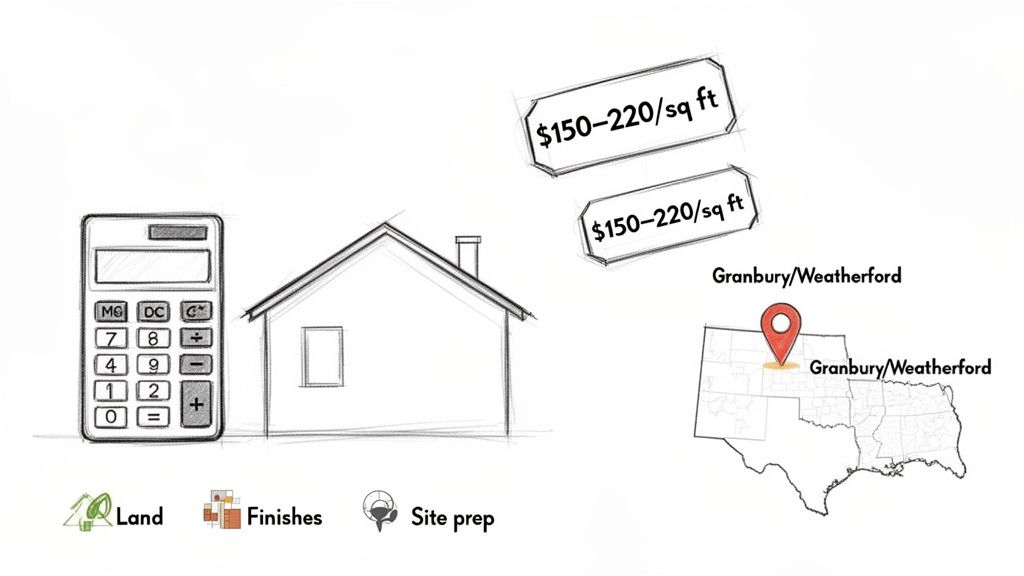
Embarking on a custom home build is thrilling, but let's be honest—the first question everyone asks is, "What's this actually going to cost me?" Before you get too attached to a specific floor plan or start clearing trees on your lot near Stephenville, getting a firm grip on the numbers is the most critical move you can make.
This is where a custom home construction cost calculator becomes so valuable in the early stages. It’s designed to cut through the guesswork and give you an initial, data-driven estimate based on local pricing. Think of it not as a final quote, but as a financial compass to get you pointed in the right direction.
Key Variables That Drive the Price Tag
The final price of your North Texas custom home isn’t just one big number. It’s a mosaic of several key components, and each one can significantly swing your budget. The biggest drivers are almost always:
Total Square Footage: This is the foundational multiplier for your entire project. A bigger house means a bigger cost for nearly every line item, from foundation concrete to roof shingles.
Level of Finishes: The gap between standard, builder-grade materials and high-end luxury finishes (think flooring, countertops, and light fixtures) can easily add tens or even hundreds of thousands of dollars to the bottom line.
Site and Land Preparation: Are you building on a perfectly flat, clear lot? Or do you need to remove a small forest of cedars, level a slope, or install a new septic system? These upfront costs can be substantial for rural property owners.
These factors have a unique weight here in our local market. For example, the expansive clay soil common across North Texas often demands specialized foundation engineering—a cost a generic national calculator might not fully capture. For a deeper dive into these local nuances, check out our detailed guide on how to estimate house building cost in North Texas.
An online calculator provides an excellent starting point, but it can't see your land. Unique site conditions, like needing to blast through rock or run utilities a long distance, are major cost factors that can only be assessed with an on-site evaluation.
North Texas Custom Home Cost Quick Reference
To give you a clearer picture, here’s a quick breakdown of what you can generally expect to spend per square foot in the Granbury, Weatherford, and surrounding North Texas areas.
Build Quality Level | Average Cost Per Square Foot | Example 2,500 Sq. Ft. Home Estimate |
|---|---|---|
Builder-Grade | $180 - $220 | $450,000 - $550,000 |
Mid-Range/Semi-Custom | $220 - $260 | $550,000 - $650,000 |
High-End/Luxury | $260 - $320+ | $650,000 - $800,000+ |
Remember, these figures are for the home itself. They don't include the cost of the land, extensive site work, or other soft costs. Use this as a guide to see where your vision might land.
Setting a Realistic Starting Point
While building a custom home has gotten more expensive nationwide, with average projects detailed by Angi.com, the good news is that we often see more approachable figures here in Texas. For families building in Granbury or Weatherford, this makes planning ahead with an experienced local builder absolutely essential to keep your project on track and on budget.
How to Get the Most Out of a Construction Cost Calculator
An online cost calculator is a fantastic starting point, but the estimate it provides is only as good as the information you put in. To get a truly useful number, it helps to think like a builder as you fill out the fields.
Let's walk through a real-world example. Imagine a family planning to build on their new acreage near Stephenville. They're dreaming of a modern farmhouse, somewhere around 2,800 square feet, with four bedrooms for their growing family and a three-car garage for their trucks and gear. By plugging in these core numbers, they're setting the project's scale—the single biggest driver of cost.
Defining Your Home’s Basic Structure
When a calculator asks for the number of stories, that choice has implications beyond your floor plan. A single-story home, for instance, needs a much larger foundation and roof footprint than a two-story home with the same square footage. This can bump up your foundation and framing costs, especially on rural North Texas properties where the soil can be tricky.
Our Stephenville family decides on a single-story layout, a practical choice for ranch-style living that's also great for retirees planning to age in place. Next up: bathrooms. They settle on three. This detail matters because every extra bathroom adds a significant cost for plumbing, fixtures, and finishes.
Making Educated Guesses on Finishes
This is where people often get hung up. What does "standard" or "luxury" really mean? If you haven't picked out every tile and faucet, don't worry. The key is to be honest about your tastes and where you want to put your money.
Standard Finishes: Think durable, attractive, builder-grade materials. This usually means quality vinyl plank flooring, laminate countertops, and basic ceramic tile. It’s functional, looks great, and is the most budget-friendly route.
Mid-Range Finishes: This is where you start introducing upgrades in the spots that matter most to you. Maybe you want engineered hardwood in the living areas, granite in the kitchen, and better-quality cabinetry. This is a common choice for families who need durability but also want a touch of elegance.
Luxury Finishes: This is the top tier—premium materials everywhere. We're talking high-end commercial appliances, fully custom cabinetry, natural stone countertops, and intricate, custom tile work.
Our example family knows their home needs to stand up to kids and dogs, but the kitchen is their non-negotiable splurge. They select "Mid-Range Finishes," figuring they can balance the budget with standard materials in the bedrooms while investing in quartz countertops and custom cabinets in the kitchen.
Don't get bogged down trying to make every input perfect at this stage. The goal of a cost calculator is to give you a realistic ballpark figure to start with. You'll dial in the exact numbers later as you make firm decisions with your builder.
For other big-ticket items like the roof, a good guess is all you need. Here in North Texas, a composition shingle roof is the most common and cost-effective choice. But if you have your heart set on a standing seam metal roof—a hallmark of the modern farmhouse style—you need to select that. It's a bigger investment, and the difference can easily be $15,000-$30,000 or more on a 2,800 sq. ft. home.
By thinking through these details, our family gets an estimate that isn't just a random number. It reflects their actual vision and gives them the power to have a much more productive first conversation with a builder. Speaking of which, it helps to be prepared. Take a look at these top 10 questions to ask custom home builders in North Texas to get started.
Uncovering the Costs a Calculator Might Miss
An online custom home cost calculator is a fantastic way to get a ballpark figure, but its real value is in framing the conversation. The true cost of building your dream home in Granbury or Tolar involves much more than square footage and bedroom counts. Several major expenses get simplified—or missed entirely—by these tools.
Site Work and Land Preparation
The biggest surprise for families building on rural acreage is almost always the cost of site work. An online calculator has to assume you’re starting with a perfectly flat, build-ready lot, but that’s rarely the reality here in North Texas.
Getting your land ready often means tackling:
Land Clearing and Grading: Removing trees, rocks, and brush, then leveling the build site, can run anywhere from $3,000 to over $15,000, depending on the density of vegetation and lay of the land.
Utility Connections: If you're on raw land, you'll need to run water, electricity, and maybe even gas lines to your homesite. The final bill here varies wildly based on how far you are from the main lines.
Septic System Installation: For any property outside city sewer service, a new septic system is non-negotiable. Depending on the soil type and system your lot requires, this can cost from $7,500 to $20,000+.
Driveway Construction: A simple gravel driveway might only be a few thousand dollars. But a long, paved concrete driveway can easily top $25,000.
Foundation: The Unseen Expense
Your home’s foundation is its most important part, and its cost is dictated almost entirely by your specific piece of land. Here in North Texas, our expansive clay soil demands careful engineering to prevent shifting and cracking down the road. A sloped lot can change everything. For example, a project on a hilly property near Glen Rose might require extensive pier-and-beam work and retaining walls, adding nearly $40,000 to the budget compared to a similar-sized home on a flat parcel. This is a variable no online tool can predict.
It’s a common misconception that foundation costs are uniform. The truth is, your land dictates the foundation, and the foundation dictates a huge chunk of your initial budget. A challenging lot can easily add 5-10% to your total construction cost before framing even begins.
Mechanical Systems: HVAC, Plumbing, and Electrical
Calculators typically bundle the costs for HVAC, plumbing, and electrical systems into an averaged-out number. In reality, your lifestyle and design choices can make these figures swing dramatically. A high-efficiency, multi-zone HVAC system for a large, single-story home with soaring ceilings will cost substantially more than a standard unit for a compact two-story house. Things like adding a tankless water heater or specialized wiring for a home workshop all add up.
Detailed Cost Breakdown for a North Texas Custom Home
Here’s an itemized look at how a typical custom home budget is allocated across different construction phases.
Cost Category | Percentage of Total Budget | Key Factors in North Texas |
|---|---|---|
Foundation & Site Work | 10-15% | Expansive clay soils, lot slope, tree clearing, septic/utility runs |
Framing & Exterior | 15-20% | Lumber prices, complex rooflines, stone/brick vs. siding |
Major Systems (HVAC, Elec, Plum) | 10-15% | System efficiency (SEER rating), home size, number of fixtures |
Interior Finishes | 25-35% | Cabinetry, flooring, countertops, paint, trim level |
Exterior Finishes & Landscaping | 5-10% | Driveway material, patios, basic sod/plantings |
Permits, Fees & Soft Costs | 5-8% | County/city fees, architectural design, surveys |
Builder Fee/Overhead | 10-15% | Project management, insurance, profit |
This breakdown highlights that while interior finishes are the largest variable, the "unseen" costs like site work and permits are significant and can't be ignored.
Permits, Fees, and Soft Costs
Finally, there’s a whole category of "soft costs" almost never included in an online estimate. These are the necessary administrative and professional expenses needed to legally build your home.
These often-overlooked expenses include:
Building Permits: Fees paid to the county or city to approve your plans.
Architectural and Engineering Fees: The cost to design your home and ensure it’s structurally sound.
Land Surveys: Required to establish property lines and the exact placement of your home.
Impact Fees: Sometimes charged by municipalities to cover new infrastructure.
The process and cost for securing these can vary widely between counties like Hood, Parker, and Somervell. For a clear breakdown of what to expect locally, our guide on permits needed to build a house in North Texas is an invaluable resource. Understanding these hidden factors is the key to turning a calculator's estimate into a realistic, actionable budget.
How Finishes and Features Shape Your Final Budget
If site work and framing are your home’s skeleton, the finishes are what give it a soul. This is also the part of the budget that can grow faster than any other. Our custom home construction cost calculator gives you a fantastic starting point, but your real-world selections for flooring, countertops, and exterior materials will truly define the final number. These choices are where your personality shines through, but they also represent a huge chunk of your total investment.
This chart gives you a bird's-eye view of a typical project budget. Notice what often takes the biggest slice of the pie.
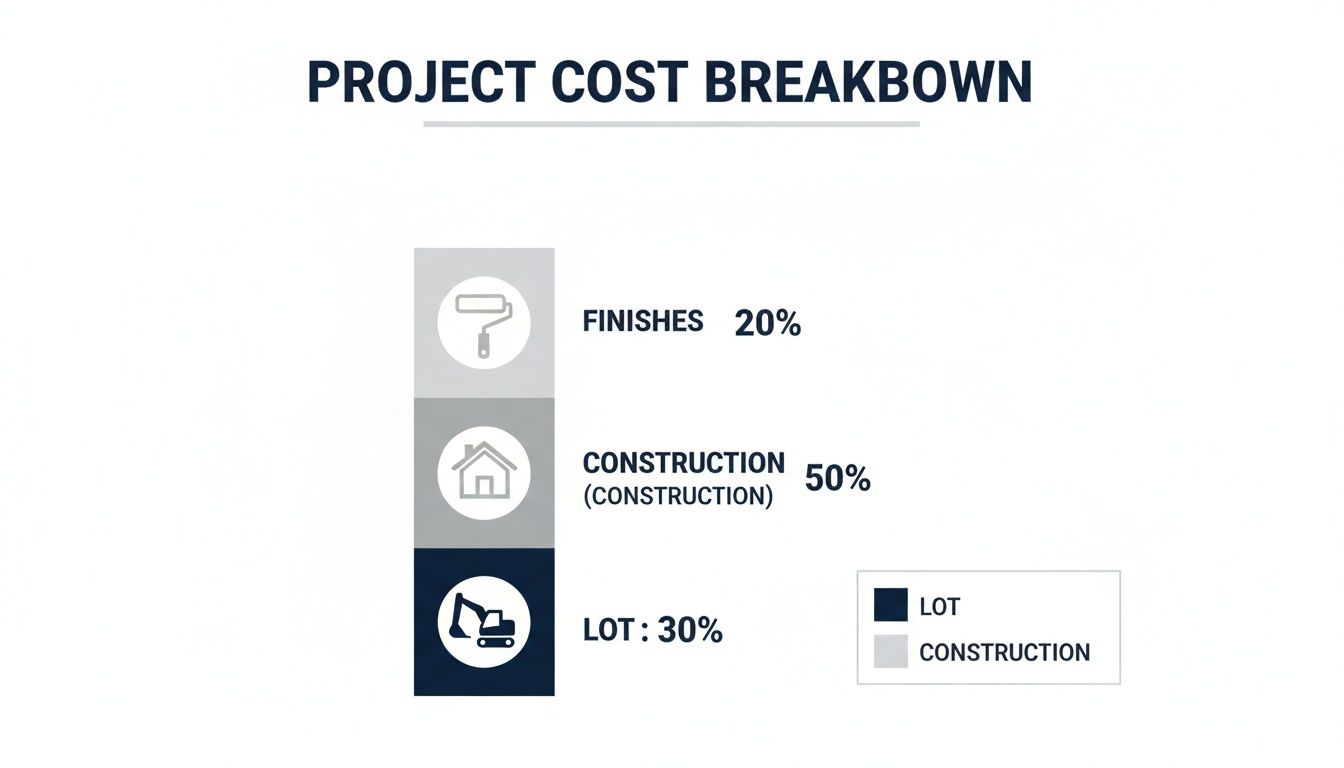
As you can see, what goes inside the walls often costs as much—or even more—than the structure itself. Your design choices here are incredibly powerful.
Interior Finishes: The Biggest Budget Mover
Interior finishes can account for 25% to 35% of your total construction cost, making it the category with the wildest price swings. It’s where a family building out near Weatherford can either find huge savings or decide to invest in luxury that will last a lifetime.
Let's break it down with some real-world numbers we see every day:
Flooring: High-quality luxury vinyl plank (LVP) is a fantastic, durable choice for North Texas life, usually running $6 to $9 per square foot installed. But if you've got your heart set on classic engineered hardwood, that price can easily jump to $10 to $15+ per square foot. In a 2,500 sq. ft. home, that one decision can swing your budget by $10,000 to $15,000.
Countertops: You can get gorgeous, modern laminate or an entry-level granite and keep your budget happy. But if you start looking at premium quartz or a one-of-a-kind exotic granite slab, you could double or triple your countertop allowance. That's an extra $5,000 to $12,000 just for the kitchen and baths.
Cabinetry: Semi-custom cabinets hit a great sweet spot between style and value. But if you're dreaming of a true chef's kitchen with fully custom, furniture-grade cabinetry and soft-close everything, the price tag is significantly different.
The secret to smart budgeting isn’t about picking the cheapest option for everything. It's about being strategic. Splurge on the high-traffic, high-impact areas you'll use every day, like your kitchen, and choose more standard, durable options elsewhere.
Exterior Choices: Defining Curb Appeal and Cost
Your home’s exterior is its first impression, and those choices dramatically affect both the look and the budget. Around here, you can't go wrong with classic brick and native Texas stone. A home with a traditional brick facade is typically the most cost-effective path to a beautiful, low-maintenance finish. But many of our clients dream of a more dynamic look, maybe a mix of stone and clean stucco. That kind of intricate masonry requires more specialized labor and can add $15,000 to $30,000 (or more) to the exterior budget compared to a straightforward brick design.
Making Smart, Budget-Conscious Decisions
Whether you're a young family, retirees, or building on a rural property, the goal is always balancing your "must-haves" with your budget. If you’re building your forever home in Glen Rose and plan to age in place, investing in durable, low-maintenance flooring from the get-go makes perfect sense. If you have a growing family, putting extra money into a high-functioning kitchen with stone countertops that can take a beating is probably the right call. Our calculator gives you the framework; your personal choices will fill in the details.
From Online Estimate to a Builder's Final Quote
Our custom home cost calculator gives you a fantastic 30,000-foot view of your project. But to actually build that home, you have to get down on the ground and navigate the real-world details. That’s where a builder’s final quote comes in. It bridges the gap between a ballpark estimate and a firm, buildable price by accounting for the crucial services that turn a plan into a home.
Understanding the "Soft Costs" Calculators Often Miss
An online tool does a great job of estimating the "hard costs"—the lumber, concrete, and labor. But it can't predict the specific professional services your unique project will need to get off the ground legally and safely.
These are what we in the industry call soft costs. For any custom home build in counties like Hood or Parker, these aren't optional.
They typically include:
Architectural Design Fees: The cost for a professional to create the detailed blueprints that bring your vision to life.
Structural Engineering: An engineer reviews those plans to certify that the home’s structure can handle Texas weather and the specific soil conditions on your land.
Permitting Fees: Every city and county, from Granbury to Weatherford, has its own set of fees for reviewing plans and issuing permits.
Land Surveys & Geotechnical Reports: A survey defines your property lines, while a geotechnical (soil) report tells us what we need to know to design the right foundation.
These aren't just line items; they are the bedrock of a successful project. A good builder will walk you through these costs from the very first conversation.
The biggest difference between an online estimate and a builder's quote is the shift from "what" to "how." The calculator estimates what the materials cost. The builder's quote details how it all gets managed, insured, and built to code on your specific piece of land.
Why a Builder's Fee Is a Smart Investment
One of the most important parts of a builder's quote is the builder's fee, sometimes called markup. This typically runs between 15% to 25% of the total construction cost. It’s easy to look at that number as just an extra expense, but it’s actually what pays for the expertise, management, and risk-mitigation that ensures your home gets built right.
So, what are you really paying for?
Full-Time Project Management: This is the daily grind of scheduling dozens of subcontractors, timing material deliveries perfectly, and solving on-site problems. It keeps your project on track and on schedule.
Overhead and Insurance: This covers the builder's business essentials, like general liability and workers' compensation insurance, which protects you from financial liability if an accident happens on your property.
Expertise and Quality Control: You're investing in years of hard-won experience. A veteran North Texas builder knows which subs do top-notch work, which materials stand up to our climate, and how to pass inspections the first time.
A builder’s quote takes a simple cost-per-square-foot number and turns it into a comprehensive, locked-in price. This level of detail is the foundation of trust and the only way to move forward with real confidence.
Common Questions About North Texas Building Costs
Even after running the numbers through a cost calculator, you're bound to have more questions. Building a custom home is a huge investment, and you deserve to feel completely confident. Here are some of the most common questions we get from families planning to build in Granbury, Weatherford, and the surrounding communities.
How Accurate Is an Online Cost Calculator?
Think of our online calculator as an excellent starting point for initial planning. It gives you a solid, realistic ballpark figure based on current local material and labor costs. It’s the perfect way to quickly see if the home size you're dreaming of lines up with the budget you have in mind. Its main limitation is that it can't walk your property. It has no way of knowing about unique challenges like hitting rock during excavation or discovering the soil needs a more engineered foundation. To get a firm, locked-in price, nothing replaces an in-person site evaluation.
Is It Cheaper to Build or Buy in North Texas?
Honestly, it depends on the current market and whether you already own your land. If you have the lot, building new can be more cost-effective per square foot than buying a comparable existing home, especially in a seller's market. When you build, you also get a home that is 100% yours—brand-new systems under warranty, modern energy efficiency, and zero need for immediate renovations. Buying an existing home is faster, but you’re also buying its age and any hidden problems. The best way to know for sure is to use a custom home construction cost calculator for your build estimate, then compare that to recent sales of existing homes that fit your family’s needs.
The biggest budget surprises rarely come from fancy countertops. They come from the ground. Site work and foundation issues are the number one source of unexpected costs, especially on rural North Texas properties.
What Is the Biggest Unexpected Budget Buster?
While high-end finishes can drive up a budget, the most significant surprise costs almost always come from site work and the foundation. This is especially true for folks building on acreage. Discovering you need to blast through rock, install a pricey aerobic septic system, or run utilities a quarter-mile down a new road can add tens of thousands of dollars to your project before a single wall goes up. This is precisely why a thorough on-site evaluation with your builder is a non-negotiable step.
How Can We Save Money Without Sacrificing Quality?
This is the smartest question you can ask. The key is to be strategic about where you spend. You can build an incredible, high-quality home by focusing your investment on the "bones" of the house.
Here’s our advice:
Prioritize the Structure: Never cut corners on the foundation, quality framing, energy-efficient windows, or proper insulation. These ensure your home's longevity and are expensive to change later.
Save on Cosmetics: Find savings on things that are easy to upgrade down the road. Start with more standard light fixtures or faucets. You can always swap those out in a few years as your budget allows.
Simplify the Footprint: Architecturally, simpler is often cheaper. A clean rectangular home with fewer corners and a less complex roofline requires less material and labor than an intricate design.
Be Decisive: Making changes once construction is underway is a guaranteed way to drive up costs and create delays. Finalizing every decision before we break ground is one of the most effective ways to protect your budget.
Clear and consistent communication with your builder is the absolute key to managing costs from start to finish.
Ready to move from a calculator estimate to a concrete plan for your North Texas property? The team at Gemini Homes offers a free, no-pressure consultation to discuss your vision, walk your land, and provide the clarity you need to take the next step. Learn more and schedule your free consultation with Gemini Homes.
Comments