
Build on Your Land: A North Texas Construction Guide
So, you’ve got the land—that perfect slice of North Texas you’ve been dreaming about. It's a huge milestone, but before you start picking out paint colors, it's crucial to understand what comes next. This is the "look before you leap" phase—a deep dive into your property to uncover its potential and, just as importantly, any hidden surprises.
What to Know About Your Land Before You Build
Owning property is one thing; knowing you can build your dream home on it is another. A thorough land assessment isn't just a box to check. It's the critical first step that separates a smooth, on-budget project from one filled with costly, frustrating delays.
Skipping this homework is like trying to drive the backroads of Parker County blindfolded. You might get where you're going eventually, but you're in for a bumpy ride. The goal is to answer the big questions upfront. Can you legally build what you envision? What will it take to get the site ready? We want to find potential red flags—bad soil, zoning issues, floodplain problems—before they become six-figure headaches.
Start with the Dirt: Soil Evaluation
The ground beneath your future home dictates more than you might think, especially when it comes to your septic system. Out in rural spots around Granbury and Glen Rose, most properties require their own septic system. That’s why a soil evaluation, often called a percolation or "perc" test, is absolutely essential.
This test determines how well your soil absorbs water, which directly influences the type and cost of the septic system you'll need. If you have sandy, loamy soil, a standard, more affordable system might be an option. But the heavy clay and rocky ground common in North Texas often requires a more advanced (and more expensive) aerobic system.
A challenging perc test result doesn't kill the dream. It just means you'll need a specially engineered septic solution. Knowing this from day one prevents a massive shock to your budget and keeps your project on track.
This whole process boils down to three key steps: testing your soil, verifying local zoning, and getting a professional survey.
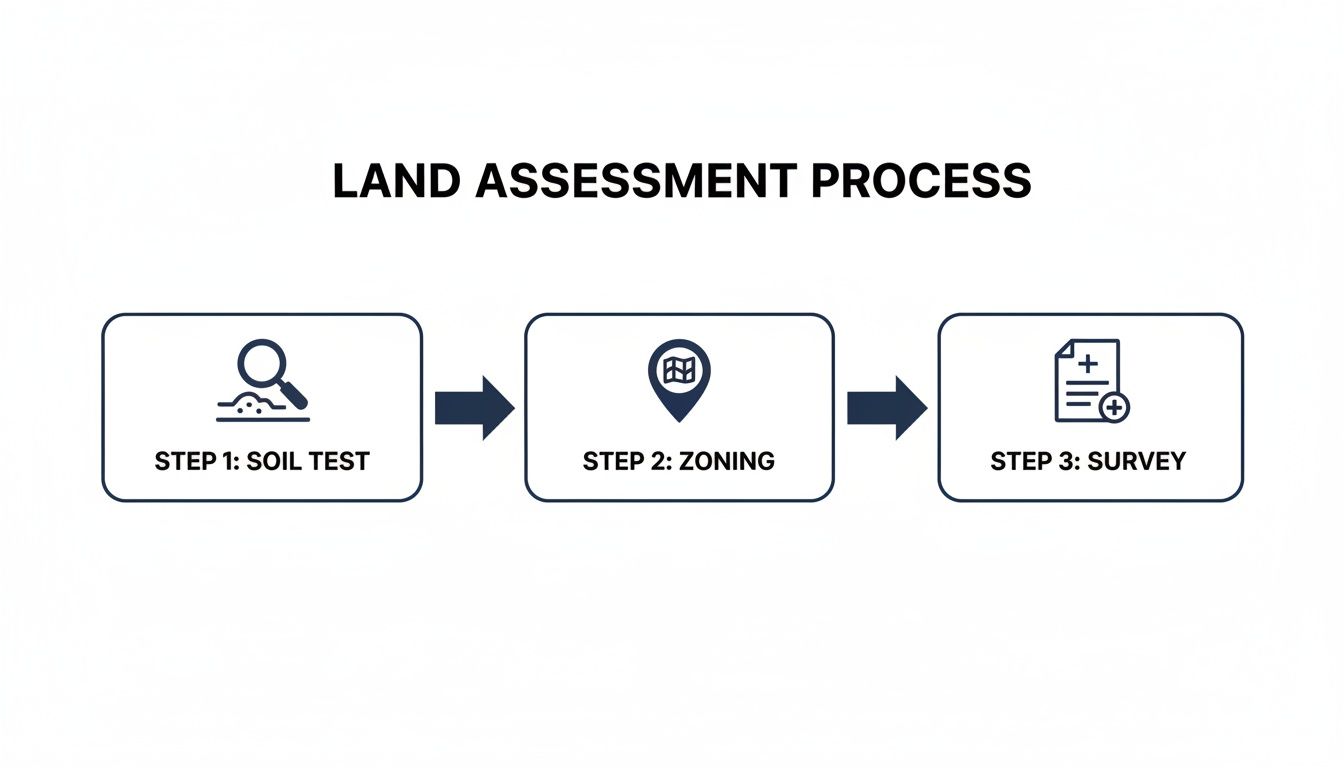
As the visual shows, each step informs the next. Getting them in the right order saves time, money, and headaches.
Untangling the Red Tape: Zoning and Deed Restrictions
Every county has its own rulebook. Before you fall in love with a set of house plans, you need to find out exactly what you’re allowed to build. This means digging into a few key areas:
Local Zoning Ordinances: These are rules set by places like Hood County or the City of Weatherford. They cover everything from minimum lot sizes and setbacks (how far your house must be from the property line) to the types of buildings permitted.
Deed Restrictions & Covenants: Sometimes, rules are written right into your property's deed. These private restrictions can be stricter than public zoning, limiting home size, exterior materials, or even whether you can run a home-based business.
Easements: An easement is a legal right for someone else to use a part of your land, like a utility company needing access to power lines or a neighbor needing to cross your property. You cannot build any permanent structures on an easement, period.
Floodplain Designations: It’s crucial to check official FEMA flood maps. If any portion of your land is in a designated floodplain, you'll face much stricter building requirements and higher insurance costs.
Getting a clear picture of these rules from the get-go will shape your entire project. For a deeper look at the paperwork involved, see our guide to the permits needed to build a house in North Texas.
Get It in Writing: The Land Survey
A professional land survey is non-negotiable. A surveyor will physically mark your property boundaries, identify any and all easements, and create a topographical map showing the slopes and elevation changes of your land. This isn't just a piece of paper—it's the blueprint for a smart site plan that ensures proper drainage and helps you position your home perfectly.
The desire to build on your land has never been stronger, especially with the U.S. housing market facing a massive supply shortage estimated between 2.5 and 5.5 million units. For those with property in North Texas, this highlights the long-term value of building a custom home. A proper land assessment turns "what-ifs" into a clear, actionable plan, allowing you to start your build with confidence.
Connecting Your Homesite to Essential Utilities
Once you have a handle on your property’s boundaries and soil conditions, it’s time to tackle the big three: power, water, and septic. When you build on your own land in a place like Bluff Dale or Stephenville, you effectively become the project manager for your own small utility company. This part of the budget is significant and frequently underestimated.
Getting these services to your site means juggling local providers, navigating the specific challenges of your land, and making decisions that will affect your wallet and daily life for years. Let's dig into what that actually looks like.
Getting Connected to the Power Grid
Unless you plan to live completely off-grid, electricity is a must. For most in this part of North Texas, that means working with a provider like United Cooperative Services. The first question to answer is simple: how far is my homesite from the nearest power pole?
That distance, along with the terrain, will drive your cost. Running power just a few hundred feet from the road to your build site can easily cost $10,000 or more. You’ll also face a choice between overhead and underground lines.
Overhead Lines: This is almost always the cheaper upfront option. The downside is vulnerability to storm damage and potential obstruction of scenic views.
Underground (Trenched) Lines: Trenching costs more per foot, especially if your land is rocky. The payoff is a clean, unobstructed view and better protection from weather. However, future repairs can be more complex.
We recently worked on a project on a heavily wooded lot near Weatherford where the owners chose to trench. The extra cost was a worthwhile trade-off to preserve the beautiful tree canopy.
Securing a Reliable Water Source
Being hooked up to city water is a luxury most rural landowners don't have, which almost certainly means drilling a private water well. This requires a reputable driller who knows the local geology and can tap into a sustainable source like the Trinity Aquifer.
The depth of the water table can vary wildly across our region. Around Glen Rose, you might hit good water at a few hundred feet. In other spots, drillers might have to go much deeper. A deeper well means higher costs for drilling, casing, and the more powerful pump required.
Expect the total cost for a complete well system—drilling, pump, pressure tank, and all—to land somewhere between $10,000 and over $25,000. It's also wise to budget for a water filtration system, as well water in Texas can be notoriously hard.
Designing a Septic System That Works
This is where your initial soil evaluation becomes critical. The type of soil on your land will determine what kind of On-Site Sewage Facility (OSSF), or septic system, the county will permit. Your main options are typically a conventional or an aerobic system.
A conventional system is simpler and cheaper, using a tank and a drain field. It works great in sandy, absorbent soils—which are uncommon in most of Parker and Hood counties.
An aerobic system is a more advanced setup that actively uses an aerator to treat waste more completely before dispersing it, usually through sprinklers. These systems are more expensive to install ($8,000 to $20,000+) and require electricity and regular maintenance, but they're often the only solution for the dense clay and rock found on trickier sites. We just managed a build on tough terrain near Bluff Dale where an engineered aerobic system was the only path forward to meet county health codes.
Planning for these three core utilities is foundational. Getting realistic numbers for them early on will help you build a budget that holds up and ensures your new home is comfortable from day one.
Choosing Your Home's Foundation and Structure
With your site prepped and utilities mapped out, we can get to the house itself. Every great home starts with a solid base, and here in North Texas, that means choosing your foundation wisely.
The expansive clay soil common from Weatherford to Glen Rose can shift, swell, and shrink with our dramatic weather, making the right foundation critical to your home's longevity. When you build on your land, this decision impacts everything from your budget to long-term maintenance.
Slab-On-Grade Foundations
The slab-on-grade foundation is the most popular choice in modern Texas construction. It’s a single, thick layer of concrete poured directly onto carefully prepared ground.
Cost and Speed: Slabs are generally faster and less expensive to install than other options, helping keep initial construction costs down.
Durability: They offer fantastic protection against termites since there’s no crawlspace for pests.
Accessibility: A slab foundation is perfect for a home with no steps at entry points—a huge plus for retirees or anyone planning for long-term accessibility.
The main drawback is access to plumbing and electrical lines. If a pipe under the slab ever leaks, the only fix is to jackhammer through the concrete floor—a messy, disruptive, and costly job.
Pier and Beam Foundations
A more traditional method is the pier and beam foundation, which elevates the home off the ground and creates a crawlspace underneath. The structure is supported by concrete piers sunk deep into the ground, connected by beams that carry the house's weight.
While often more expensive upfront, pier and beam foundations have serious advantages, especially on a sloped lot or in an area with significant soil movement. The crawlspace makes it incredibly easy (and cheaper) to access and repair plumbing or run new wiring. Many people also find these floors feel a bit softer underfoot compared to concrete.
For a property with a scenic slope overlooking the Brazos River near Granbury, a pier and beam foundation is often the most practical solution. It avoids thousands in dirt work and allows the home to sit more naturally on the land.
Choosing between them is a balancing act. If your lot is flat and your budget is tight, a well-engineered slab is a fantastic choice. If you’re on a slope or you prioritize easy future repairs, the extra investment for a pier and beam may be worthwhile.
Traditional Stick-Built vs. Barndominium
Once the foundation is sorted, what kind of structure will go on top? This choice defines your home's entire look, feel, and floor plan.
A stick-built home is the classic American house, built with a wooden frame (studs, joists, and rafters). This method offers almost limitless design flexibility. If you can dream it—complex rooflines, custom room shapes, intricate details—you can probably build it with wood framing.
Then there's the barndominium, which has exploded in popularity across North Texas. Built with a rugged steel frame, "barndos" are known for durability and their ability to create massive, wide-open living spaces without needing interior load-bearing walls. This is a game-changer for families who want a huge, combined kitchen, living, and dining area.
While stick-built homes offer deep customization, a barndominium's metal shell can be erected incredibly fast, saving time on your overall construction schedule. The main trade-off is that some find the exterior aesthetic limiting, though this is easily addressed with creative use of stone, wood siding, and oversized porches.
It's clear people want unique homes. Custom builds now represent about 19% of all new single-family construction, a peak not seen since 2022. This trend shows a desire for personalized spaces that cookie-cutter subdivisions can't deliver. You can dig into more data on these market trends from the National Association of Home Builders.
Foundation & Framing Options for North Texas Homes
Feature | Slab Foundation | Pier & Beam Foundation | Stick-Built Framing | Barndominium (Metal Frame) |
|---|---|---|---|---|
Initial Cost | Lower | Higher | Moderate to High | Moderate (can be lower) |
Best For | Flat lots, budget-conscious builds | Sloped lots, expansive soils | Unlimited design flexibility | Open-concept floor plans |
Construction Speed | Fast | Slower | Standard | Very Fast (framing) |
Utility Access | Difficult, requires breaking concrete | Easy, via crawlspace | Standard, within walls | Standard, within walls |
Durability | Excellent against pests | Good, requires crawlspace maintenance | Excellent | Superior against pests/fire |
Design Flexibility | Not applicable (foundation) | Not applicable (foundation) | Extremely High | High (interior), Lower (exterior shell) |
Long-Term Repairs | Very Expensive (plumbing) | Less Expensive | Standard | Standard |
Planning for More Than One Structure
One of the greatest perks of owning acreage is having room to grow. Many of our clients don't just plan for a main house; they dream of a detached garage with a workshop, a small guest casita for aging parents, or a large barn for equipment.
If this sounds like you, it is essential to plan for it from the very beginning. Your site plan must account for the placement of these future buildings, ensuring proper access and separation. Even more importantly, think about your utilities. It’s far cheaper to lay extra conduit for power and water to a future shop during the initial trenching than it is to dig everything up again in five years.
Thinking through these structural choices now will ensure the home you build truly fits your family for decades to come.
Creating a Realistic New Build Budget
So, what does it really cost to build on your land in North Texas? The most honest answer is, "It depends." A simple price-per-square-foot estimate is often misleading because it rarely accounts for the significant, unpredictable expenses you'll face before the foundation is even poured.
A truly accurate budget separates "hard costs"—tangible materials and labor like lumber and concrete—from "soft costs." These soft costs are essential services and fees needed to get the project off the ground, like architectural plans, engineering reports, and county permits. This is where many budgets go off the rails.
The Hidden Costs Beyond the House Itself
Here are the critical site work items you must account for:
Septic System Installation: As we've covered, your soil dictates the system. A conventional septic might run $8,000-$12,000, but the aerobic systems common in our area's clay soil often range from $15,000 to $20,000+.
Water Well Drilling: Depth is the biggest variable. A complete well, including the pump and pressure tank, typically costs between $10,000 and $25,000, but can climb higher if the driller has to push through significant rock.
Running Utilities: Bringing electricity from the nearest pole to your homesite can be a major expense, especially on larger tracts. Don't forget to budget for trenching if you want those lines buried.
Driveway and Culvert: If your homesite is set back several hundred feet from the road, the cost for materials, grading, and culvert installation can easily top $10,000.
One of the best ways to get a handle on these numbers is to talk to a builder early. We’ve managed projects all over the Granbury area and can often give you a solid ballpark for site costs just by looking at the location and topography of your land.
Estimated Cost Factors for Building on Raw Land in North Texas
Expense Item | Typical Cost Range | Key Influencing Factors |
|---|---|---|
Septic System | $8,000 - $20,000+ | Soil type (conventional vs. aerobic system), property size, and county regulations. |
Water Well | $10,000 - $25,000+ | Depth to a reliable water source, rock formations, pump and tank size. |
Electrical Service | $5,000 - $15,000+ | Distance from the nearest utility pole, trenching for underground lines vs. overhead. |
Driveway/Culvert | $5,000 - $20,000+ | Length and material of the driveway (gravel, concrete), grading needs, culvert size. |
Land Clearing/Grading | $3,000 - $10,000+ | Density of trees and brush, topography of the land, amount of dirt work needed. |
Permits & Fees | $2,000 - $7,000 | Varies by county/city; includes building, septic, electrical, and other permits. |
Keep in mind these are estimates. Your final costs will depend on the unique conditions of your property.
What Drives Your Home's Final Price
Once you’ve nailed down site development costs, the price of the home itself boils down to two key things: complexity and finishes. A simple, rectangular home design will always be more cost-effective than a complex one with numerous corners, gables, and intricate rooflines.
Inside, your finish-out choices have a massive impact. The difference between standard builder-grade fixtures and high-end selections can swing your final cost by tens of thousands of dollars. Think about flooring, countertops, cabinets, appliances, and lighting—this is where your personal taste directly shapes the budget.
For a deeper dive into these variables, check out our guide on how to estimate house building costs in North Texas.
Understanding Construction Loans
Unless you're paying with cash, you will likely need a construction loan. These are different from a standard mortgage. They are short-term loans that cover the cost of construction and are paid out to your builder in stages, or "draws," as specific milestones are completed. Lenders will want to see detailed plans, a signed contract with your builder, and a comprehensive budget. After construction is finished, the loan is usually converted into a permanent, long-term mortgage. Working with a local lender who understands construction projects in the Weatherford or Stephenville area can make this process infinitely smoother.
Building a solid, all-inclusive budget is the bedrock of a successful project. It’s about planning intelligently to avoid financial stress and ensure you can build the home you’ve envisioned.
Finding The Right Builder For Your Project
Choosing who you partner with to build on your land is the single most important decision you'll make. This isn't just a contractor; this is the team you're trusting to bring your vision to life, manage a significant investment, and handle the inevitable construction challenges.
Finding a great custom home builder in the Granbury or Stephenville area isn't about chasing the lowest bid. It’s about finding a partner with the right expertise, a solid reputation for integrity, and a communication style that works for you. You're entering a partnership that will likely last a year or more, so you need a builder who not only has a portfolio full of on-your-lot projects but who you feel comfortable talking to.
Questions to Ask Every Potential Builder
Before signing a contract, it's time to do some serious interviewing. Go beyond the basics like licensing and insurance—those should be a given. You need to dig deeper to understand their process and experience with local challenges.
Here are a few essential questions to get the conversation started:
How many on-your-lot projects have you completed in this area? A builder who knows Hood or Parker County inside and out understands the tricky soil, who to talk to at the permitting offices, and which subcontractors are reliable.
What does your communication process look like? Do they use a project management app, send weekly emails, or prefer scheduled phone calls? A clear plan for communication is the best way to prevent misunderstandings.
How do you handle changes or unexpected issues? Ask for a real-world example of a problem they encountered on a past project and how they resolved it. Their answer will reveal their transparency and problem-solving skills.
Properly vetting your builder is a step you can't afford to rush. For a deeper dive, check out our detailed guide on how to choose a home builder in North Texas.
Understanding Your Contract
In the world of custom home building, you'll generally see two main contract types: fixed-price and cost-plus.
A fixed-price contract locks in the total cost of your home from the start. This provides budget predictability but can be rigid if you want to make major changes later.
A cost-plus contract means you pay the actual cost of materials and labor, plus a pre-agreed-upon percentage or fee for the builder's profit and overhead. This model offers more transparency and flexibility, but the final price can fluctuate.
The right contract depends on your project's complexity. For a highly-customized home where design decisions will evolve, a cost-plus agreement can be a great fit. If you have every detail finalized beforehand, a fixed-price contract offers peace of mind.
Seeing is Believing
Finally, don't just rely on glossy photos. Ask to speak with recent clients. Better yet, ask if you can visit one of their completed homes. Seeing the quality of their craftsmanship up close is the ultimate litmus test. It’s your chance to inspect the details—the trim work, the paint lines, the overall fit and finish—that separate a good builder from a great one. The demand for builders who deliver this level of quality is high; the National Association of Home Builders forecasts the residential remodeling market will see a strong 5% gain in 2025. You can read more about these positive industry trends and forecasts for the coming years.
Frequently Asked Questions About Building On Texas Land
Building your own home is a huge step, and naturally, you have questions. We hear many of the same ones from landowners across North Texas, so let's get you some straight answers.
How Long Does It Take to Build a Custom Home on My Land in Texas?
Once the foundation is poured, you can generally expect a custom home build in places like Granbury or Weatherford to take anywhere from 9 to 14 months. However, the pre-construction phase—finalizing designs, getting permits, and preparing the site—can easily add another 3 to 6 months. Factors like Texas weather, a complex design, or supply chain hiccups can also extend the timeline. A good builder will lay all this out for you upfront.
Can I Be My Own General Contractor to Save Money?
This is a tempting thought, but we almost never recommend it unless you have a serious background in construction management. Being your own General Contractor is a full-time job. You're responsible for hiring and managing every subcontractor, scheduling inspections, ordering materials, and solving problems daily.
One scheduling mistake or a wrong material order can create a domino effect of delays and cost overruns, quickly erasing any potential savings. The network of trusted, reliable trades that a professional builder brings to the table, especially in an area like Glen Rose, is invaluable.
What Is the Biggest Unexpected Cost When Building on Rural Land?
Site work and utilities, hands down. This is where budgets most often get blown. Landowners are frequently surprised by the real-world cost of drilling a deep water well through local rock, running power hundreds of yards from the road, or installing a specific septic system required by uncooperative soil. The best way to protect your budget is to get a thorough feasibility study done before you finalize your house plans. Getting a handle on these big-ticket items early is the secret to creating a budget you can actually stick with when you decide to build on your land.
At Gemini Homes, we believe building your dream home should be an exciting journey, not a stressful one. If you’re ready to talk about the vision you have for your North Texas property, we'd love to hear it. Contact us for a free, no-obligation consultation today.
Comments