
A Homeowner's Guide to Building On Your Lot in North Texas
- scott shipp
- Jan 4
- 18 min read
So, you’ve found the perfect piece of land in Granbury, Weatherford, or maybe a quiet spot just outside of Glen Rose. That’s the dream, right? But turning that raw dirt into a real homesite is a whole other journey. Building on your own lot isn't just about putting up walls and a roof; it’s about everything that comes before it—assessing the land, planning for utilities, designing the right foundation, and navigating local regulations.
Your Guide to Building a Custom Home in North Texas
Building your dream home on a piece of North Texas land is one of the most exciting things you can do. It's a world away from buying a house in a cookie-cutter subdivision. Here, you're in the driver's seat, making every decision about the layout, the materials, and the final feel of your home. Whether it's a few acres near Stephenville or a beautiful plot overlooking the hills of Glen Rose, you’ve got a blank canvas.
Of course, starting from scratch comes with its own set of questions and hurdles, especially in our corner of Texas. Our unique terrain and notoriously tricky soil conditions demand a smart, local approach.
What This Guide Will Cover
Think of this as your practical, no-nonsense roadmap for building on your lot in North Texas. We’re going to skip the fluff and get right into the details that actually matter. The goal here is to trade uncertainty for confidence by giving you clear, actionable steps.
Here’s what you’ll learn:
How to really understand what your land can handle before a single shovel hits the ground.
The essential prep work for rural properties, from clearing the land to figuring out wells and septic systems.
How to find a great local builder who knows the area and can handle the specific county requirements.
A realistic look at the entire process, including timelines, budgeting, and the major milestones you can expect.
Building on your own land gives you a level of freedom you just can't get anywhere else. You get to decide exactly where the house sits to catch that perfect sunset view. You design a floor plan that actually works for your family's life. You pick every single finish. This is how you create a home that is 100% yours.
For a family that needs room to grow or retirees ready to build their forever home, this is a significant investment. Understanding the road ahead is the best way to protect that investment and ensure the home you end up with is the one you’ve been dreaming about. This guide is here to give you that solid foundation.
Ready to get started? Let's begin with the most important first step: learning about your land.
What to Know Before You Break Ground
So, you've found that perfect piece of land in Granbury or Weatherford. It feels like a blank canvas, full of possibility. But before the first scoop of dirt ever moves, the most important work has already begun.
This is the due diligence phase—the unglamorous but absolutely critical groundwork that uncovers the realities of your property. Getting this right prevents those nightmare-inducing surprises and transforms a simple plot of land into a true, buildable homesite.
The journey is really a three-part process: understanding the land, creating the plan, and finally, starting the build.
Everything flows from that first step: the land. Let's dig into what you need to investigate before you even think about pouring a foundation.
Uncovering the Rules of Your Land
Every single property, no matter how remote it feels, comes with a set of rules you didn't create but absolutely have to follow. Your first task is to investigate local zoning laws and any existing deed restrictions tied to the property. These regulations are the rulebook for what you can build, where on the lot you can build it, and sometimes even the materials you're allowed to use.
For example, a property just outside the Glen Rose city limits might be zoned for agricultural use, which dictates minimum lot sizes and what kind of outbuildings (like a workshop or barn) are allowed. Deed restrictions, often put in place by a developer years ago, can get even more granular, governing everything from minimum home size to exterior paint colors.
Ignoring these can bring your project to a screeching halt. Start your research at your local county clerk’s office in Hood or Parker County. For a truly deep dive into the property's history and any lingering covenants, it's also worth understanding the role of a title company. Check out our guide to North Texas title and escrow services to see how they can help you uncover the full story of your land.
The Importance of a Professional Land Survey
A professional survey isn't optional—it's essential. This isn't just about putting a few flags in the ground. A full boundary and topographic survey is a detailed map defining your legal property lines, identifying any easements (like a utility company's right-of-way), and documenting the land's unique topography—all the slopes and elevation changes.
This map is mission-critical for a few key reasons:
Proper Home Placement: It guarantees your foundation sits entirely on your property and honors all legal setbacks from roads, property lines, and creeks.
Driveway & Access Planning: It shows the best, most cost-effective path for a driveway, which is especially important on sloped or heavily wooded lots around Stephenville.
Smart Drainage Strategy: Understanding how water naturally flows across the land is the key to grading the site correctly and preventing future foundation problems.
Here in North Texas, expect a boundary and topo survey to cost anywhere from $1,500 to $4,000+, depending on the acreage and complexity of your lot. It's an investment that pays for itself by preventing costly mistakes and boundary disputes.
To help you keep track of these initial steps, we've put together a quick checklist. This covers the essential due diligence items you'll need to tackle before construction can begin.
Your Land Due Diligence Checklist
Checklist Item | What It Is & Why It's Critical | Typical Cost Range | Who to Contact |
|---|---|---|---|
Zoning & Deed Research | Verifying local laws and private restrictions that dictate what, where, and how you can build. | Minimal (Clerk Fees) | County Clerk's Office, Title Company |
Land Survey | A professional map of boundaries, easements, and topography. Essential for site planning. | $1,500 - $4,000+ | Licensed Professional Land Surveyor (RPLS) |
Geotechnical Soil Report | Lab analysis of soil samples to determine stability and expansion potential. Dictates foundation design. | $2,500 - $5,000 | Geotechnical Engineering Firm |
Utility Verification | Confirming access and cost to connect power, water, and sewer/septic. Prevents massive budget surprises. | Varies Widely | Electric Co-op, City/MUD, Well Driller, Septic Installer |
Tackling these items systematically gives you and your builder a clear, realistic picture of your project's scope and costs from the very beginning.
Understanding North Texas Soil Conditions
If there's one famous "gotcha" for building in our area, it's the soil. From Cleburne to Cresson, much of North Texas is built on expansive clay soil. Think of it like a giant sponge—it swells up dramatically when wet and shrinks just as much when it dries out.
This constant movement can put incredible stress on a home's foundation, leading to major cracks and structural failure if it's not engineered correctly from the start.
This is precisely why a geotechnical soil report is one of the most important pre-construction investments you can make. A soils engineer will take core samples from your exact building site and analyze them to determine the soil’s "potential vertical rise" (PVR)—a measurement of how much it's likely to move.
The findings in this report, which typically costs $2,500 to $5,000, will directly tell your engineer how to design the foundation. They might recommend a slab-on-grade foundation heavily reinforced with piers drilled down to more stable earth, or other specific designs to counteract that clay movement. Skipping this step is a high-stakes gamble you simply don't want to take.
Planning for Essential Utilities
You can't have a home without power, water, and a way to handle waste. Out on a rural lot, you can never take these for granted.
Start by calling the local electric cooperative, like United Cooperative Services or Tri-County Electric, to get a quote for bringing power to your homesite. If the nearest pole is a quarter-mile away, the cost to run lines and set poles could easily be $10,000 to $25,000 or more.
For water and sewer, your path depends entirely on your location:
City Services: If you're in a city or a municipal utility district (MUD), you'll pay tap fees to connect to public water and sewer.
Well and Septic: For most rural properties in places like Tolar or Godley, you'll be installing your own systems. Drilling a water well can cost $8,000 to $20,000+, depending on how deep they have to go. A modern septic system, which has to be engineered for your soil and family size, typically runs from $15,000 to $30,000.
By methodically working through this pre-build checklist—zoning, survey, soils, and utilities—you lay a solid foundation for a much smoother, more predictable custom home build. This upfront homework is your best defense against the budget overruns and delays that can derail a project before it even starts.
Choosing the Right Custom Home Builder
Once you’ve confirmed your land is buildable, you’ve reached the most critical decision of your entire project: choosing the right builder. This isn't just about hiring someone to swing a hammer; it's about finding a partner who will guide you, protect your investment, and turn your vision into a reality.
Here in North Texas, you need to know the difference between a production builder and a true custom builder. Production builders are the ones you see in large subdivisions, offering a set menu of floor plans with limited customization. A genuine custom builder starts with a blank slate—your ideas and your specific piece of land—to design and build a home that is uniquely yours.
Vetting Your Potential Building Partner
The best way to get a feel for a builder’s quality is to see it for yourself and talk to the people who live in their homes. Don't just scroll through a glossy photo gallery on their website.
Ask for a list of addresses for recently completed homes, especially in areas like Cresson, Godley, or the rural outskirts of Weatherford that might be similar to your own property. Drive by and see if their craftsmanship and style match what you’re looking for.
Even better, ask for a list of past clients you can call. A builder who is proud of their work and has a history of happy customers will gladly provide references.
When you connect with these homeowners, get specific with your questions:
How did the builder handle surprises or changes you wanted to make?
Did they stick to the budget and the timeline they promised?
How was communication during the process? Were you kept in the loop?
Knowing what you know now, would you hire them again?
This kind of real-world feedback is worth its weight in gold.
Key Questions to Ask Every Builder
Think of your first meetings with potential builders as job interviews—where you’re the one doing the hiring. You need to dig into their experience, their process, and their communication style to make sure it's a good fit.
Show up with a list of questions that get to the heart of building on a private lot in North Texas.
Experience: "How many homes have you built on rural properties with a well and septic system in the last five years?" This tells you if they understand the unique challenges of country living.
Process: "What’s your system for managing the budget and timeline? How often can I expect updates from you?" You’re looking for someone with a clear, organized process and a commitment to communication.
Challenges: "Tell me about a time a project went off the rails—a major supply delay or an unexpected site problem. How did you handle it?" Their answer will reveal their problem-solving skills and how they act under pressure.
For a deeper dive, our guide on how to choose a home builder in North Texas has even more questions you should be asking.
Understanding Contract Types
Finally, you have to get clear on the money. The two most common contracts in custom home building are fixed-price and cost-plus. Each has its own pros and cons.
Fixed-price contracts lock in the total cost before breaking ground, giving you budget certainty. However, they can be rigid if you want to make changes along the way. A cost-plus contract means you pay for the actual cost of materials and labor, plus the builder’s fee. This offers great transparency and flexibility, but the final price isn't set in stone from day one.
A good builder will walk you through both options, explaining which one might be a better fit for your personality and financial comfort level. Taking the time to find this kind of transparent, experienced partner is the single best investment you’ll make in your new home.
From Foundation to Finishes: What to Expect When You Build
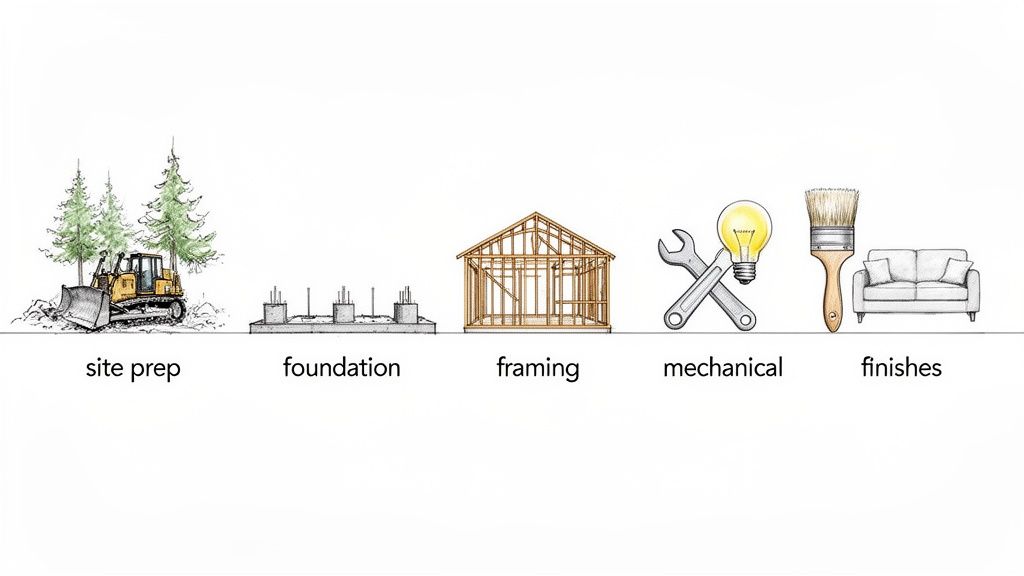
Alright, you’ve done the hard work of planning, and you’ve shaken hands with a builder you trust. Now for the exciting part—watching your dream home rise from the ground. This is where the vision starts to become a reality, and you’ll see progress almost every day.
It might look like a chaotic whirlwind of activity, but building a home is a carefully choreographed dance. Each step has to happen in the right order for the next one to succeed.
Knowing the sequence helps you understand what’s happening on your property and why. For homeowners in North Texas, the decision to build on your lot is a big one. Even when the market gets a little shaky, that desire for a home built just for you stays strong. In the first quarter of 2025, for instance, the US saw 34,000 new custom home starts, a number that’s held surprisingly steady. You can dig into the latest custom home data to get a feel for the market yourself.
Let's walk through the major stages, from the dirt work that sets the stage to the final doorknob that welcomes you home.
Site Preparation: The First Transformation
Before a single bag of concrete shows up, your land needs to be prepped for construction. This is more than just leveling a patch of dirt. Especially on those beautiful, sprawling rural lots we have around Granbury and Weatherford, site prep is a critical first step.
Your builder’s crew will first carve out a temporary driveway so heavy equipment can get in and out without getting stuck. Then comes the “clearing and grubbing”—taking out trees, brush, and stumps where the house will sit. Finally, they'll grade the land to match the architectural plans, making sure water will drain away from your future foundation, not toward it.
If you have a heavily wooded lot out near Glen Rose, this can be a significant job. Expect tree removal and earthmoving costs to run anywhere from $5,000 to $15,000, sometimes more, depending on just how wild your slice of Texas is.
Pouring the Foundation: The Bedrock of Your Home
With a clean slate to work on, the focus turns to the foundation. Here in North Texas, this is probably the single most important engineering phase of the entire build. Why? Our infamous expansive clay soils. That geotechnical report you got earlier is now the most important document on the job site.
Here’s what you’ll see happen:
Forming: Crews will build a wooden mold that outlines the exact shape of your home's slab.
Plumbing Rough-in: Plumbers arrive to lay the network of drain pipes and water lines that will live inside the concrete.
Reinforcement: A web of steel rebar and post-tension cables is carefully laid out. This is what gives the concrete its incredible strength.
Inspection: Before the concrete trucks roll in, an inspector from the city or county has to sign off on all the plumbing and steel work.
For most homes in our area, a slab-on-grade foundation with piers is the go-to solution. Those piers are drilled deep into the earth, past the shifting clay, until they hit stable ground. This anchors your home and prevents the soil from cracking your foundation down the road.
From Skeleton to Shell: Framing and Dry-In
This is when it really starts to look like a house. In what feels like an impossibly short amount of time, a framing crew will erect the entire wooden skeleton—walls, floors, and roof trusses. It's a dramatic few weeks, going from a flat slab to a full structure.
Once the frame is up, the house gets "dried in." This means putting on the roof decking and covering the exterior walls with sheathing and a weather-resistant house wrap. The goal is to create a shell that keeps the rain out so the interior work can start. Windows and exterior doors go in around this time, too, officially closing up the house.
This is a huge milestone. Once the house is dried in, your builder can get electricians, plumbers, and HVAC crews working inside at the same time, no matter if it’s a blazing August afternoon or a classic North Texas spring thunderstorm.
The Mechanical Rough-In and Insulation
With a roof over its head, the house is ready for its guts. This is the "mechanical rough-in," where all the hidden systems that make a home livable are installed.
Plumbers will run supply and drain lines through the walls, electricians will pull miles of wire for outlets and lights, and the HVAC crew will install the ductwork that will keep you cool in the summer. Each of these trades requires a separate inspection in places like Cleburne or Joshua to ensure everything is up to code before it gets hidden behind drywall.
After the inspections pass, it’s time for insulation. This is what will keep your home comfortable and your energy bills from going through the roof during our long, hot summers.
Finishes: From Drywall to Door Knobs
This final stretch is all about the details that turn a building into your home. It kicks off with hanging and finishing drywall, which gives you the smooth walls and ceilings you’ll soon be painting.
From there, it’s a flurry of finishing touches:
Interior Trim and Doors: Installing baseboards, window casings, and all the interior doors.
Cabinetry and Countertops: Your kitchen and bathrooms start to take shape.
Painting: The colors you agonized over for weeks finally go up on the walls.
Flooring: Tile, hardwood, or carpet is laid throughout the house.
Final Systems: The electricians and plumbers come back to install light fixtures, faucets, toilets, and appliances.
This is often the longest phase of the build, but it's also the most rewarding as you see your design choices come to life. After a final punch list with your builder and one last inspection, you get the keys. It’s finally move-in day.
Budgeting and Timelines for Your North Texas Home
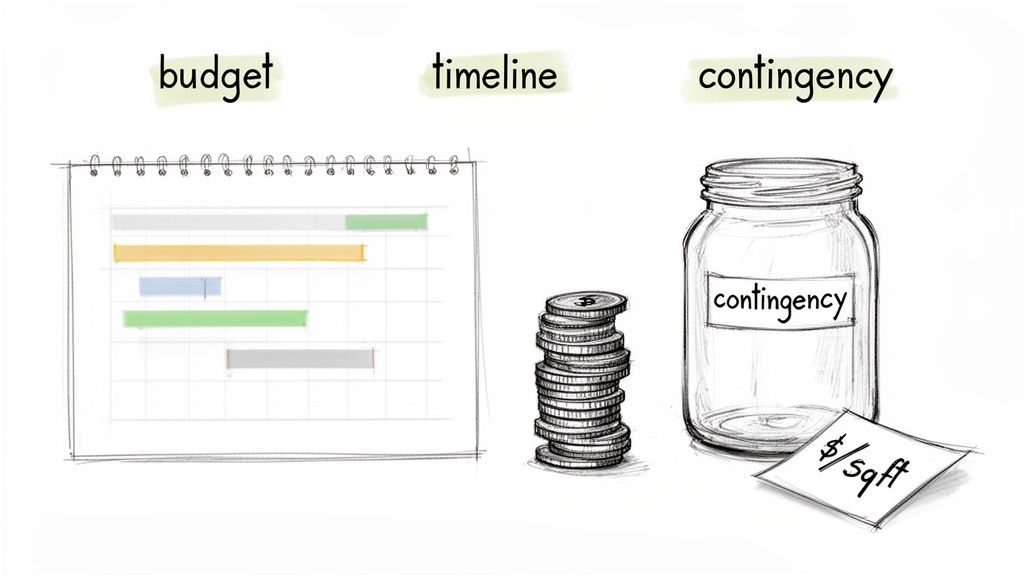
Alright, let's get down to the two questions everyone really wants to ask: “How much is this going to cost?” and “How long will it take?” These are the make-or-break questions, and getting straight answers upfront is the key to a build you can actually enjoy.
Here in North Texas, the cost to build on your lot is about much more than the square footage. The land itself is a massive variable. A heavily wooded lot near Glen Rose that needs extensive tree clearing or a beautiful, secluded piece of land in Weatherford that requires a half-mile driveway will add serious costs before we even think about a foundation.
The complexity of your dream home is another huge piece of the puzzle. A simple, classic rectangular design is always going to be more budget-friendly than a home with a dozen different rooflines, intricate angles, and custom archways.
Deconstructing the Cost Per Square Foot
You’ve probably heard builders throw around a "price per square foot." It’s a decent starting point, but it's far from the whole story. The true cost of a home is a blend of what it takes to prep the land, build the structure, and finish it with your personal touches.
It helps to break it down into three buckets:
Site and Foundation Costs: This is everything we've talked about—grading the land, running utilities, pouring a driveway, installing septic and a well, and engineering the right foundation for our unique Texas soil. This slice of the pie can easily range from $50,000 to over $100,000, depending entirely on your specific property.
The "Shell" of the Home: This covers the actual structure. Think lumber, framing crews, roofing, windows, and the exterior materials like the brick or stone that give the home its character.
Interior and Exterior Finishes: This is where you have the most control, but also where the budget can get away from you. Custom cabinetry, high-end granite countertops, luxury vinyl plank floors, and designer light fixtures all carry a different price tag than standard, builder-grade options.
With all these moving parts, a custom home around here can land anywhere from $200 to $350+ per square foot. To really get a handle on what goes into these numbers, I highly recommend reading our guide on how to estimate house building costs in North Texas.
Planning for the Unexpected
No matter how perfectly you plan, home building is a real-world process. Surprises happen. A sudden jump in lumber prices or hitting a layer of rock during excavation can really mess with the numbers. This is precisely why a contingency fund isn't just a good idea—it’s essential.
We always advise our clients to set aside 10% to 15% of the total construction cost. This isn’t a slush fund for upgrading your tile later. It's a true safety net for things nobody could have seen coming. If you don't use it, fantastic! But having it there brings incredible peace of mind.
It’s also crucial to understand how change orders work. If you decide halfway through to upgrade your countertops or add that covered patio you were on the fence about, your builder will issue a change order. This is a formal document that lays out the new cost and how it might affect the schedule. Nothing moves forward until you've signed off on it.
Mapping Out a Realistic Project Timeline
From the day we break ground to the day I hand you the keys, a typical custom home in the Granbury area takes about 10 to 16 months. And that's not even counting the pre-construction work—the design, engineering, and permitting phase—which can add another three to six months to the front end.
Here’s a rough sketch of how that time breaks down:
Site Prep & Foundation: 1-2 months
Framing & Dry-In: 1-2 months
Exterior & Mechanicals: 2-3 months
Insulation & Drywall: 1 month
Interior Finishes: 3-5 months
Final Details & Punch List: 1 month
Of course, this can shift. Our wild North Texas weather, especially spring storms, can delay foundation work for weeks. Sometimes, getting a specialty item can be held up by supply chain issues.
A good builder turns the overwhelming questions of cost and time into a clear, manageable plan. They’ll give you a detailed schedule and keep you in the loop every step of the way, so you always know what’s happening next.
So, What's the First Real Step?
Building a home on your own land here in North Texas is a huge deal—there's no getting around that. But with the right homework and the right people in your corner, it's one of the most fulfilling things you'll ever do. We've walked through all the critical pieces, from digging into the details of your property to finding a builder you can trust and staying plugged in as the walls go up.
The truth is, the real journey to your dream home starts way before a single shovel hits the dirt. It begins with careful planning. That's what transforms a simple plot of land in Granbury or Weatherford into a place your family will love for generations.
If you're standing on your property and trying to imagine what comes next, let's talk. A simple conversation is all it takes to start understanding your land's true potential. We can help you take that first confident step toward bringing your vision to life.
Your Questions Answered: What to Expect When Building on Your Lot
If you're thinking about building a custom home in North Texas, you probably have a lot of questions. That’s a good thing. After years of doing this, we've heard just about all of them, and here are the answers to the ones that come up most often.
What's a Realistic Timeline for a Custom Home Build Around Granbury?
This is usually the first question people ask, and for good reason! While no two projects are ever identical, you can generally expect the construction phase of a custom home in the Granbury or Weatherford area to take about 10-16 months. That clock starts the day we break ground.
Of course, several things can shift that timeline. A highly complex design, unexpected spring storms, or delays in getting specialty materials can add time. The permitting process also varies from county to county, which can be a wildcard.
Don't forget the work that happens before we dig. The pre-construction phase—where we nail down the design, get engineering stamps, and secure all the necessary permits—typically adds another 3-6 months to the front end. A builder worth their salt will hand you a detailed schedule from the get-go and keep you in the loop about anything that might cause a delay.
What Are the Biggest Hidden Costs of Building on Rural Texas Land?
When you’re building out in the country, the house itself is only part of the equation. The biggest budget surprises almost always come from getting the land ready and hooking up utilities. These costs can really sneak up on you if they aren't planned for meticulously.
Watch out for these common budget-busters:
Access: If your dream spot is tucked away from the road, you'll need a long driveway. The cost of materials and labor can add up fast.
Site Work: A heavily wooded or sloped lot might need significant tree clearing and earth-moving to create a stable building pad.
Water: Drilling a well is a major expense. The final cost depends entirely on how deep we have to go to find a reliable water source, which can be unpredictable.
Wastewater: You'll need a septic system, and it has to be specifically engineered based on your soil's percolation rate.
Power: Getting electricity from the main line to your homesite can sometimes cost tens of thousands of dollars, depending on the distance.
The key is to get firm quotes for all these site-specific items before you finalize your home budget.
The most successful projects are the ones where we identify and price out all the "land" costs before we ever finalize the "house" budget. Getting this order right is key to staying on track financially.
Can I Bring My Own Architect or Floor Plan to the Table?
Absolutely. In fact, many of our clients do. A true custom home builder's job is to be a flexible partner, not to force you into a pre-set box.
Whether you've already hired an architect or found a floor plan online that you love, we can work with it. Our role becomes ensuring that design is practical for your specific piece of land, that it complies with all local building codes, and, most importantly, that it can be built within your budget. We'll collaborate with you and your architect to make it a reality.
We also offer a full design-build service, where we can start with you from a blank slate. We’ll help you craft a plan from scratch that’s perfectly tailored to your family and the unique character of your property.
Ready to move from questions to answers for your own property? The team at Gemini Homes is here to help you understand your land's potential and take the first confident step. Let's start the conversation.
Comments