
A Granbury Guide to Build on Your Own Land in North Texas
So, you have the land. The dream of building a custom home in North Texas, exactly the way you want it, is starting to feel real. But before you get lost in floor plans and paint colors, let's talk about what it really takes to turn that piece of dirt into your dream home.
Successfully building on your own land, especially here in Granbury, Weatherford, and the surrounding areas, is all about the groundwork you lay before a single nail is hammered. This initial planning phase is, without a doubt, the most critical part of the entire project.
What Building on Your Own Land Really Involves
Building a custom home from the ground up on your North Texas property is an incredible journey. It's also a process filled with practical, boots-on-the-ground realities you have to tackle head-on. This guide is your realistic roadmap, designed to get you from that initial dream to the day you turn the key in the door.
Think of this as your high-level strategy session. We're going to walk through the entire process, focusing on the non-negotiable groundwork that ensures your project starts on a solid foundation—both literally and figuratively.
More Than Just a Blueprint
It’s easy to fall in love with a house design, but the truth is, your land dictates what’s possible. For landowners in places like Aledo or Glen Rose, this first phase is all about due diligence.
Before you even think about framing walls, your focus will be on things like:
A deep-dive site evaluation: We're talking about analyzing the property's slope, access points, and any hidden restrictions that could completely change your home's placement.
Getting your utilities in order: Planning for and connecting a water well, septic system, and power are major budget items, especially on rural lots.
Finding the right financing: A construction loan isn't like a standard mortgage. You'll need to understand how they work and find a lender who specializes in building on your own land.
Putting your team together: You need a local builder, a surveyor, and other pros who know the ins and outs of building in North Texas.
A common mistake is underestimating site prep costs. In our area, hitting rock when digging a foundation or trenching a long driveway for a family's new home can add thousands to the budget unexpectedly. You have to account for these potential costs from day one.
Our goal is to give you total clarity. Understanding the local challenges—from navigating the Hood County permit office to engineering a foundation for our infamous expansive clay soil—is what gives you the confidence to move forward. A successful custom home build is always the result of meticulous planning.
Let’s dig into the first practical step: evaluating your land to save yourself time, money, and a world of headaches down the road.
Getting to Know Your Land Before You Build
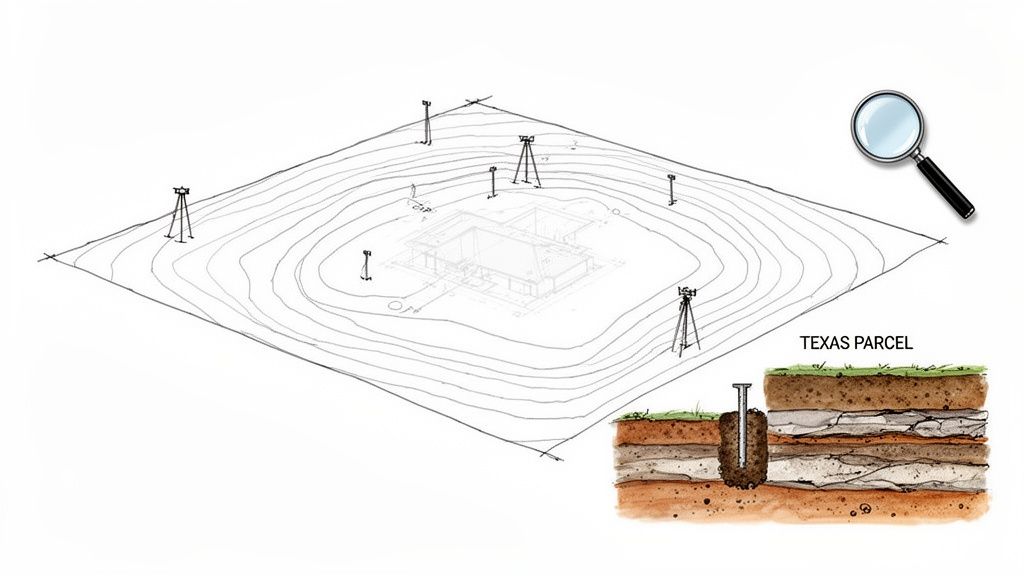
Before a single shovel hits the dirt, you have to get brutally honest about your property. This isn't just about checking boxes; it's about protecting your investment and making sure the dream home in your head can become a reality on the land you own.
The biggest mistake landowners make is falling in love with a house plan before they've truly understood their property. It’s the land—its slope, its soil, its hidden rules—that ultimately calls the shots on your home's design, foundation, and, most importantly, the final budget.
Reading the Lay of the Land
The natural topography of your lot has a huge say in your project. A flat, level lot out in Weatherford is pretty straightforward, but many of the most beautiful properties around here, especially in the rolling hills near Glen Rose and Granbury, come with a serious slope.
A sloped lot is by no means a deal-breaker. In fact, it can be a great opportunity for a walk-out basement, which is perfect for families needing extra space. But it also might demand a more complex and expensive foundation. We once worked on a property near Lake Granbury with such a steep grade that we had to build extensive retaining walls just to create a stable pad for the house—a major cost the owners hadn't planned on.
The Land Survey: Your Non-Negotiable First Step
You absolutely must get a professional land survey. It does more than just stake out the corners of your property; it’s a detailed map that tells you things you’d never see with your own eyes. A surveyor will mark your legal boundaries, which is critical for making sure your new house isn’t accidentally creeping onto your neighbor’s land.
More than that, the survey reveals hidden constraints that will dictate where you can and can't build.
Easements: These are legal rights-of-way for things like utility lines or a neighbor's driveway. You can't build on them.
Setbacks: Every county has rules about how far your home must be from property lines, roads, and lakes.
Floodplains: The survey will show if any part of your land is in a floodplain, which triggers a whole different set of building codes and insurance requirements.
Don't be tempted to use an old survey from the previous owner. A new, certified survey gives you the most current information, protecting you from future legal headaches and budget-busting surprises.
Digging Deeper with Soil Testing
Here in North Texas, what’s underground is just as important as what you see on the surface. We're famous for our expansive clay soils. This stuff swells up like a sponge when it’s wet and shrinks and cracks when it’s dry. Putting a standard foundation on that kind of ground is a recipe for disaster—think cracked slabs, doors that won't close, and major structural damage down the road.
This is why a geotechnical soil report is so important. An engineer takes core samples from your build site and analyzes them to see what you're really dealing with. That report gives your builder the critical data needed to design a foundation that can handle our local soil conditions. Spending a few thousand dollars on a soil report now can save you tens of thousands in foundation repairs later. It's some of the smartest money you'll spend.
This kind of careful, upfront analysis is becoming more common. Custom home building now makes up about 19% of all new single-family homes, its highest share since 2022. As more North Texas families choose this path, a professional site evaluation is the obvious first move. You can find out more about the resilience of the custom home market here.
Checking the Rules: Zoning and Deed Restrictions
Finally, you have to make sure your plans play by the local rules. Every county—Hood, Parker, Somervell—has its own set of zoning ordinances and permit requirements. These rules govern everything from your home's size to the types of outbuildings you can have. Our guide on permits needed to build a house in North Texas is a great place to start figuring this out.
On top of that, many rural lots have deed restrictions left by a previous developer. These can dictate things like minimum square footage or the color of your roof. You need to uncover these rules before you spend a dime on architectural plans, not after.
Connecting Utilities to Your Property
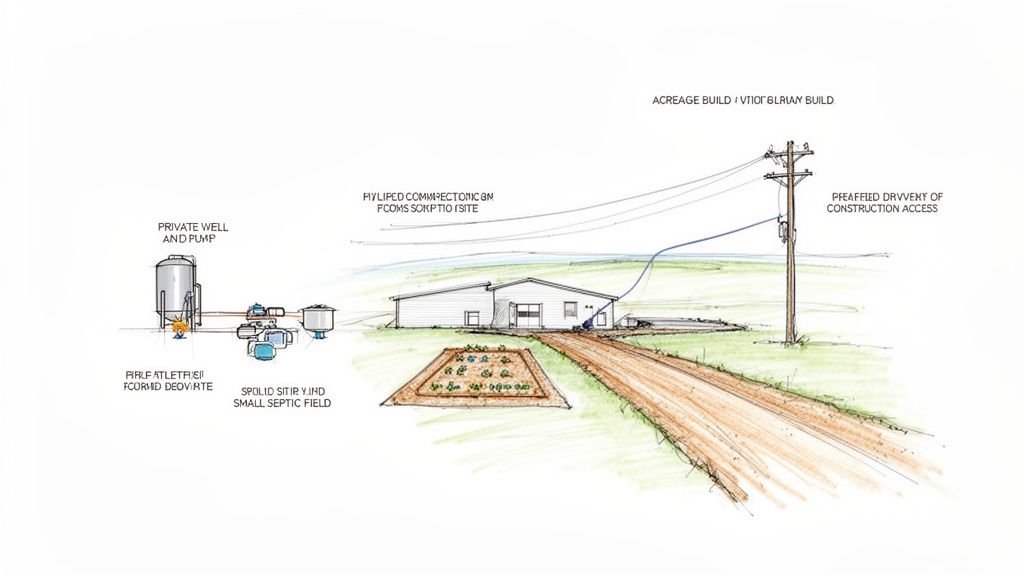
Once you've given your land the green light, it's time to tackle the essentials. A beautiful home is just a shell without power, water, and septic. On rural Texas properties, these aren't services you can just flip a switch for. You have to build the infrastructure from the ground up, and these costs are a major part of your budget when you build on your own land.
This part of the journey is all about logistics. It demands a carefully choreographed dance between well drillers, septic designers, and the local electric co-op. Getting the sequence right is critical to keeping your project on track and avoiding expensive mistakes.
Water Where There Are No Pipes
If your property is outside city limits, like many great lots around Tolar or Stephenville, you're going to need a private water well. This is a lot more involved than just digging a hole; it's a process that brings in geologists, drillers, and pump installers.
First, a driller will assess your land to find the best spot to tap into an aquifer, like the Trinity Aquifer that runs under a huge swath of our area. The final cost is almost entirely driven by depth—a well might be 200 feet deep or over 800 feet deep, and that difference can mean a huge shift in price.
Here's the typical game plan for getting water:
Drilling and Casing: A rig bores down to the water source, and then a steel or PVC casing is installed to keep the well shaft from collapsing.
Water Testing: As soon as they hit water, a sample gets sent off for potability testing to ensure it's safe to drink.
Pump Installation: A submersible pump goes down into the well, which is then connected to a pressure tank to supply your home with steady water pressure.
A complete well system in North Texas can range from $8,000 to $20,000 or more, depending on how deep they have to go, the soil conditions, and the type of pump system you need.
Planning Your Septic System
For wastewater, a septic system is the standard for rural living. And just like with the well, your land—especially your soil—calls the shots. The clay soil common in North Texas often means we need to install more advanced systems than a basic conventional setup.
A licensed septic designer will start with a "perc test" to measure how quickly water absorbs into your soil. The results dictate the type and size of system you'll need. It might be a conventional system, or it could be a more complex aerobic system with spray heads. Aerobic systems are very common on smaller lots or properties with poor drainage and can cost $12,000 to over $25,000. The design must be permitted by the county before any work begins.
Getting Power to Your Build Site
Next up is getting electricity from the main road to your future home. This means working closely with the local electric cooperative, like United Cooperative Services, which covers much of Hood, Erath, and surrounding counties.
Don't assume power is cheap or easy to get. We worked on a project on a large parcel near Glen Rose where the homesite was nearly a quarter-mile from the road. The cost to set poles and run the line was over $30,000—a significant budget item the homeowner hadn't fully anticipated.
Get in touch with the co-op early. They'll help you figure out the most efficient route for the power line, which might involve clearing a path through trees. The cost is almost completely dependent on the distance and the terrain.
Finally, remember that all those heavy construction vehicles need a solid path. You'll need to install a temporary construction driveway early on. This usually involves clearing, grading, and laying down a thick base of crushed rock to support concrete trucks and other heavy equipment.
North Texas Utility Installation Checklist
This checklist breaks down the major steps for getting your rural lot ready for your new home.
Utility | Key Steps | Local Considerations (Granbury/Weatherford Area) | Estimated Cost Factors |
|---|---|---|---|
Water Well | 1. Hire a licensed well driller. 2. Site selection and depth estimate. 3. Drill, case, and install pump. 4. Water potability testing. | Access to the Trinity Aquifer varies. Well depth can change significantly even over short distances. | Depth of well is the #1 factor. Type of pump and pressure tank system. |
Septic System | 1. Hire a septic designer for a site evaluation. 2. Conduct a soil percolation ("perc") test. 3. Design system and obtain county permit. 4. Installation by a licensed professional. | Clay soil is common, often requiring an aerobic system with spray heads instead of a conventional system. | System type (aerobic vs. conventional). Size of the drain field. Complexity of installation. |
Electricity | 1. Contact the local electric co-op (e.g., United Cooperative Services). 2. Schedule a site visit to plan the route. 3. Clear easement path if needed. 4. Co-op sets poles and runs lines. | Wooded or hilly terrain increases costs. The distance from the main road to the homesite is crucial. | Distance from the nearest power line. Number of poles required. Need for trenching vs. overhead lines. |
Putting this checklist into action will help ensure you’ve covered all your bases before breaking ground.
Financing Your Custom Home Build
Securing the funds to build your dream home isn't like buying a house that's already standing. The process is different, and the financing is, too. Instead of a standard mortgage, you'll be looking at a construction-to-permanent loan, which is tailor-made for projects where you build on your own land.
Think of it as two loans bundled into one package. The first phase is the construction loan, which is how your builder gets paid. The bank releases funds in stages, or "draws," as major milestones are hit—like when the foundation is poured or the framing is complete. Once your home is finished, the loan automatically rolls over into a regular mortgage, saving you the headache and cost of a second closing.
What the Bank Wants to See
When you meet with a lender for a construction loan, they're going to ask for a lot more than they would for a standard home purchase. You're asking them to finance something that doesn't exist yet, so they need to be completely confident in your plan.
Be prepared to provide a full package of documents, including:
Detailed Architectural Plans: Your complete set of blueprints and specifications.
A Signed Builder Contract: This needs to be a fixed-price or cost-plus contract with a reputable, licensed general contractor.
A Comprehensive Budget: A line-item breakdown of every anticipated cost, from permits and site work all the way down to doorknobs and light fixtures.
Proof of Land Ownership: If you already own your property free and clear, that equity is a huge asset and can often be used as part of your down payment.
A vague budget is the fastest way to get a "no" from a lender. They need to see that you and your builder have thought through every detail.
What About Financing the Land Itself?
So, what if you’ve found the perfect acreage in Weatherford but haven’t bought it yet? You’ve got a couple of solid paths forward.
Many people buy the land first, either with cash or a separate lot loan, which is short-term financing for buying land you plan to build on soon. The other route is to find a lender who will roll the cost of the land purchase directly into the construction loan. This can simplify things by wrapping it all into one transaction, but you need to have your builder, plans, and budget lined up before you can close on the property.
Making the choice to build on your own land is more than just a lifestyle decision; it's a smart financial move. Custom home building has shown impressive resilience, even when the broader housing market slows. While high interest rates have cooled demand for spec homes, the custom building sector has actually grown by 6% compared to the third quarter of 2024. This happens because a custom home isn't a speculative asset; it's built for a specific owner, insulating it from many market pressures. You can find out more about the resilience of the custom home market here.
Always Plan for the Unexpected
This is where the rubber meets the road. Your budget must be realistic and account for everything, especially the "soft costs" that are easy to forget.
For example, we recently worked with a family building near Glen Rose who had a great plan, but their initial budget completely missed the $15,000 it would cost to clear dense cedar trees and cut a 500-foot gravel driveway to their build site. Those are real-world costs that have to be in the budget from day one.
This is why every construction budget needs a contingency fund of at least 10-15% of the total build cost. This isn’t slush money. It's a non-negotiable buffer for the curveballs that construction projects always throw, like hitting solid rock when digging the foundation or a sudden spike in lumber prices. A healthy contingency fund is what separates a stressful build from a smooth one.
Navigating financing can feel overwhelming, but a good local lender who specializes in construction loans is worth their weight in gold.
How to Choose the Right Home Builder
You’ve navigated the complexities of land and financing. Now, you’ve reached the most critical decision of the entire project: choosing the builder who will bring your dream to life.
This isn’t just about hiring a crew. It's about finding a long-term partner who will guide you through a thousand decisions, manage a massive budget, and ultimately be responsible for the quality of your home for decades.
When you build on your own land, the builder’s role is even more crucial. They aren’t just putting up a structure; they're solving the unique puzzles your property presents, whether it’s dealing with the tricky soil around Weatherford or navigating the specific permitting quirks of Hood County. This is where a builder's local experience isn't just a bonus—it's essential.
Look for Deep Local Roots
A builder who’s been working in the Granbury or Stephenville area for years brings more to the table than just construction know-how. They've spent decades building a network of the best local subcontractors—the electricians, plumbers, and framers you want working on your home. They know the county inspectors by name and understand exactly what they’re looking for, which saves you from frustrating and costly delays.
This network is a massive advantage. A well-established local builder can often get better pricing and more reliable schedules from their trade partners, passing those benefits directly on to you.
Go Beyond the Standard Questions
Sure, every builder will hand you a list of references. You should call them, but to find a real partner, you have to dig deeper. Think of this as hiring a key executive for your family's biggest investment.
Here are the questions you really need to be asking:
How do you handle budget changes? Ask for a real-world example of a project where costs changed unexpectedly. A great builder will have a rock-solid, transparent change order process that requires your signature before any changes are made.
What does your communication process look like? Will you get weekly updates? Who is your go-to person on a Tuesday morning? A consistent, clear communication rhythm is the secret to preventing misunderstandings.
Can I see a home you have under construction right now? A finished home is designed to look perfect. A job site in progress, however, tells the real story about a builder's standards for organization, cleanliness, and safety.
What does your warranty really cover? Get specifics on the warranty for workmanship (usually one year), systems like HVAC and plumbing (often two years), and major structural components (which should be up to ten years).
A builder's true character isn't revealed when things go right; it's when they go wrong. Ask them to tell you about a time a subcontractor made a mistake or a material shipment was delayed. How did they fix it for the homeowner? Their answer will tell you everything you need to know about their integrity.
Red Flags to Watch Out For
Knowing what to look for is only half the battle; you also need to know what to avoid. Be cautious of any builder who gives you a vague, "back-of-the-napkin" estimate, pressures you to sign a contract on the spot, or can't immediately provide proof of general liability and worker's compensation insurance.
The custom home market is strong right now, which is great news for landowners. The residential remodeling and custom building sector is projected to see healthy growth, with forecasts predicting a 5% increase in 2025 and another 3% in 2026. This stability means there are plenty of excellent builders out there, so there's no reason to settle for anyone who doesn't feel like a perfect fit. Discover more insights about the custom home market's future on BirminghamRemodelers.com.
Finding the right builder is all about balancing experience, transparency, and simple chemistry. For more detailed advice, check out our guide on how to choose a home builder in North Texas.
Navigating the Home Construction Process
Alright, you've done the hard work. The land is ready, your financing is in place, and you've shaken hands with your builder. Now comes the part you've been dreaming of—watching your home come to life. Seeing it all take shape is an incredible journey, but remember, it’s a marathon, not a sprint. Knowing the sequence of events will help you track the progress and ask the right questions.
Think of the construction schedule as a line of dominoes; each step has to happen in the right order for the next one to fall. A delay in one area can easily cause a ripple effect. This is where a seasoned builder’s project management skills are worth their weight in gold, especially when you build on your own land.
This quick visual guide breaks down the essential first steps for bringing a professional builder on board.
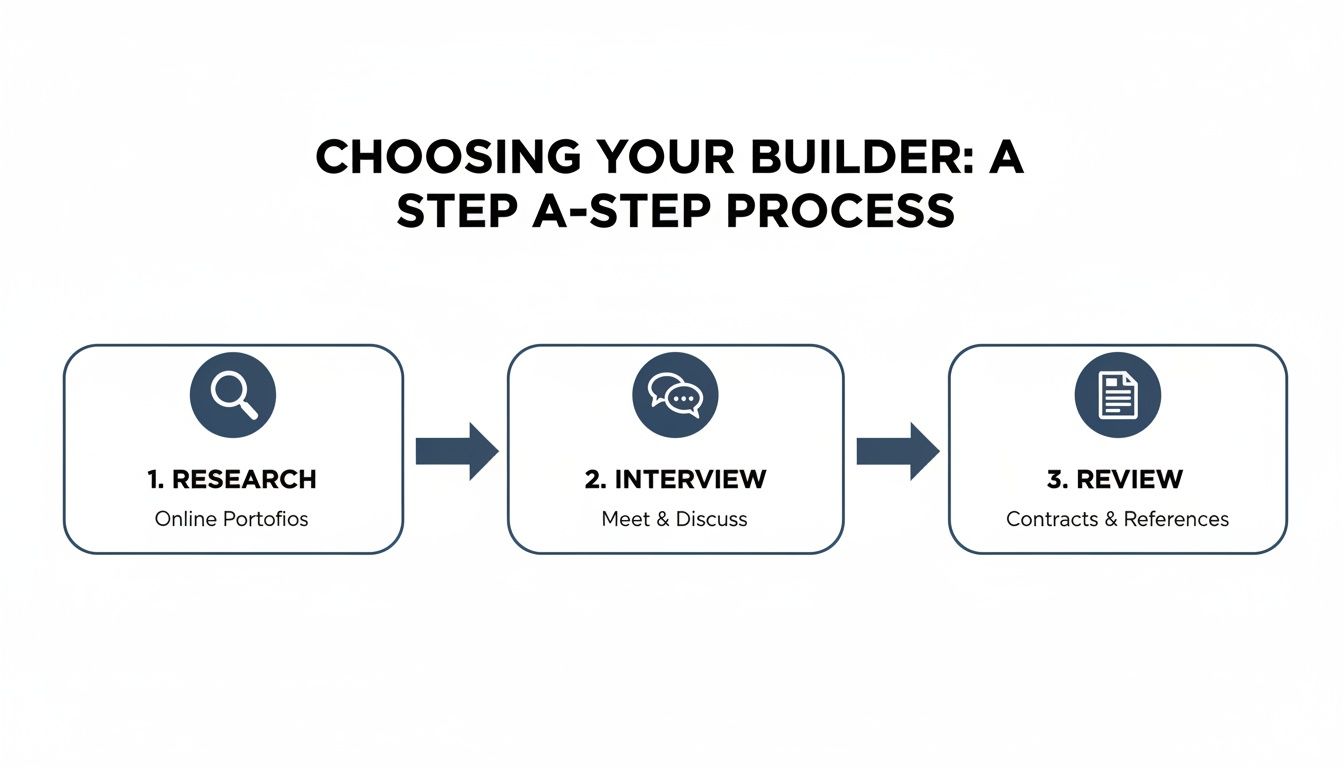
This process of digging in with research, having direct conversations, and carefully reviewing the paperwork is key to finding a partner who truly gets your vision and budget.
From Foundation to Framing
The first huge milestone is the site work and foundation pour. After clearing and grading, forms are built to create the mold for your slab. Plumbers will lay underground lines, and a grid of steel rebar is installed for strength. This is a massive inspection point—a Hood or Parker County inspector must sign off before a single drop of concrete is poured. Pouring the foundation solidifies your home’s exact footprint on the property forever.
Next up, your home starts going vertical. The framing stage is often the fastest and most dramatic part of the build. One week you have a flat concrete slab, and just a few weeks later, you can physically walk through the skeleton of your house. It’s an amazing feeling to see the rooms, windows, and doorways take shape.
Getting Dried-In and Roughed-In
Once the frame is standing tall, the immediate goal is to get the house "dried-in" and protected from the weather. This involves a few key steps:
Sheathing and House Wrap: Covering all the exterior walls to create a weather barrier.
Roofing Installation: Shingles or metal roofing goes on top.
Windows and Exterior Doors: These are installed to officially seal the structure from the elements.
With the house protected, the organized chaos of the mechanical "rough-in" begins inside. This is where crews run all the hidden systems that make a house function. Plumbers install supply lines and drains, electricians run wires for every outlet and switch, and the HVAC team installs all the ductwork. It's a flurry of activity before the walls get closed up.
The rough-in stage is your last easy chance to make small but important tweaks. Want to add an outlet behind your nightstand for charging your phone or move a light switch? Now is the time. A good builder will schedule a walkthrough with you at this point to confirm everything is exactly where you want it before it gets covered up.
Bringing the Interior to Life
After all the mechanical systems pass inspection, insulation is packed into the walls and ceilings. Then comes the drywall, which is what transforms that open frame into defined, solid rooms. The drywall crew will then tape, float (mud), and texture the walls, getting them perfectly prepped for paint.
From here on out, it’s all about the finishes that inject your personality into the home. Trim carpenters will install baseboards, door casings, and cabinets. Flooring goes down, painters bring your chosen colors to the walls, and the electricians and plumbers return to install light fixtures, faucets, and appliances. Every single step brings you closer to the finish line. Of course, North Texas weather can always throw a curveball, but a great builder communicates proactively and adjusts the schedule to keep things moving forward.
The journey from a raw piece of land to a move-in-ready home is complex, but it doesn't have to be a mystery. If you want to dive deeper into the play-by-play, check out our homeowner's guide to the construction timeline.
Got Questions About Building on Your Land? We've Got Answers
Once you've decided to build a custom home on your own lot, the practical questions start piling up fast. We hear the same ones from landowners all over North Texas, so let's get you some straight answers based on our experience right here in the Granbury area.
How Long Does a Custom Home Build Actually Take?
From the first design sketch to the day you get the keys, you're typically looking at a 10 to 16-month journey in our neck of the woods. It’s not a single sprint; it's a series of phases, each with its own timeline.
Here’s a realistic breakdown:
Design & Permitting (2-4 months): This is where your vision takes shape. We'll be working through architectural plans, you'll be making material selections, and we'll be navigating the approval process with local authorities, whether that's Hood County, Parker County, or the City of Granbury.
Site Work & Foundation (1-2 months): This phase is all about getting the ground ready and pouring the slab. This part of the schedule is completely at the mercy of the weather. A few weeks of solid Texas rain can definitely cause delays.
Construction (7-10 months): This is the longest phase, covering everything from framing the walls and putting on the roof to installing drywall, cabinets, and all the final finishes that make it a home.
What’s the Real Cost Per Square Foot to Build?
This is the million-dollar question, and anyone who gives you a flat "average" isn't giving you the full picture. The truth is, the cost per square foot can swing wildly. It comes down to two big variables: your land and your taste.
Prepping a flat, clear lot in Weatherford is a completely different budget than tackling a sloped, rocky property down near Glen Rose that needs extensive excavation. On top of that, your personal choices in finishes, from flooring and countertops to appliances and fixtures, will have a huge impact on the final number. The only way to get a reliable figure is to work with a builder to create a detailed, line-item quote based on your specific plans and your specific land.
Can I Save Money by Doing Some of the Work Myself?
The idea of contributing "sweat equity" seems like a straightforward way to trim the budget. In reality, it’s a lot more complicated and can introduce serious risks.
Most construction lenders won't allow it. They need to know that every part of the build is being handled by licensed, insured professionals to protect their investment—and yours. It can also create major scheduling headaches for your builder and even void parts of your home warranty. Whether you're a young family or a retiree, letting the pros handle the construction ensures it's done right and keeps everyone safe.
Your builder's risk insurance is a critical policy. It's what protects your massive investment from things like fire, theft of materials, or vandalism during the entire construction process. This policy covers the structure and everything on-site until the project is officially complete and handed over to you.
Building a custom home should be an exciting, rewarding experience. If you have questions about your specific property or are ready to take the next step, our team is here to provide clear, honest guidance.
Comments