
Mastering Task Lighting in Your North Texas Kitchen
Have you ever tried to chop vegetables while your own head casts a shadow over the cutting board? That’s the classic sign of a kitchen crying out for proper task lighting.
This isn't just about making the room brighter. Task lighting is about putting focused, intentional light exactly where you do the work—on countertops, over the sink, and above the cooktop. It’s the key to a safe, efficient, and more enjoyable kitchen, whether you're in Granbury, Weatherford, or anywhere in between.
It’s More Than Just Pretty Fixtures
When you're planning a kitchen remodel, it’s easy to get swept up in picking out countertops and cabinet styles. But I've seen it time and again in North Texas homes: it’s the lighting plan that truly makes or breaks the usability of the space.
Your main overhead lights are great for general ambiance, but they almost always position you directly between the light source and your workspace, creating frustrating shadows. Dedicated task lighting is the unsung hero that solves this problem, making your kitchen work for you.
Think about how you really use your kitchen. It’s not just a food factory; it’s the command center of the home.
For Families: When you’re prepping a meal in a busy Granbury kitchen, clear sightlines for chopping and measuring are critical. Good lighting means the kids can help out safely.
For Retirees: For folks enjoying their new custom home in Weatherford, bright and direct light reduces eye strain, making it easier to read recipes or check medication labels.
For Rural Property Owners: On a sprawling Glen Rose property, a well-lit kitchen is a warm, inviting beacon on dark country nights. It turns canning projects or late-night baking into a genuine pleasure.
A well-designed lighting plan elevates a kitchen from just looking good to being brilliantly functional. It’s a non-negotiable part of any quality custom home or remodel.
Ultimately, putting thought into your task lighting is an investment in your home’s everyday safety and usability. It ensures that whether you're slicing an onion or just reading the mail at the counter, you have the perfect light to do it comfortably.
For more ideas on blending beauty with practicality, take a look at our guide to interior design for country homes in North Texas.
Mapping Your Kitchen's Most Important Work Zones
Before you pick out fixtures, the real work begins with a "work zone audit" of your kitchen layout. The idea is simple: pinpoint exactly where the real work happens so every chop, stir, and rinse is perfectly lit.
Every kitchen has its own rhythm, whether it’s a sprawling ranch home in Stephenville or a cozy barndominium in Glen Rose. Your lighting needs to match that unique flow.
The Primary Work Triangle
Start by thinking about the classic triangle between the fridge, sink, and cooktop. These are non-negotiables for dedicated task lighting. Too often, a single ceiling light is expected to do all the work, but your own body gets in the way, casting a shadow right where you need to see. The solution is to layer direct light sources right over these three core areas for clear, unobstructed light.
Identifying Key Countertop Zones
Not all counter space is created equal. Some stretches become landing pads for mail, while others are the true workhorses.
Main Prep Counter: This is your command center, usually the longest stretch of counter between the sink and stove. It's where you do 90% of your chopping and mixing. This zone demands continuous, even lighting—a perfect job for under-cabinet fixtures.
The Kitchen Island: In many North Texas homes, the island is the hub for everything from homework to holiday baking. Getting the light right here often means using a combination of fixtures, like pendants for direct light and recessed cans overhead to fill in the rest.
Appliance Garages & Coffee Bars: Don't overlook smaller, dedicated spots. A well-lit coffee station makes the morning routine smoother, and a light inside an appliance garage means you can actually find what you're looking for.
This simple diagram shows how function, safety, and ambiance build on each other to create a solid kitchen lighting plan.
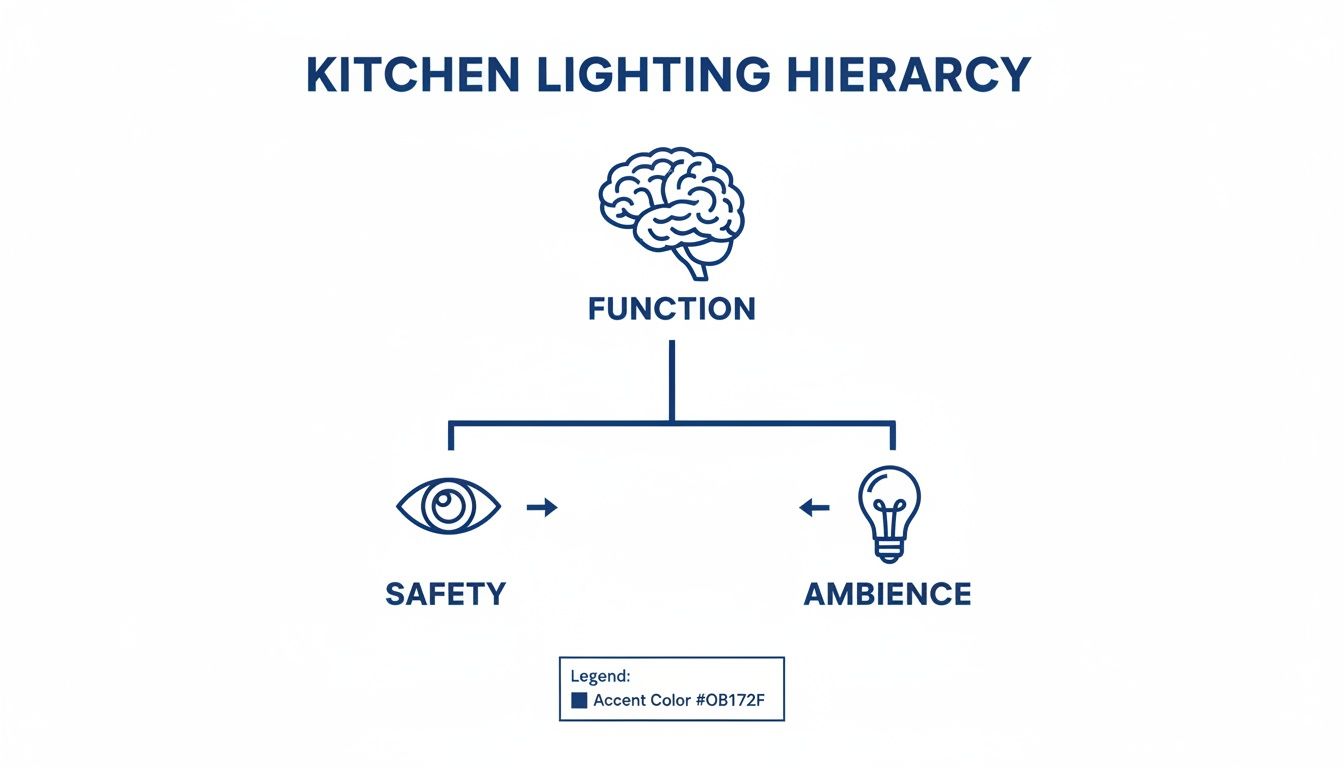
Function is the foundation. Get that right, and you automatically improve the safety and overall feel of your space.
By treating each work zone as its own project with specific lighting needs, you move from a generally "bright" kitchen to a brilliantly functional one. The difference it makes in day-to-day use is incredible.
Keep in mind that your lighting choices have to work with your other design selections. For more on that, read our guide on how to choose kitchen cabinets for your North Texas home.
Choosing the Best Fixtures for Every Kitchen Task
Alright, you’ve mapped out your work zones. Now comes the satisfying part—picking the hardware that will bring your lighting plan to life. This is where we match the right type of fixture to the job, ensuring it works perfectly and looks right at home in your North Texas kitchen.
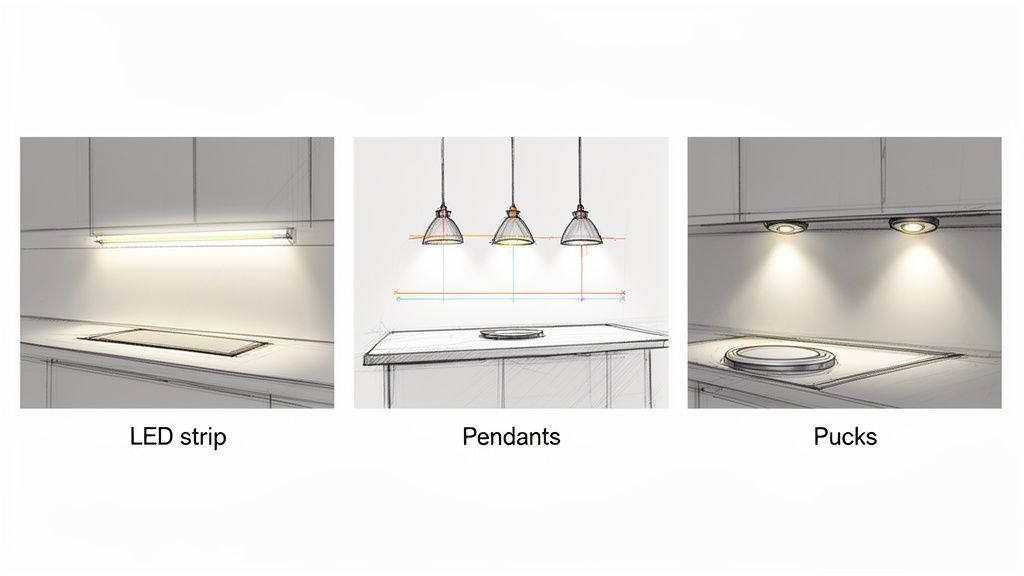
This isn’t just about style; it’s a strategic decision. For a sleek, modern kitchen in Godley, a low-profile LED strip might provide a seamless, continuous light. For a rustic farmhouse in Tolar, the charm of pendant lights over the island could be a better fit.
Under-Cabinet Lighting: The Unsung Hero
For your main countertop prep areas, under-cabinet lighting is the undisputed champion. It’s a non-negotiable in my book because it puts light directly on your work surface, wiping out shadows. For any kitchen remodel we do in the Granbury area, this is the first layer of task lighting we recommend.
Here’s a look at the best options:
LED Tape or Strip Lights: Incredibly versatile and our top pick for most projects. They create a continuous, even wash of light, are discreet, energy-efficient, and can be cut to fit any cabinet length.
Puck Lights: These small, round lights create focused pools of light. While we use them less for full-length counters, they're fantastic for accenting a specific spot, like a coffee bar.
Linear Fixtures: These are rigid, bar-like fixtures that are hardwired for a clean, professional look. They’re extremely durable, making them a great long-term investment.
The importance of task lighting in kitchen design isn't just an opinion—it's backed by data. Under-cabinet options make up 45-50% of global installations. Meanwhile, LEDs now command 70-75% of the entire lighting market thanks to their incredible efficiency and longevity.
Modern LEDs are up to 75% more efficient than old-school incandescent bulbs and can last up to 25 times longer. That translates into real savings on your energy bills. You can dig into more insights about the kitchen lighting market to see the trends for yourself.
To make the choice easier, here's a quick breakdown of the most common task lighting fixtures we install in North Texas homes.
Comparing Kitchen Task Lighting Fixtures
Fixture Type | Best For | Pros | Cons / Considerations |
|---|---|---|---|
LED Tape/Strip | Continuous under-cabinet lighting, toe-kicks, display shelving. | Even, shadow-free illumination; highly flexible; energy-efficient; can be cut to any length. | Installation can be tricky to get perfectly straight; requires a transformer. |
Puck Lights | Small, targeted areas like coffee stations, inside glass-front cabinets, or accent nooks. | Easy to install; great for highlighting specific items; available in battery-operated versions. | Can create "scallops" of light instead of an even wash; not ideal for long countertops. |
Pendant Lights | Kitchen islands, peninsulas, and sinks. | Brings light down to the task level; acts as a major design element; available in endless styles. | Can obstruct sightlines if hung too low; spacing and height are critical to get right. |
Track Lighting | Vaulted ceilings, kitchens where wiring is complex, or for flexible, multi-point illumination. | Highly adjustable heads can be aimed precisely; great for hitting multiple work zones from one fixture. | The track itself can look dated if you don't choose a modern style; can feel a bit industrial. |
Pendants and Track Lighting for Islands and Cooktops
Your island and cooktop need their own focused solutions. These central hubs demand bright, direct illumination without compromise.
Pendant Lights Pendants are fantastic for kitchen islands, serving as both a light source and a beautiful design focal point. When we’re designing a kitchen in Weatherford or Stephenville, we stick to a few key guidelines:
Height: Hang pendants so the bottom is 30 to 36 inches above the countertop. This sweet spot provides plenty of light without blocking views.
Spacing: A good rule of thumb is to leave about 30 inches between the center of each fixture to avoid hot spots and dark areas.
Quantity: For a standard 6-foot island, two pendants usually look best. For longer islands, three or more may be needed for full coverage.
Track Lighting If you need flexibility, track lighting is a brilliant problem-solver. You can aim the individual heads precisely where you need light, making it a go-to for kitchens with tricky vaulted ceilings or when you want to light multiple zones with a single system.
Ultimately, the goal is to match the hardware to the task. By layering these different types of fixtures, you create a kitchen that’s not just beautifully lit but perfectly functional.
Understanding Lumens and Color Temperature
Let's get into the nitty-gritty of what makes task lighting work. When you talk to your builder or electrician here in North Texas, two terms will come up: lumens and Kelvin. Getting a basic feel for these is key to getting the lighting you've envisioned.
Simply put, lumens measure brightness, and Kelvin measures the color of that light.
Lumens: How Bright Is Bright Enough?
Lumens tell you the total amount of light a bulb emits—the bigger the number, the brighter the light. For kitchen work zones, you need focused, powerful light for safety and precision.
A great target for your countertops is 300-500 lux, which is how we measure lumens hitting a specific surface. This level of brightness means you can read a messy recipe or finely chop vegetables without squinting. It's a practical detail that makes a world of difference, whether you're a retiree in Weatherford who loves to bake or a busy Granbury family getting dinner on the table.
Kelvin: Finding the Right Color Temperature
Kelvin (K) is all about the color of the light, ranging from a warm yellow to a crisp, blue-ish white. This choice has a huge impact on the mood of your kitchen.
Here’s a quick guide to the Kelvin scale:
2700K (Warm White): This has a soft, inviting glow like an old incandescent bulb. It’s fantastic for a relaxing atmosphere but can cast a yellow hue on food.
3000K (Soft/Bright White): This is the sweet spot for most North Texas kitchens I've worked on. It’s a clean, neutral white light that shows colors accurately without feeling sterile.
4000K-5000K (Cool White/Daylight): This light is very crisp with blue undertones, like natural daylight. It's excellent for task clarity but can make a kitchen feel clinical if it's the only light source.
The kitchen lighting industry has been transformed by LEDs, which now hold over 62% of the market share. These lights offer up to 80% in energy savings and can last for an incredible 50,000 hours—a massive jump from the 1,000-hour lifespan of old bulbs. You can read more about the growth of the kitchen lighting market to see why this technology is now the standard.
The single most important feature for functional task lighting is a dimmer switch. It’s a non-negotiable. A dimmer gives you the flexibility to have bright, focused light for meal prep and then dial it down to a soft, ambient glow for a quiet evening.
This simple control turns your kitchen from a pure workspace into a multi-functional living area, making it a small addition that delivers huge value.
How to Budget for Your Kitchen Lighting Project
Great lighting is one of the best investments you can make, so let's talk numbers. Budgeting for lighting here in North Texas comes down to fixture quality, installation complexity, and local labor rates. Swapping an old pendant light is a simple job, but wiring a new custom home in Cresson is a whole different ballgame.
Key Cost Factors to Consider
Look past the price tag on the fixture itself. The total investment includes several moving parts.
Fixture Quality: A basic LED under-cabinet strip from a big-box store might cost $50-$100. An architectural-grade system with better color rendering and a solid warranty could run $300-$500 for the same length. The difference in performance and longevity is significant.
Installation Complexity: Adding lights to an existing kitchen with easy access is straightforward. If we need to open drywall to run new wiring and add switches, labor costs will climb.
Labor Rates: A licensed electrician in the Weatherford and Glen Rose area typically charges between $75 to $125 per hour. A simple fixture swap might take a couple of hours, while a full kitchen remodel could involve a few days of electrical work.
Focusing on Long-Term Value
While upfront cost is a factor, smart spending on lighting means thinking long-term. The global kitchen lighting market is projected to hit $30.7 billion by 2028, fueled almost entirely by demand for LEDs.
These modern fixtures use 80-90% less energy than old incandescent bulbs, which translates directly to lower electricity bills. You can explore the growth of the kitchen lighting market to see just how big this shift is. To see how these costs fit into the bigger picture, take a look at our guide on breaking down your North Texas kitchen remodel cost.
Bringing It All Together: From Plan to Perfect Light
Getting from a frustrating, shadowy kitchen to a space that's both stunning and perfectly functional boils down to a solid plan and quality execution.
The process starts with a simple map of where you actually work. Once you’ve pinpointed those high-traffic spots, choosing the right fixtures, lumens, and color temperatures becomes straightforward. It’s a deliberate approach that ensures every dollar you spend makes your daily life better.
Don't Skip Professional Installation
Swapping out a single pendant light might feel like a fun DIY project. But for a full remodel or new custom build here in North Texas, getting that clean, seamless look depends on a professional. This is about more than just aesthetics—it's about safety and long-term performance.
A licensed electrician will ensure all wiring is up to code, transformers for LED strips are installed correctly, and every dimmer switch works flawlessly. From our experience building homes from Granbury to Weatherford, we know a flawless lighting installation is a hallmark of true craftsmanship.
A great lighting plan isn't tacked on at the end. It's a foundational piece of the design that elevates the entire kitchen, making the space feel finished, safe, and truly yours.
Investing in proper installation is non-negotiable. It protects your home and ensures you get the full performance out of the fixtures you chose, turning your well-laid plan into a bright, welcoming reality.
A thoughtfully lit kitchen can change the entire feel of your home. If you're ready to create a space in the Granbury area that works as hard as you do, we can help bring your vision to life. Let’s talk about your project—schedule a free, no-pressure consultation with the team at Gemini Homes.
Learn more about our process and see our work at https://www.geminihomesgranbury.com.
Comments