
How to Build a Barn in North Texas: A Practical Guide
So you’re thinking about building a barn. It’s a fantastic addition to any property, whether you're right here in Granbury or out on a few acres near Stephenville. But it's more than just putting up four walls and a roof; it's about creating a structure that truly works for you. The entire process comes down to four key stages: planning and permits, picking your style and materials, the construction itself, and finally, setting a budget and hiring the right team. Get a handle on these, and you’ll be well on your way.
Your North Texas Barn Building Journey Starts Here
Think of this guide as your personal playbook, walking you through everything from the first sketch to the day you park your tractor inside. We'll tackle the real questions we hear from landowners across North Texas, especially those dealing with our unique climate and soil.
Here, from Weatherford to Glen Rose, a barn isn't just a barn anymore. We see it all the time with the projects we build for local families and folks settling into their retirement property. These buildings have become incredibly versatile spaces.
More Than Just a Structure
Today, that new "barn" on your property could actually be a:
Workshop: Your dedicated spot for woodworking, tinkering with an old truck, or running a small business, all properly wired and ventilated.
Guest House: A cozy, private space for when the kids and grandkids come to visit your rural property.
Entertainment Hub: A wide-open area for hosting family get-togethers and cookouts, maybe with a big covered porch attached.
Barndominium: The perfect mix of rustic charm and modern convenience, where your home and workshop live together under one roof. If you're curious, you can learn more about barndominiums and see just how customizable they are.
Our job is to make the process of building a barn feel less intimidating by giving you straightforward, practical advice. We want you to work with a builder you trust to bring your idea to life—and make sure it’s tough enough to handle whatever Texas weather throws at it.
Building a barn is an investment in your property’s future. It should be designed to support not just your current needs but also how your family will use the space a decade from now.
From sorting out Hood County permits to choosing materials that won’t bake in our summer heat, every choice you make is important. This guide will give you the know-how to make smart decisions and ensure your new barn turns out exactly how you pictured it.
Laying The Groundwork: Planning and Permitting
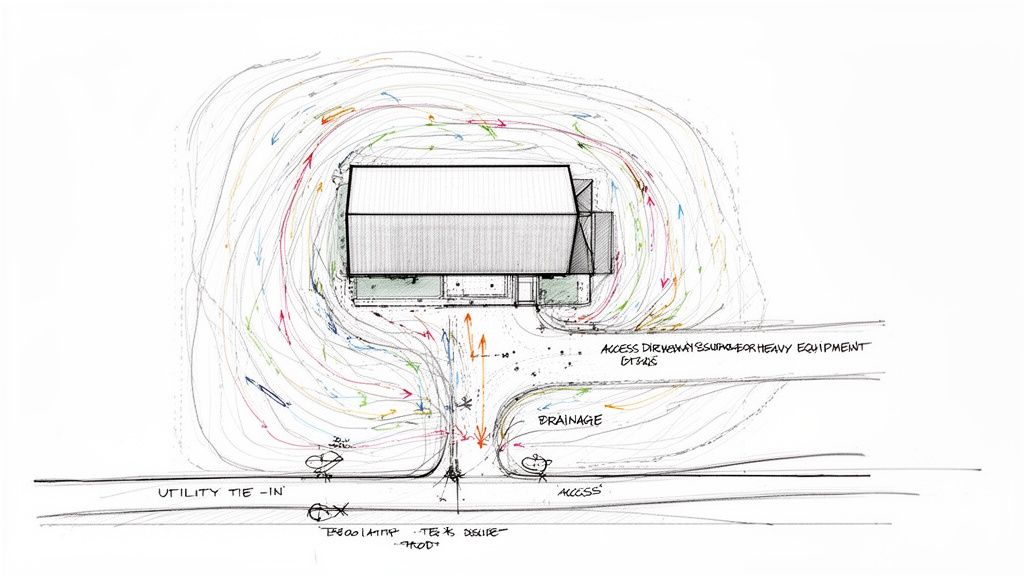
Before a single post is set, the real work begins with a site plan and a trip to the county office. This is where a barn build is truly made or broken, especially on rural properties in Parker, Hood, and Erath counties where the land can have surprises. A good plan now saves a world of hurt—and money—later.
You have to consider logistics. Where will water go during a classic North Texas downpour? How will a massive concrete truck get back there without destroying your pasture? Rushing this part invites headaches and a stack of unexpected bills.
Conducting a Proper Site Evaluation
Picking the perfect spot for your barn is about much more than a flat patch of dirt with a nice view. I remember a client project near Glen Rose on a gorgeous, gently sloping piece of land. It looked perfect, but a proper evaluation showed the natural drainage path cut right through their chosen spot. They would've had a flooded foundation every spring.
To avoid nightmares like that, you have to dig into the details:
Drainage and Grading: You need to know the high and low points of your property. Your barn must sit on slightly higher ground to ensure water flows away from your foundation, not into it.
Accessibility: Think about heavy machinery. You’ll need a clear path that’s at least 12-14 feet wide with enough vertical clearance to avoid those beautiful low-hanging oak branches.
Utility Access: Find your nearest electrical pole and water source. Trenching for utilities can easily run $20 to $40 per linear foot, so the shorter the run, the better for your budget.
Soil Conditions: Our North Texas clay soil is notorious for swelling when wet and shrinking when dry. A soil test will tell you if you need a more robust foundation with piers to keep things from shifting.
Key Takeaway: Always plan for the worst-case scenario. When you’re thinking about drainage, plan for a 100-year flood, not a light drizzle. That’s how you protect your investment for decades to come.
Navigating Local Building Codes and Permits
Once you’ve got your site dialed in, it’s time to tackle local regulations. Every town, from Cleburne to Weatherford, plays by its own set of rules.
For example, unincorporated parts of a county might have relaxed requirements for agricultural buildings. But build that same barn inside city limits, and you're dealing with strict zoning, setbacks, and maybe even style restrictions. For a deeper look, our guide to permits needed to build in North Texas is a fantastic starting point.
You’ll almost certainly need to pull together a few key documents:
A Detailed Site Plan: This is a professional drawing showing property lines, the barn's exact location, and its distance from other structures.
Engineered Building Plans: These are the official blueprints that detail the foundation, framing specs, and structural load calculations.
Proof of Ownership: A copy of your property deed is usually sufficient.
Septic System Permit: If your barn will have a bathroom or living quarters (like a barndominium), your septic plan needs to be approved first.
Getting a local surveyor involved early is a smart move. They will officially mark your property lines and create a certified site plan that ensures you’re compliant from day one.
Picking the Right Style and Materials for Your Barn
What does the "right" barn look like for your slice of North Texas? The best answer comes down to what you need it to do. The path you choose here—the style, the materials—will set the tone for your budget, the build timeline, and future upkeep. Let's walk through the most common options to figure out what truly fits your land and your life.
Why Pole Barns Are Everywhere in North Texas
You've probably heard the term "pole barn" or "post-frame construction," and for good reason. It’s all about efficiency. Instead of pouring a continuous concrete foundation, a pole barn is built on large posts set deep into the ground. These posts support the entire structure.
The advantages are clear:
Cost-Effective: A simpler foundation and faster framing process mean pole barns are often more affordable than traditional stick-built or all-steel buildings.
Fast Construction: With fewer components, the shell of a pole barn can be assembled remarkably quickly, saving on labor costs.
Wide-Open Space: This design creates massive, unobstructed interiors without support walls, perfect for parking big equipment, setting up a workshop, or even an indoor riding arena.
From a small workshop in Godley to a large equipment shed out in Tolar, the sheer flexibility of post-frame construction is its greatest strength.
North Texas Barn Styles: A Head-to-Head Comparison
While pole barns are a fantastic choice for many, they aren't the only option. Some folks love the timeless look of a traditional wood-frame barn, while others need the brute strength of an all-steel building.
Barn Type | Typical Cost Range | Durability & Maintenance | Best For |
|---|---|---|---|
Pole Barn (Post-Frame) | $25 - $75+ per sq. ft. | Low maintenance with metal siding/roofing. Minimal upkeep required beyond occasional checks. | Workshops, equipment storage, basic agricultural use, and barndominium shells where budget and open space are key. |
Traditional Wood Frame | $50 - $150+ per sq. ft. | Higher maintenance. Requires regular staining or painting to protect wood from sun and moisture. | Homeowners seeking a classic, rustic look, often for smaller barns, guest houses, or event spaces. |
All-Steel Building | $40 - $100+ per sq. ft. | Extremely durable. Resistant to fire, pests, and rot. Virtually zero exterior maintenance needed. | Large-scale commercial or agricultural operations, industrial workshops, and anyone prioritizing maximum longevity. |
It's crucial to remember that these numbers are just for the basic shell.
My Two Cents: When you're running the numbers, always factor in the "extras." A finished concrete floor, insulation, and all the electrical and plumbing work will be separate line items on your budget.
The Barndominium: A True Texas Original
Nowhere is the evolution of the barn more obvious than with the boom in "barndominiums." This is the ultimate hybrid, blending living quarters with a workshop or garage all under one roof. It’s a perfect solution for retirees building on their dream acreage or for a young family that needs a flexible live/work setup.
The real beauty of a barndo is how you can make it your own. We’ve helped clients in the Granbury area design everything from a simple apartment tacked onto a massive garage to sprawling luxury homes with soaring ceilings and wraparound porches—all using cost-effective post-frame building blocks.
Choosing Materials That Can Handle Our Weather
Picking the right exterior for your barn is about more than just color; it’s about surviving the Texas climate. Between the blistering summer sun, surprise hail storms, and straight-line winds, your materials must be tough.
Standing Seam Metal Roofing: This is the gold standard. It’s incredibly tough, reflects solar heat to keep the inside cooler, and the hidden fasteners are far less likely to leak than old-school screw-down panels.
26-Gauge Metal Siding: This is rugged, low-maintenance, and comes in countless colors. Modern metal siding resists fading, pests, and fire—a huge plus for any rural property.
Spray Foam Insulation: You have to plan for this from the start. In a metal building, spray foam is your best weapon against condensation (that dreaded "sweating" on the ceiling) and creates an amazing thermal barrier to keep your space comfortable.
From Foundation to Finishes: The Build Process
Alright, you’ve got your designs and the permits are in hand. Now the real fun begins—watching your barn take shape. This is where the lines on paper become posts in the ground and a roof over your head. Seeing the process unfold is incredibly rewarding, and here in North Texas, getting each step right is critical for a long-lasting structure.
Pouring a Foundation That Can Handle Texas Soil
Everything starts from the ground up. Here in the Granbury and Weatherford areas, we’re famous for our expansive clay soil. It swells when wet and shrinks when it dries, putting tremendous stress on a building’s foundation.
You have to build for the ground you’re on. For local barn projects, two types of foundations are the clear winners:
Monolithic Slab-on-Grade: This is our go-to for most workshops and barndominiums. It’s a single, beefy pour of concrete where the slab floor and reinforced footers are formed all at once. It’s tough, cost-effective, and gives you a solid, level floor.
Pier Foundation: This is the bedrock of a good pole barn. We auger deep holes past the shifting topsoil to a more stable layer. We fill those holes with concrete, and the main posts of your barn are set directly into these piers, anchoring the structure against soil movement and wind uplift.
This diagram gives you a simple look at how different construction types come together.
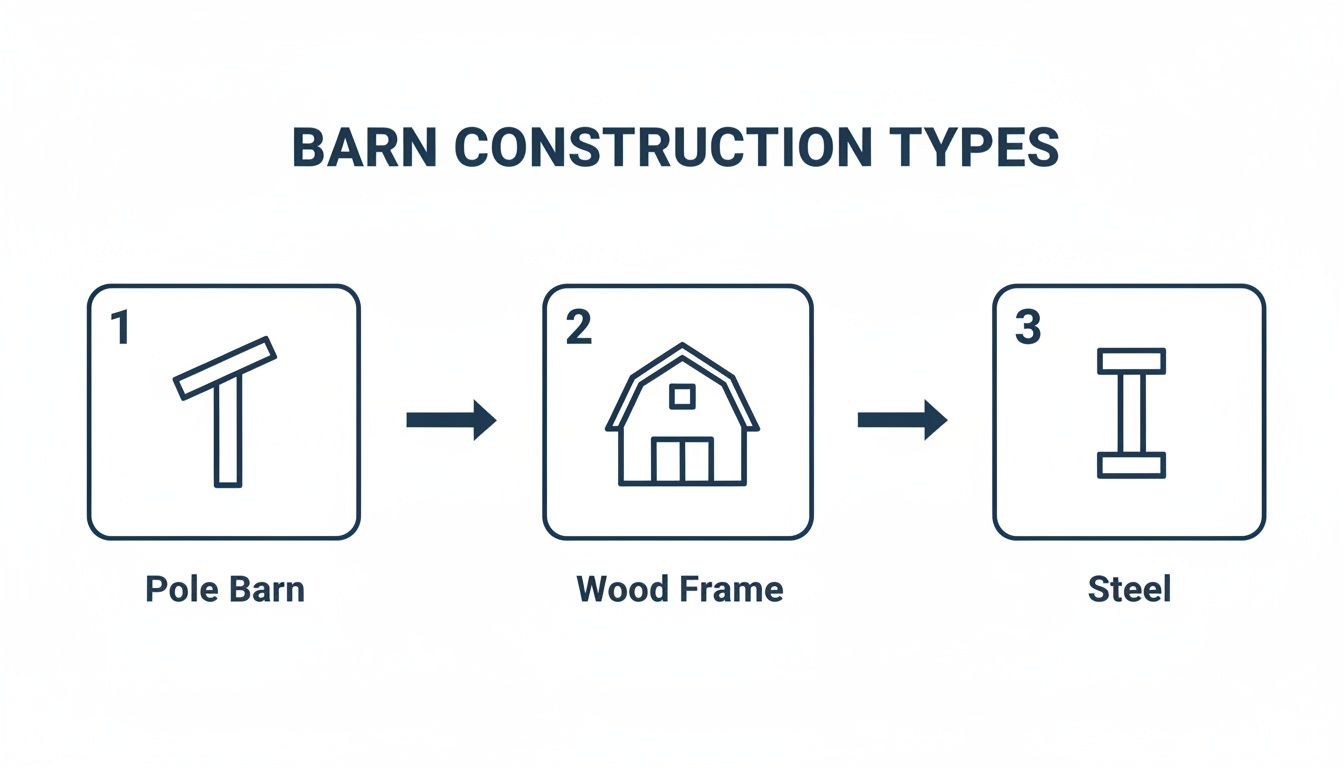
Whether you choose a post-frame, traditional wood, or an all-steel building, the foundation is specifically engineered to handle that structure's load and our local conditions.
Framing and Roofing to Beat the Weather
Once the concrete is cured, the skeleton of the barn shoots up fast. For a post-frame building, we set the large vertical posts first, followed by the roof trusses and the horizontal girts that the wall panels will fasten to. You see huge progress every single day.
The framing and roofing must be engineered to shrug off the high winds we get every spring. That means using heavy-duty bracing, hurricane ties on the trusses, and the right fasteners. It’s not just about keeping the roof on; it’s about creating a rigid structure that won’t twist or flex.
A Pro Tip From the Field: Don't skimp on wind bracing. We always recommend beefing up the corners and using engineered hardware to connect every post and truss. It’s a small extra cost upfront that buys you a massive amount of peace of mind when a storm rolls in.
Insulation and Beating Condensation
A metal building in Texas without proper insulation is just an oven in the summer. It will also "sweat," and that condensation can drip on everything, rusting your tools and equipment.
Your best defense is a complete moisture and thermal barrier. We almost always recommend 2 to 3 inches of closed-cell spray foam insulation. It’s sprayed directly onto the interior of the metal panels, creating a seamless seal that stops air leaks, prevents condensation, and keeps the barn comfortable.
Doors, Windows, and Ventilation
The doors and windows you choose will define how your barn functions. A great trick for a workshop is to place large roll-up doors on opposite ends—it creates a fantastic cross-breeze that cools the place down naturally.
A few things to consider:
Roll-Up vs. Garage Doors: Basic roll-up doors are workhorses. But if you're conditioning the space, an insulated sectional garage door offers better security and efficiency.
Window Placement: Placing windows up high or adding skylights lets in tons of natural light without taking up valuable wall space.
Ventilation: If you have animals, good airflow is non-negotiable. A combination of ridge vents, soffit vents, and cupolas will pull hot, stale air out.
Running Electrical, Plumbing, and HVAC
Finally, it’s time to bring your barn to life. All under-slab plumbing for drains and water lines has to be laid out and "stubbed up" before any concrete gets poured.
For the electrical, walk through the empty frame and imagine your workflow. Where does the welder go? It’ll need a 220-volt outlet. Where will your main workbench be? You’ll want plenty of outlets and good task lighting there. Mapping this out ahead of time means you get power exactly where you need it.
If your barn includes a workshop or living quarters, the HVAC system goes in during this final push. We’ll get the ductwork and equipment set up before the interior walls go in. With these systems in place, your barn transforms from an empty shell into a fully functional space.
Budgeting Your Build and Finding The Right Partner
A barn build lives and dies by two things: a realistic budget and the right team. Nail these from the get-go, and you'll avoid the stress and sticker shock that can derail a project. It’s all about creating a clear financial roadmap and finding a partner who understands your vision and knows how to build here in North Texas.
The total cost to build a barn covers everything from grading the land to installing the last light fixture. When we help families in places like Granbury and Weatherford plan their projects, we make sure they see that complete picture.
Breaking Down the Costs of Your Barn
The final number on your barn invoice is influenced by a few key variables. Knowing what they are helps you make smart decisions to keep your budget in check.
Site Preparation: This is your first big variable. If your land is flat and clear, you're in great shape. But if you need serious grading, tree removal, or have to haul in fill to build a solid pad, this line item can grow quickly.
Materials and Finishes: The gap between a basic metal shell and a fully finished barndominium is huge. Choices like insulated doors versus standard ones, high-end windows, or adding interior finishes will move the needle on cost significantly.
Utilities: How far is your build site from the nearest electric pole and water line? Trenching hundreds of feet across a property can add thousands to the final bill.
Labor Rates: The cost of a reputable, insured crew might seem more expensive upfront than a local handyman, but their quality and efficiency prevent costly mistakes and do-overs.
My Advice: Always budget for a 10-15% contingency fund. It's the single best piece of financial advice I can give. This is your safety net for the unexpected—like hitting rock when digging footers or deciding you want an extra window—without blowing up your budget.
The Big Question: DIY vs. Hiring a Pro
The temptation to DIY a barn is real, especially for handy landowners. Before you jump in, though, be brutally honest about your skills, tools, and available time.
Putting up a barn is a massive undertaking that demands knowledge of local building codes, experience with heavy equipment, and the ability to handle large materials safely. One mistake in the foundation or framing phase can compromise the entire structure.
Hiring an experienced local builder brings a ton of expertise to your project. They manage the whole process—from pulling permits to coordinating the concrete crew and electricians. For many of our clients, from families to retirees out in Glen Rose, the peace of mind knowing the job is done right and to code is worth every penny. If you're weighing your options, our guide on how to choose a home builder in North Texas walks you through exactly what to look for.
Building Smart for the Future
Thinking about long-term costs is just as critical as the upfront build price. Investing in good insulation and energy-efficient windows might cost a bit more initially, but it pays you back for years in lower utility bills, especially with our Texas heat. A good builder doesn't just put up four walls and a roof; they build a structure designed to last and perform efficiently for decades. That forward-thinking approach is what turns a simple building project into a genuine investment in your property.
Common Questions We Hear About Building a Barn in North Texas
When you're thinking about adding a barn to your property, you've probably got a dozen questions. It's a big project, and it's smart to do your homework. We get calls every day from folks around Granbury, Weatherford, and the surrounding areas, and they often ask the same things. Here are some straightforward answers to help you plan with confidence.
How Long Will It Actually Take to Build My Barn?
This is almost always the first thing people ask. While every build has its own quirks, a standard 30x40 pole barn can go up surprisingly fast—often in just 4-8 weeks once we have permits in hand and your site is ready.
The entire process, from our first conversation to you parking your tractor inside, usually lands somewhere between 3-6 months. What stretches it out? Sometimes Hood County's permitting office gets backed up, or a spring storm can turn a job site into a mud pit for a week. A more complex barndominium with custom finishes also adds to the timeline. A good builder will walk you through a detailed schedule from day one so you know what to expect.
What Are The Biggest "Hidden" Costs I Should Watch Out For?
If you're going to get hit with a surprise cost, it's almost always going to come from what's under the ground. Site prep and bringing in utilities are the two wild cards in any budget. For instance, we might start digging for your foundation and hit a solid shelf of rock—that means bringing in heavier equipment and more time.
The same goes for running power and water. The cost can jump significantly depending on how far we have to trench from the main service lines. Always plan for these possibilities:
Tough Excavation: Hitting rock or finding soil that won't compact properly can add thousands to the site prep bill.
Long Utility Runs: The further your barn is from the road, the more it will cost to get electricity and water to it.
Proper Drainage: This isn't optional in North Texas. Grading the land correctly and sometimes adding swales or French drains is a necessary expense to keep water away from your foundation.
Here's a piece of advice we give every client: budget a contingency fund of 10-15% of your total project cost. Think of it as insurance. If you don't need it, great. But if you do, it won't derail your project.
Can I Just Build a Shell and Turn It Into a Barndominium Later?
You can, but it's often the most expensive and frustrating way to do it. Turning an agricultural-style barn into a home down the road is a massive undertaking, not just a matter of putting up some drywall.
You'd be looking at a complete overhaul—ripping things apart to add residential-grade insulation, running all new electrical and plumbing systems to meet code, and possibly even beefing up the foundation. If there's even a chance you'll want living quarters in the future, plan for it now. It's far cheaper to pour a thicker slab and use taller posts from the start than it is to retrofit everything years later.
What Kind of Maintenance Does a New Metal Barn Really Need?
Honestly, this is one of the best parts of building with modern materials. They are incredibly low-maintenance, a huge plus when you already have a property to look after. For the most part, you're just looking at a couple of simple annual check-ups.
After a big hailstorm, walk the perimeter and eyeball the roof and siding to make sure no screws have worked loose. You'll also want to clean out your gutters in the spring and fall to keep water flowing away from the foundation. Beyond that, a good power wash every now and then is all it takes to keep it looking sharp. The coatings on metal panels today are so durable you won't have to think about repainting for decades.
Building a barn is a major investment in your property, and doing it right the first time is what matters most. At Gemini Homes, we’ve been helping families across North Texas build structures that last, and we take pride in our work.
If you’re ready to discuss the specifics of your project, we’d be happy to provide a free, no-nonsense estimate to help you get started. Visit us online to get started and let’s talk about building your vision.
Comments