
Your Guide to a Beautiful Landscaped Entrance Driveway in North Texas
Your driveway is far more than just a path to the garage. It's the handshake that greets your guests, the very first impression your home makes, and it sets the stage for everything that lies beyond the front door. For families building a custom home in communities like Granbury and Weatherford, a thoughtfully designed landscaped entrance driveway is an essential piece of the puzzle, tying together practicality and personal style.
Your Driveway Is Your Home's First Impression
Think about it: your driveway is the first thing guests see when they pull up and the last thing they see as they leave. It's the prologue to your home’s entire story. A well-designed and landscaped entrance creates a deliberate transition from the public road to your private retreat, making the act of coming home feel like a genuine experience.
This is especially true for custom homes across North Texas, where properties are often larger and the driveway itself becomes a significant landscape feature. It's not just a path for your car; it's a fundamental part of your home’s curb appeal and architectural statement.
Blending Style and Practicality
A great driveway entrance does more than one job. Functionally, it has to work for daily life—being wide enough for vehicles, safe to navigate in all weather, and properly graded for drainage. Aesthetically, it must echo the character of your home. A sprawling ranch in Glen Rose, for instance, might feel right with a curving gravel drive lined with native grasses. A modern farmhouse in Aledo, on the other hand, demands the clean lines of a concrete path bordered by formal boxwoods.
This guide will walk you through the practical steps to get it right. We'll cover the critical considerations from the ground up:
Planning and Site Assessment: Every North Texas property has its own quirks and opportunities. Understanding them is the key to a successful project.
Durable Materials: We’ll explore driveway surfaces that can handle our climate, from classic pavers to modern concrete finishes that last.
Smart Planting: You need plants that will thrive in the Texas heat and survive the occasional freeze. We'll talk about what works for local homeowners.
Finishing Touches: We’ll get into the details—lighting, gates, and edging—that pull the entire design together and add real curb appeal.
Our goal is to help you create an entrance that isn't just beautiful on day one, but is also built to last for years to come.
Laying the Groundwork for Your Driveway and Landscape
Before a single shovel hits the dirt on your North Texas property, the most critical work happens on paper. A truly great landscaped entrance isn't an afterthought; it’s woven into the very fabric of your land. This planning stage is where you get ahead of potential problems, spot hidden opportunities, and ensure the final result is as functional as it is beautiful for decades to come.
Honestly, thinking through the layout from the very beginning saves countless headaches and money down the road. It's all about working with the natural character of your property, not fighting against it.
Getting to Know Your North Texas Property
Every piece of land has its own personality. On a rural lot out in Glen Rose, that might mean rolling hills and majestic old oaks. In a newer Weatherford community, you might be starting with a blank canvas that has specific drainage rules. The first step is to understand what your land is telling you.
Walk your property at different times of the day. Where does the sun bake the ground in the late afternoon? This doesn't just dictate plant choices; it influences where you’ll want to create shade. Pay close attention to existing trees. That huge Cedar Elm or gnarly Post Oak isn't an obstacle—it’s a priceless feature to design around, something to highlight with a gentle curve in the driveway.
Next, get a feel for the natural slope, or grade, of the land. Water is a serious force in North Texas, and you have to know how it’s going to move across your site.
Key Takeaway: Proper grading isn't just about avoiding puddles. It's about pulling rainwater away from your home's foundation, stopping erosion, and making sure your entire investment stays safe and stable.
Ignoring drainage is one of the most expensive mistakes a homeowner can make. We've seen poorly planned driveways that funnel water straight into a garage during a big storm. For a deeper dive, check out our guide to household flood protection; it's full of practical tips for North Texas properties.
Mapping the Driveway's Path and Purpose
Once you have a read on your site, you can start mapping the driveway's journey from the road to your home. This is where practicality and aesthetics shake hands. The path needs to feel inviting, but it also has to serve how your family actually lives.
Consider these real-world factors:
What Are You Driving? Do you need to park a big F-250, a boat trailer, or an RV? A straight shot to the garage might seem efficient, but it can be a nightmare for maneuvering larger vehicles. A soft curve or a dedicated parking pad can make a world of difference.
The Turnaround: On bigger rural lots, a well-planned turnaround spot is a must. No one enjoys backing down a long, dark drive at night. A simple teardrop or hammerhead design near the garage is a safe and convenient solution.
Guest Parking: Where will visitors park when they come over? Planning a dedicated pull-off area keeps cars from lining up on your grass or blocking the main drive, which is especially important for retirees who may have frequent guests.
This is also your chance to think about the "arrival experience." A gracefully curving driveway that slowly reveals the house as you approach builds a sense of anticipation and makes coming home feel special.
Working with Your Builder and the Site Plan
This last point is arguably the most important: your driveway plan can't be created in a bubble. It has to be developed hand-in-hand with your builder and the overall site plan. Bringing a builder like our team at Gemini Homes into the conversation early isn't just a good idea; it's essential.
The driveway's location affects—and is affected by—things you can't see:
Buried Utilities: Routes for water, septic, gas, and electrical lines must be set before any grading or paving can start. Your builder coordinates this complex puzzle to avoid costly conflicts.
Construction Access: During the build, heavy trucks need a clear, stable path. The initial base layer of the driveway often serves as this construction entrance, so its location and durability are critical from day one.
Connecting the Dots: The driveway has to line up perfectly with the garage, but it also needs to create a logical flow to your front walkway and other entry points.
By planning your landscaped entrance as part of a cohesive site plan, you ensure everything fits together. This early collaboration prevents the common problem of a beautiful new driveway leading awkwardly to the front door or getting torn up because a utility line was forgotten. It sets the foundation for a home where every detail feels intentional.
Choosing the Right Materials for Texas Driveways
Once you've figured out the path and flow of your driveway, it's time for the next big decision: the surface material. This choice does more than just look good; it's a critical investment that has to endure everything the North Texas climate throws at it—from punishing 100°F summer heat to sudden thunderstorms and hard freezes.
This choice is a balancing act between budget, long-term maintenance, and the overall aesthetic you want. A crisp, clean concrete driveway might be perfect for a modern farmhouse in Weatherford, while a sprawling ranch in Glen Rose would feel right at home with the rustic character of pavers or decomposed granite.
Homeowners are increasingly looking for hardscaping that is not only beautiful but also built to last. It’s no surprise the market for high-quality landscaping products is projected to grow significantly. You can get a better sense of these industry trends from sources like petruslandscape.com.
Before you pick the surface material, remember that the groundwork is everything. The success of your driveway hinges on getting the grading, water flow, and utility lines right from the start.
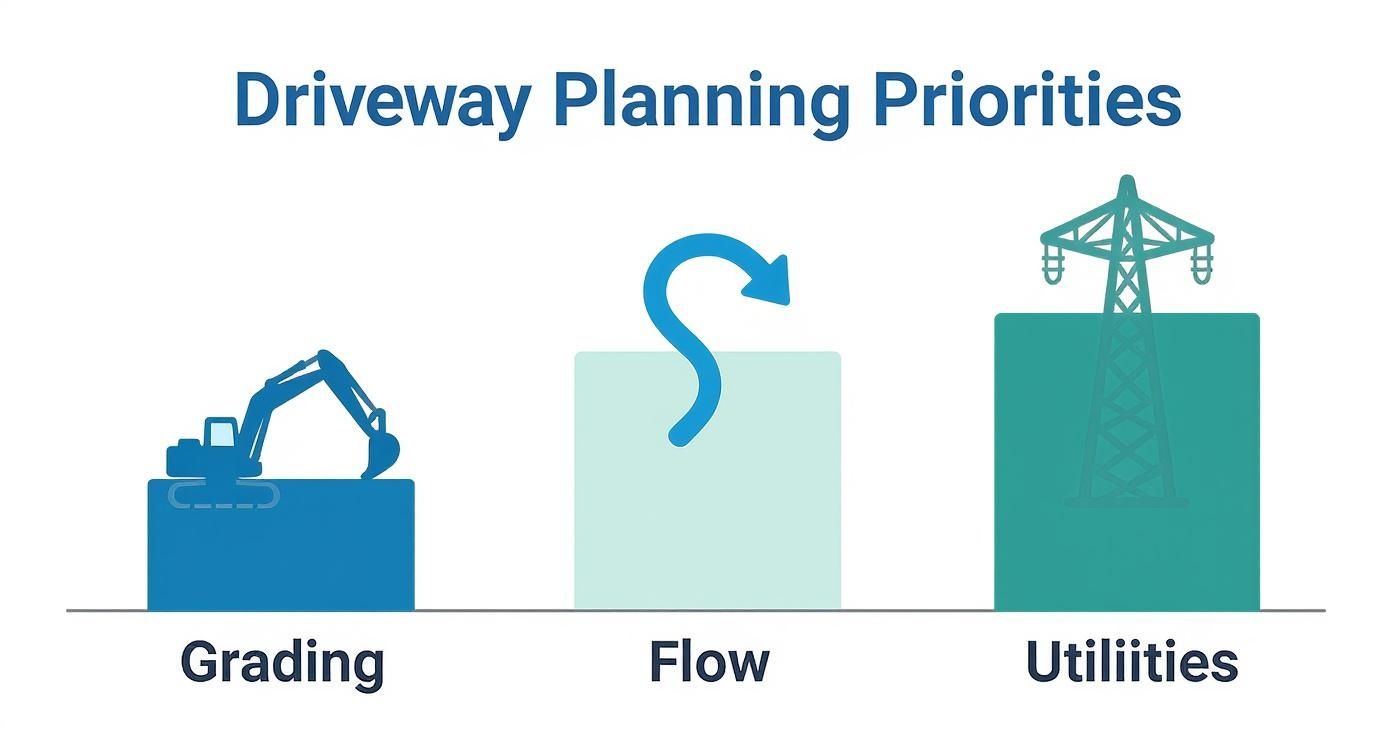
As this graphic highlights, getting these foundational elements right is non-negotiable. Skipping these steps is a recipe for a failed driveway, no matter how expensive the material you put on top.
North Texas Driveway Material Comparison
To help you weigh your options, here’s a breakdown of the most common materials used for custom home driveways in this area. Each has its own set of trade-offs when it comes to cost, durability, and the look it creates.
Material | Average Cost (per sq ft) | Pros | Cons |
|---|---|---|---|
Concrete | $8 - $18+ | Durable, cost-effective, low maintenance, versatile with stamping/staining. | Can crack over time, repairs can be noticeable, can look plain without upgrades. |
Pavers | $15 - $30+ | High-end look, endless design options, easy to repair individual pieces, permeable options available. | Higher upfront cost, can shift or grow weeds if not installed correctly. |
Gravel | $2 - $5 | Budget-friendly, excellent drainage, great for long rural driveways. | Requires regular raking and replenishment, can be dusty, not ideal for snow removal. |
Decomposed Granite (DG) | $3 - $7 | Natural, rustic aesthetic, packs down firmer than gravel, more color options. | Can wash out in heavy rain without a stabilizer, tracks indoors, needs occasional top-offs. |
The best choice marries your home’s architectural style with your budget and lifestyle. There's no single "right" answer, just the one that works best for your property.
Concrete: The Practical Workhorse
There's a reason concrete is the go-to choice for driveways across North Texas. It's durable, relatively easy on the wallet, and gives you a clean, smooth surface. A standard broom-finish concrete driveway usually runs between $8 to $12 per square foot, fully installed.
But "standard" doesn't have to mean boring. Modern decorative techniques can turn a simple slab into a standout feature.
Stamped Concrete: Molds are used to press patterns into wet concrete, creating a convincing imitation of stone, brick, or even wood. It’s a fantastic way to get a high-end look without the high-end price tag.
Stained Concrete: Acid or water-based stains add rich, permanent color, allowing you to move beyond basic gray to earthy browns or subtle reds that tie into your home’s exterior palette.
Exposed Aggregate: This finish reveals the small stones within the mix, resulting in a beautifully textured, slip-resistant surface.
Real Texas Example: We recently built a Gemini Home in Aledo where the owners loved the look of natural flagstone but needed the practicality of concrete for their growing family. We used a detailed stamping pattern combined with several stain colors to craft a driveway that perfectly matched their stone-accented modern farmhouse. It was a huge win—all the character, none of the cost or maintenance headaches of real stone.
Pavers: For Unmatched Style and Permeability
If you're looking for maximum design flexibility, interlocking pavers are in a class of their own. Made from concrete, classic brick, or natural stone, they allow you to create intricate patterns and custom borders that simply aren't possible with a solid pour.
For properties that struggle with drainage during our notorious Texas downpours, permeable pavers are a brilliant solution. They let rainwater filter through the joints into the ground beneath, which drastically reduces runoff.
Pavers have a higher upfront cost, typically $15 to $30 per square foot, but offer a major advantage. If a paver ever cracks or gets stained, you can just pop it out and replace it. That simple repairability makes them a smart long-term investment for a landscaped entrance driveway.
Gravel and Decomposed Granite: For a Rustic, Rural Feel
For a large property in Granbury or Stephenville, paving a long driveway with concrete or pavers can be cost-prohibitive. This is where materials like gravel and decomposed granite (DG) shine, providing a natural, informal aesthetic that feels right at home in the Texas countryside.
Gravel: The most budget-friendly option, often landing in the $2 to $5 per square foot range. It drains exceptionally well and gives you that satisfying crunch under the tires. The trade-off is the upkeep; it needs periodic raking and a fresh layer every few years.
Decomposed Granite (DG): A finer-grained material that packs down more firmly than loose gravel. For better performance on rural properties, we recommend stabilized DG, which includes a binder that helps prevent dust and erosion.
While these looser materials demand a bit more attention, their affordability and natural charm are hard to beat for creating a relaxed, welcoming feel on a larger North Texas property.
Choosing Plants That Will Actually Thrive in North Texas
This is where your landscaped driveway finds its soul. While driveway materials form the functional backbone, plants bring it to life with personality and color. But here in North Texas, picking plants isn't just about what looks good—it's about survival. We need plants that can handle our scorching summer heat, snap freezes in the winter, and everything in between.
Choosing native and adapted plants is the smartest thing you can do to ensure your landscape thrives. These plants are already used to our heavy clay soils and wild weather swings, which means less work and watering for you.
The Building Blocks of a Resilient Texas Entrance
For that classic North Texas look that’s as tough as it is beautiful, think in layers. A great entrance landscape combines the height of trees, the solid structure of shrubs, and the texture of grasses and perennials.
Here are a few workhorses that do exceptionally well in the Granbury and Weatherford areas:
Specimen Trees: On a larger rural lot, nothing makes a statement like a magnificent tree. Live Oaks and Cedar Elms are Texas icons, providing priceless shade and a feeling of permanence.
Hardy Shrubs: These are the backbone of your design. Texas Sage (Leucophyllum frutescens) is a local hero with its silvery leaves and purple flowers that explode after a summer rain. For an evergreen look, you can't go wrong with Dwarf Yaupon Holly.
Drought-Tolerant Grasses: Ornamental grasses soften the hard edges of a driveway. Gulf Muhly is a showstopper, erupting in a cloud of pinkish-purple haze in the fall. For vertical interest, Little Bluestem is an excellent choice.
This kind of smart, sustainable landscaping is catching on everywhere. A big part of the growth in global landscaping trends comes from homeowners wanting low-maintenance, eco-friendly designs that rely on native plants—a perfect strategy for our region.
Smart Placement and the Truth About Xeriscaping
Picking the right plants is only half the battle; where you put them is just as important. The idea is to build layers and depth without compromising safety or visibility.
Here's a simple, practical strategy:
Closest to the Road: Keep everything low to the ground for clear sightlines. Low-growing groundcovers like Frogfruit or perennials like Blackfoot Daisy are perfect here.
The Middle Layer: Bring in your medium-sized shrubs and ornamental grasses to start building visual interest.
The Back Layer: Set against a fence or farther back, use taller shrubs or small ornamental trees like a Desert Willow or Vitex to create a beautiful, textured backdrop.
This layered method is a core principle of xeriscaping. Don't let the name scare you—it doesn't mean your entrance has to look like a desert with only rocks and cacti.
Xeriscaping is just a fancy word for water-wise landscaping. It's about grouping plants with similar water needs and using mulch to keep moisture in the soil. For any homeowner in Glen Rose or Stephenville, it's a huge win, saving time on maintenance and money on water bills.
Giving Your Plants a Fighting Chance
Finally, we have to talk about the dirt. Most of us in North Texas are dealing with heavy clay soil. While it’s full of nutrients, it drains poorly. That’s why proper soil preparation is something you cannot skip.
Before planting, amend the soil by working a few inches of good-quality compost into the top 6-8 inches of your planting beds. This one step works wonders—it breaks up dense clay, improves drainage, and allows oxygen to get to the roots so they can get established.
Taking the time to choose the right plants, place them strategically, and prepare the soil will pay off for years to come, giving you a beautiful entrance that thrives. If you're building a new home, a quick chat with an experienced local builder like Gemini Homes can point you in the right direction.
Adding Lighting and Finishing Touches
With the driveway material, layout, and core plants in place, the heavy lifting is done. Now comes the fun part—the details that turn a functional driveway into a spectacular welcome. This is where we add layers of light and structure that create a real "wow" factor, especially after dark.
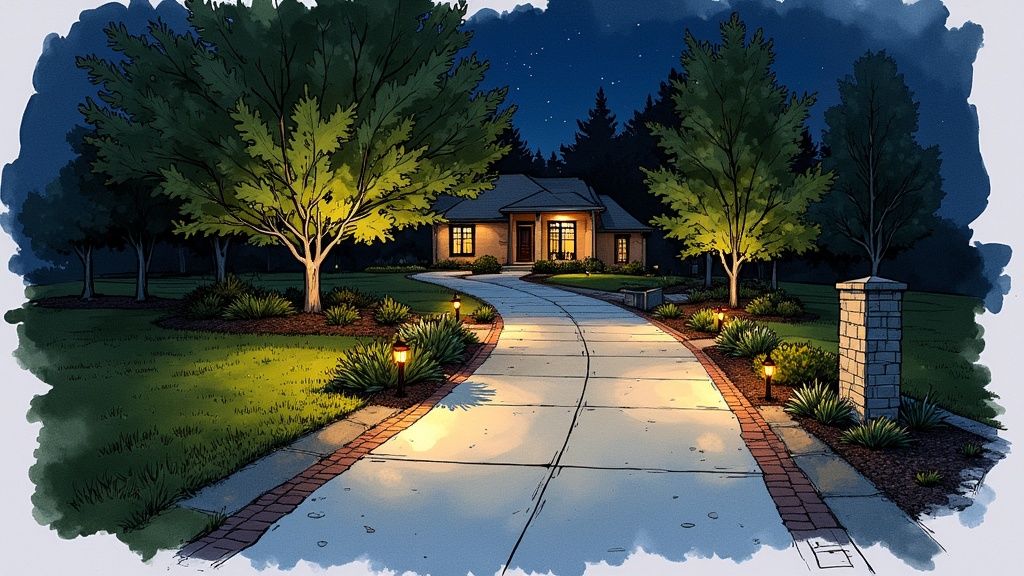
Great lighting is about more than just seeing where you're going. It sets a mood, guides visitors safely, and highlights the best features of your home and landscape. The goal is a soft, ambient glow, not a harsh glare.
Illuminating Your North Texas Driveway
In areas like Granbury or Weatherford, long, dark driveways are common. A thoughtful lighting plan isn't a luxury; it's a necessity for safety and ambiance.
Here are a few of the go-to lighting types we use:
Path Lights: These low-profile fixtures are installed along the edges to cast soft pools of light downward, clearly marking the way without blinding the driver.
Uplights: Have a stunning Live Oak or a beautiful stone column? An uplight at the base creates gorgeous shadows and turns a simple feature into a dramatic focal point.
Bollard Lights: Taller and more substantial, bollards are perfect for marking key spots, like the main entrance from the road or where a walkway branches off.
Pro Tip: I always advise homeowners in North Texas to stick with warm-temperature LED lights, between 2700K and 3000K. This temperature casts a soft, golden hue that feels incredibly welcoming, unlike the sterile, blue-white light of cooler LEDs.
Defining the Edges and Entry Points
Beyond lighting, physical borders and entry features give your driveway a crisp, finished look. These elements provide structure and tie the design back to your home's architecture.
Driveway EdgingEdging creates a clean, professional line between the driveway and your landscape beds. It also keeps mulch in and stops grass from creeping onto your pavers or concrete.
Steel Edging: Gives you a sharp, minimalist line that’s durable and almost vanishes into the landscape.
Stone or Brick Edging: Creates a more traditional border. We often match it to the home's masonry for a cohesive look.
Gates, Pillars, and MailboxesThink of these as the official handshake of your property. They should feel like a natural extension of your home. A rustic ranch in Glen Rose might get a beautiful cedar-and-iron gate flanked by stone pillars. A modern new build might call for a sleek metal gate and a custom mailbox that reflects its contemporary lines.
This is where the entire vision for your landscaped entrance comes together. For more ideas on creating seamless flow in other areas, check out our guide on 10 outdoor living space design ideas for your North Texas home.
Weaving It All Together: Your Cohesive Driveway Design Plan
Let's put all the pieces together into a practical, working plan. A stunning landscaped driveway isn't an add-on at the end of a build; it has to be woven into your home's design from the start. We're aiming for a unified vision where the house and its surroundings feel like they were made for each other.
Thinking through the entire process from day one is how you get an entrance that feels intentional. The key? Getting your builder, site planner, and landscape designer on the same page. This collaboration stops expensive do-overs and creates the seamless flow you see in professionally designed properties around Granbury and Weatherford.
A Practical Checklist for Your North Texas Driveway
To keep everything straight, use this checklist of key decisions. This guide will ensure all the critical elements are playing nicely together.
Plotting the Path: Before anything else, lock in the driveway's route and grade. Have you accounted for proper drainage? Is there enough room for a three-point turn? What are the sightlines from the road?
Matching Materials: Settle on your primary driveway material—pavers, stamped concrete, or gravel—and the edging that frames it. These choices should echo your home's architectural style.
The Planting Blueprint: Sketch out your plant strategy. You'll want a solid mix of native North Texas plants: trees for scale, shrubs for structure, and grasses for texture. Pay close attention to sun exposure.
Finishing Touches: Pinpoint where lighting will go. A few well-placed path lights and uplights make a world of difference. Now’s the time to also consider details like entry pillars or a distinctive mailbox.
Planning for the Long Haul
A beautiful driveway is one thing; a driveway that stays beautiful is another. That's where a realistic maintenance plan comes in. Here in North Texas, our climate requires a smart approach.
This means scheduling seasonal pruning, topping up mulch beds each year to lock in moisture, and giving your irrigation system a check-up before the brutal summer heat sets in.
Pro Tip: A smart design is your best defense against endless weekend chores. By choosing drought-tolerant native plants and durable, high-quality materials from the beginning, you're not just designing an entrance. You're investing in a beautiful first impression that will thrive for years with manageable effort.
These same ideas work just as well for the rest of your property. For more on this, check out our guide on simple back patio ideas for your North Texas home.
Common Driveway Landscaping Questions
Even the most thorough plan can leave you with a few nagging questions. When it comes to designing a driveway entrance here in North Texas, we hear a lot of the same ones from homeowners in places like Granbury and Weatherford. Let's get them answered.
Can I Phase My Driveway Landscaping Project?
Absolutely. For larger rural properties, breaking the project into phases is often the smartest way to manage your budget.
For example, you might focus on the big-ticket items in year one: the driveway installation, grading, and planting any large trees. Then, in year two, you can add finishing touches like perennial beds, lighting, and irrigation.
The key is to have a complete master plan from day one so that each phase builds logically on the last without redoing work later on.
What Is the Best Landscaping for a Long Driveway?
Long driveways are common on acreage in Glen Rose and the surrounding areas. The challenge is creating a beautiful journey without an astronomical budget. The trick is to be strategic.
Create "Moments" of Interest: Instead of lining the entire driveway with plants, create vignettes. Plant a small grove of three ornamental trees at a curve, or place a large, interesting boulder and surround it with hardy grasses.
Embrace Native Grasses: Let the natural landscape do the heavy lifting. Allowing native grasses and wildflowers to fill in the wider spaces cuts down on mowing and creates a stunning, low-maintenance meadow look.
Focus on the Bookends: Concentrate your budget and detailed landscaping where they have the most impact: the main entrance off the road and the arrival court right in front of your home.
How Wide Should My Landscaped Entrance Be?
For a standard single-car path, 10-12 feet is typical. But for the main entrance to your property, I always advise clients to think bigger.
We strongly recommend flaring the entrance where it meets the main road to at least 16-20 feet. This simple change makes a world of difference. It gives guests, delivery trucks, and even your own vehicles a much safer and more comfortable turning radius, a practical consideration for rural properties with larger vehicles.
Thinking through your dream entrance can feel like a huge undertaking, but tackling it one question at a time makes the process manageable. When you're ready to build a custom home with a beautiful, functional entrance that feels like a true welcome, the team at Gemini Homes is here to guide you. Schedule your free, no-obligation consultation today.
Comments