
What Is a Custom Home Builder: Create Your Dream Home in North Texas
So, what exactly is a custom home builder? Think of them as the captain of your ship, guiding the entire process of building your dream home from a simple idea to a finished reality. They're part architect, part project manager, and your single most important partner in creating a home that’s truly one-of-a-kind.
A custom builder works with you to design and construct a house from the ground up, specifically for you and on your piece of land. Every single detail—from the placement of the windows to the height of the ceilings—is meant to reflect your vision.
The Blueprint for a Truly Personal Home
This is completely different from a production builder, who offers a limited menu of pre-designed floor plans in a specific subdivision. With a custom home builder, you start with a blank slate—your ideas, your land, your future.
Imagine trying to build a sprawling family ranch house in Granbury using a floor plan designed for a narrow suburban lot. It just wouldn't fit the land or the lifestyle. A custom builder’s entire job is to prevent that kind of disconnect.
They become your guide through what is an incredibly creative and deeply personal journey. From the very first napkin sketch to the final coat of paint, their focus is on translating your lifestyle, needs, and tastes into a physical home. This hands-on approach ensures the house isn't just perfect for you, but that it also feels completely at home on your unique piece of North Texas property.
Key Roles of a Custom Builder
A good custom builder wears many hats, managing every piece of the puzzle so you have one point of contact and clear accountability. Their main responsibilities boil down to a few key areas:
Personalized Design: They collaborate directly with you, an architect, or a designer to create a floor plan that is 100% unique to your family. For example, if you're a retiree who wants single-story living with wide doorways, that's designed from day one.
Site-Specific Construction: Every decision is made with your lot in mind—from positioning the home to capture the best views in Glen Rose to dealing with the clay soil conditions common in Weatherford.
Unlimited Material Selection: You have total freedom. You get to choose every finish, fixture, and material, from the foundation type to the doorknobs. Want reclaimed wood beams from an old Texas barn? Your builder will help you source them.
Budget Management and Transparency: They provide detailed, upfront cost estimates and actively manage the budget, helping you make smart decisions that keep your vision and your investment aligned.
A Custom Builder at a Glance
Characteristic | What This Means for Your Home |
|---|---|
Starts with a Blank Slate | Your home design isn't pulled from a catalog; it's created just for you. |
Builds on Your Land | The house is designed to perfectly fit your property's size, shape, and views. |
Offers Full Customization | You have final say on every detail—layout, materials, finishes, and features. |
Provides a Single Point of Contact | One team manages everything from design and permits to construction and finishing. |
Essentially, the custom route is a partnership. It's about bringing a completely original vision to life, piece by piece.
A custom builder doesn’t just build houses; they build a home that tells your family’s story.
Ultimately, choosing this path means you aren't just buying a house; you're commissioning a piece of functional art designed for your life. To get a better feel for how these ideas become reality, you can explore some examples of local custom builds right here in our community.
Custom vs. Production Builder: What's the Difference?
So, what’s the real difference between a custom builder and the other guys you’ll find across North Texas? It all boils down to one simple, powerful idea: choice. Production builders are all about efficiency and predictability, whereas a custom builder is your partner in creating something from scratch.
Think of it like buying a car. A production builder is the big dealership with three popular models on the lot. You can pick your color and maybe an interior package, but what you see is largely what you get. It’s a fast, straightforward process with a clear price tag.
Working with a custom builder? That’s like commissioning a car built just for you. You’re in the driver’s seat for every decision, from the engine and the body style right down to the specific leather and stitching on the seats. It’s a deeper, more collaborative journey, but the end result is a machine built to your exact specifications.
Production Builders: The Community Model
You’ve seen their work everywhere. Production builders are the ones behind those large suburban communities popping up around Fort Worth. They purchase massive tracts of land and fill them with homes based on a handful of pre-designed floor plans.
Here’s what defines their approach:
Limited Customization: Your choices are usually confined to a pre-set menu of cosmetic finishes—think paint colors, countertops, and flooring. Making structural changes is almost always off the table.
Builder-Owned Lots: You don’t get to bring your own land. You select a lot from within their pre-planned development.
Efficiency and Speed: They’ve perfected the art of building the same few home models over and over again. This assembly-line process makes construction incredibly streamlined and often much quicker.
Lower Entry Price: Because of their high-volume, standardized method, production homes typically have a lower cost per square foot, making them an affordable option for many families.
Semi-Custom Builders: Finding a Middle Ground
As the name suggests, a semi-custom builder offers a hybrid approach. They start with a library of their own floor plans but give you more wiggle room to make modifications. You might be able to move a non-load-bearing wall, add a third bay to the garage, or reconfigure the primary bathroom layout. You get more flexibility than a production builder, but you’re still working within the framework of their existing designs.
The True Custom Builder: Your Vision, Your Land
This is where everything changes. A true custom builder begins with nothing more than a conversation and a blank piece of paper.
A custom home isn't about picking options from a list; it's about creating the list itself. Every detail is a reflection of how you want to live on your unique piece of Texas land.
Going custom means total freedom. Do you own a beautiful piece of acreage out in Glen Rose and dream of a home with a wall of windows perfectly positioned to capture the sunset? A custom builder will make that view the heart of the entire design. Need a dedicated in-law suite with its own private entrance for your family in Weatherford? We’ll draw it into the blueprints from the very beginning.
This deep level of personalization is why custom building remains so popular. In fact, custom-built homes now make up around 18-19% of all new single-family homes constructed, showing just how many people are looking for a space that truly fits them. You can dive deeper into these figures by checking out the latest custom building market trends.
Choosing Your Builder Type in North Texas
Deciding which type of builder is right for you can feel overwhelming. To make it easier, here's a breakdown of the key differences.
Feature | Production Builder | Semi-Custom Builder | Custom Builder |
|---|---|---|---|
Land | You buy a home on the builder's lot in their community. | Usually on the builder's lot, sometimes on yours. | You own the land, and the home is designed specifically for that property. |
Floor Plans | Choose from a very small portfolio of set plans. | Choose from a larger library, with modification options. | Starts from a completely blank slate; the floor plan is designed for you. |
Design Involvement | Minimal. You select finishes from a pre-set menu. | Moderate. You can alter existing plans and choose more finishes. | Full collaboration. You are involved in every design decision from start to finish. |
Price & Budget | Lower cost per square foot, more predictable pricing. | Mid-range pricing with some budget variability due to changes. | Higher cost per square foot with the budget defined by your choices. |
Timeline | Fastest construction timeline. | Slower than production, faster than full custom. | Longest timeline due to the detailed design and construction process. |
Best For | Buyers who prioritize speed, affordability, and simplicity. | Buyers who want more options than production but not a full custom build. | Buyers with a unique vision who want a one-of-a-kind home on their own land. |
Ultimately, the best path forward depends entirely on what you value most. If getting into a new home quickly and on a predictable budget is your top priority, a production builder might be the right call. But if your dream is to build a truly one-of-a-kind home that’s a perfect reflection of your land and your lifestyle, then partnering with a custom home builder is the only way to make that vision a reality.
Your Custom Home Journey From Vision to Move-In Day
Building a custom home from the ground up is an incredible experience, but it’s definitely a marathon, not a sprint. While every project here in North Texas has its own unique character, the process usually follows a clear path. Knowing what to expect helps you prepare for the roughly 12-to-24-month adventure that lies ahead.
It all starts with your vision. This is the fun, creative stage where you get to dream big. You'll gather inspiration, figure out what your family truly needs, and start imagining how you want to live on your piece of land. Are you picturing a huge outdoor living area to soak up those Granbury evenings? Or maybe a dedicated workshop on your Weatherford acreage? This initial dream is the blueprint for everything that follows.
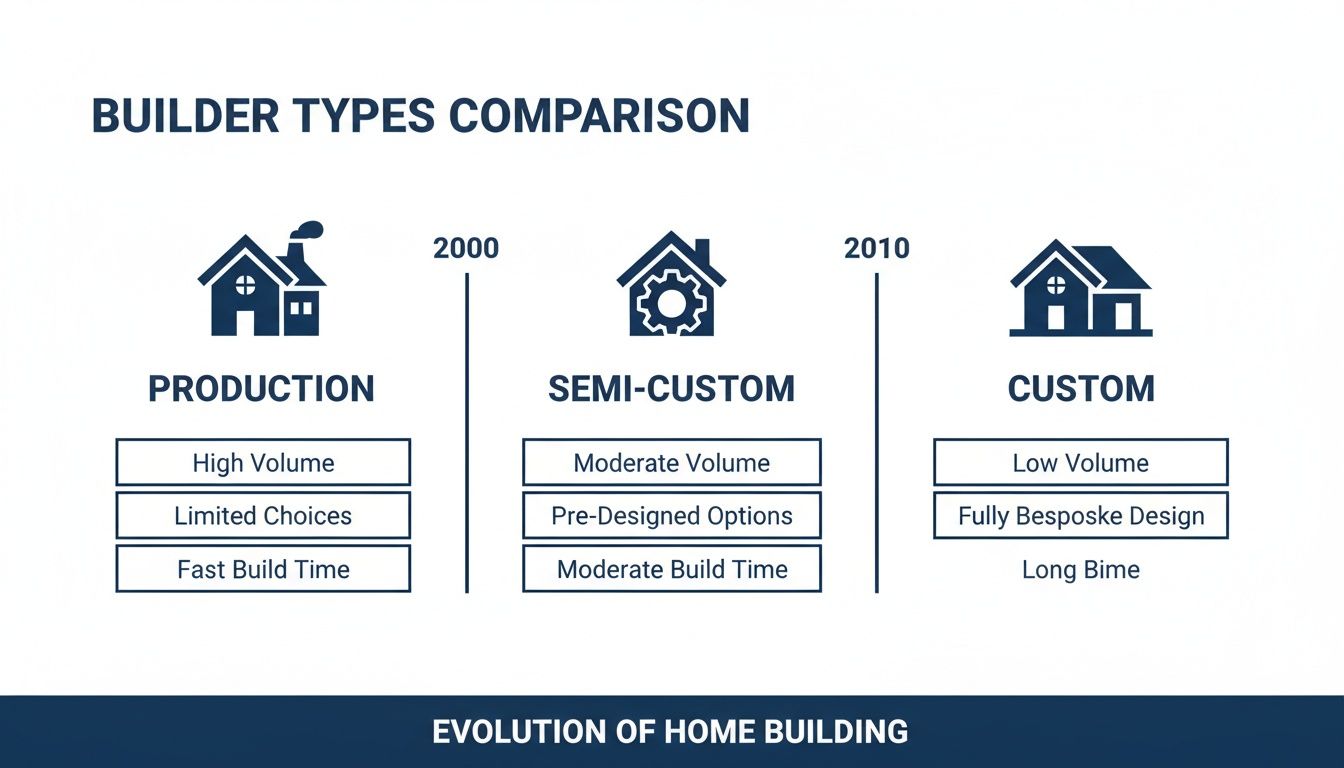
As you can see, the custom home path gives you a level of freedom that other builders just can't match, letting you create a home that’s truly one-of-a-kind.
The Phased Approach to Building Your Home
Once you team up with a custom builder, the journey shifts from ideas to concrete plans. This pre-construction phase is arguably the most important part of the entire process, as it lays the groundwork for a smooth and successful build.
Land Evaluation and Site Planning: First, your builder will walk your property to understand its specific quirks. In North Texas, this often means analyzing the soil—which can dictate foundation requirements—and planning for proper drainage or septic systems, especially on rural lots in places like Glen Rose.
Architectural Design and Budgeting: This is where collaboration is key. You’ll work closely with the builder and an architect to turn your vision into a real set of blueprints. At the same time, your builder creates a detailed, transparent budget based on your design choices and finish-out level.
Permitting and Approvals: This part can be a headache, but your builder handles it all. They'll manage the complex process of getting all the necessary permits from local authorities, whether you're in Hood County, Parker County, or somewhere in between. This step ensures your home is built to code and meets every local regulation.
From Foundation to Final Finishes
With the permits approved, the real magic begins as your home starts rising from the ground. The construction phase is broken down into several major milestones, and your builder is there every step of the way, managing every subcontractor and detail.
A well-managed construction site is like a carefully choreographed dance. Your builder is the director, making sure every specialist—from the foundation crew to the painters—shows up on time and performs their part perfectly.
The major construction stages typically look like this:
Site Work and Foundation: The land is cleared, and the concrete slab is poured, creating the solid base that will support your home for generations.
Framing and "Drying In": This is when it really starts to look like a house. The skeletal structure goes up, followed by sheathing, roofing, and windows to seal the interior from the weather.
Mechanical, Electrical, and Plumbing (MEP): Now it's time for the "guts" of the home. All the wiring, plumbing lines, and HVAC systems are carefully run through the walls.
Interior and Exterior Finishes: This is where your personal style comes to life. Drywall goes up, paint goes on, and your chosen flooring, cabinets, light fixtures, and exterior materials like stone or siding are installed.
Final Walk-Through and Move-In: The moment you've been waiting for! You'll do a final walk-through of the completed home with your builder to create a "punch list" of any tiny items that need a touch-up before you officially get the keys.
To see how these stages come together in the real world, you can explore a gallery of completed new home builds. At the end of the journey, you have more than just a house—you have a home built by a dedicated team, just for you.
The Many Hats Your Custom Builder Wears
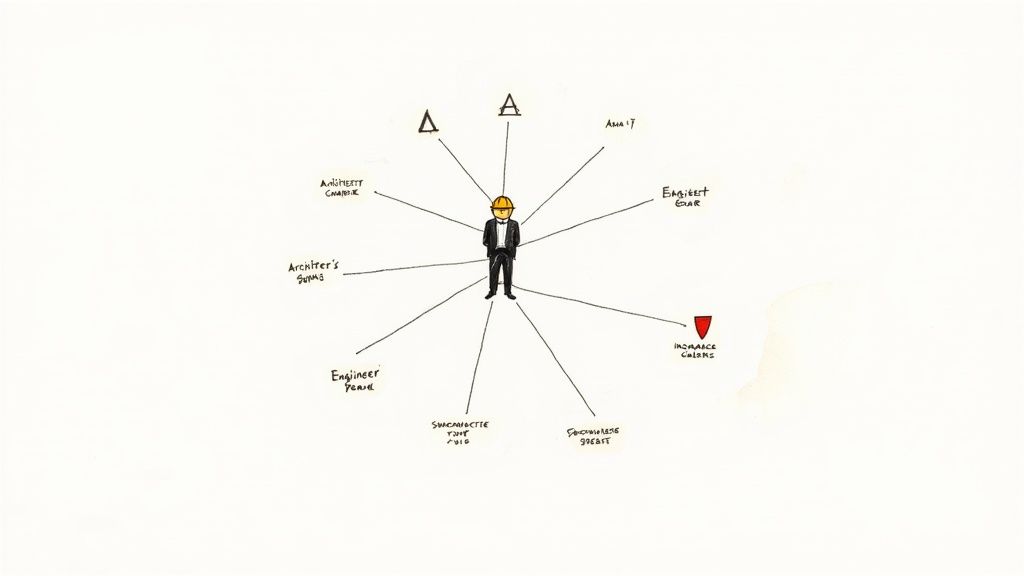
When you hire a custom home builder, you’re getting much more than a construction manager. You’re bringing on a project quarterback, a logistics guru, and a problem-solver all in one. Your builder acts as the central hub, coordinating a network of skilled professionals to bring your unique vision to life.
Their role goes way beyond swinging a hammer. A builder's day-to-day is a constant juggling act of scheduling, communication, and quality control. They become the single point of contact responsible for making sure dozens of moving parts click into place.
The Conductor of Your Build
Think of your builder as the conductor of an orchestra. Each professional—the architect, the engineer, the plumber, the electrician—is an expert in their own right. The builder's job is to make sure they're all playing from the same sheet music (your blueprints) and that the final performance is flawless.
This coordination is a massive undertaking. Within the sprawling home builders industry, valued at $166.9 billion in 2024, a custom builder’s reputation hinges on their network of trusted partners. With over 456,000 businesses in the field, having the right team is everything. You can get a better sense of the current state of the home building industry to see just how complex this market is. A great builder comes to your project with their own vetted team ready to go.
This means they’re managing a wide range of critical players and tasks:
Architects and Designers: Helping translate your ideas into a set of buildable plans.
Engineers: Ensuring the structural integrity and safety of your home.
Surveyors and Excavators: Getting your land prepped and ready for construction.
City and County Officials: Navigating the maze of permits and inspections.
Subcontractors: Scheduling and overseeing everyone from framers and roofers to painters and flooring installers.
Suppliers: Sourcing, ordering, and managing the delivery of countless materials.
Navigating Complex Challenges in North Texas
This central role becomes even more critical when things get complicated. For example, imagine a family in Weatherford loses their home in a nasty hailstorm and needs to rebuild using an insurance claim. This is a far more complex situation than a typical new build.
The builder becomes a crucial advocate, managing not just the construction but also the intricate communication between insurance adjusters, structural engineers, and the homeowners to ensure the new home isn't just rebuilt, but built better and stronger.
They step in to document the damage, align the new construction plan with the insurance payout, and implement modern building codes that will make the home more resilient against future Texas storms. Having someone manage all that brings incredible peace of mind during an incredibly stressful time.
Ultimately, the real value of a custom home builder is that they take the immense weight of project management off your shoulders. This frees you up to focus on the exciting decisions that will truly make your new house a home.
How to Choose the Right Building Partner
Picking a builder is easily the most critical decision you'll make when building a custom home. This isn't just a transaction; it's a partnership that will likely last for a year or more. The right team can make the entire process a joy, while the wrong one can quickly turn your dream into a nightmare.
To find the right fit, you have to dig deeper than just a price quote. You need to ask questions that reveal a builder's real-world experience, their communication style, and their reputation right here in our local communities. Think of it like a job interview—you're hiring someone for a very important, long-term role. Coming prepared with the right questions is the best way to make a choice you feel great about.
Questions About Local Experience and Portfolio
A builder’s past work is the best predictor of your future experience. You need a partner who not only builds beautiful homes but has specific, proven experience with the type of project and the location you have in mind. Start with these questions to get a feel for their expertise.
Can I see a few homes you've built in the Granbury or Weatherford area? This helps you verify their local track record and lets you see the quality of their work up close. A good builder will be excited to show you what they've done.
What is your experience with [barndominiums, outdoor living spaces, etc.]? If you have a specific vision, like a modern barndo on your property in Glen Rose, make sure they have direct experience with that unique style of construction.
Can you provide a few recent client references? Speaking to past clients is non-negotiable. Don't be shy—ask those references about the builder's communication, how they handled unexpected challenges, and whether they stuck to the budget.
Questions About Process and Communication
A smooth build is all about clear communication and a predictable process. These questions will help you understand how a builder operates day-to-day and how they’ll keep your project on track from start to finish.
The blueprints define the house, but the builder's process defines the experience. A transparent, well-communicated plan is just as important as the architectural drawings themselves.
Ask them directly about their methods:
How do you handle budget changes or unforeseen costs? Surprises can happen on any job site. A true professional will have a clear change-order process that requires your written sign-off before any extra costs are added.
Who will be my main point of contact, and how often will we communicate? You need to know if you’ll be talking directly with the owner or a project manager. It's also good to set expectations for weekly updates or regular site meetings.
Questions About Credentials and Guarantees
Finally, you need to confirm you're dealing with a legitimate, professional business that stands behind its work. This is all about protecting your investment and ensuring your home is built to last.
Are you fully licensed and insured in Texas? Ask to see proof of their general liability insurance and builder's license. This is a basic requirement that protects you from liability during construction.
What warranties do you provide on your work? A reputable builder will always offer a structural warranty (often for 10 years) and a workmanship warranty (typically 1-2 years) on their homes.
Asking these targeted questions will empower you to look past a sales pitch and find a genuine building partner.
Bringing Your North Texas Vision to Life
Building a custom home isn't just about sticks and bricks; it's about crafting a space that feels like it was always meant to be right there on your land, tailored perfectly to your life. The right builder turns what could be an overwhelming process into a genuinely exciting and rewarding journey.
That’s what we live for at Gemini Homes. We specialize in bringing unique visions to life on rural properties across the region, whether it's a classic ranch home in Weatherford or a modern barndominium in Glen Rose. We get it—your land has character, and your home should too.
Because we're a family-owned business, we’re personally invested in every home we build. We’re the team you call when you need to navigate something as complex as an insurance rebuild, and we’ll be there to make sure your new home is not only beautiful but stronger and safer than what you had before. This hands-on, personal commitment is really what separates a true custom home builder from the rest.
The custom home market has a unique strength. Unlike large-scale production building, it's often driven by long-term family goals rather than short-term interest rate swings. That makes it a solid, stable investment in your family's future.
In fact, over the last year, 184,000 custom homes were started across the country. It’s clear proof that the dream of creating a one-of-a-kind home is as strong as ever. You can read more about the growth in custom home building and see why so many people are choosing this path.
We believe a home should be a direct reflection of both the people inside it and the land it sits on. Whether you're picturing a sprawling family estate or a quiet country retreat, understanding the ins and outs of building in North Texas is the perfect place to start.
Answering Your Top Questions About Building a Custom Home
Thinking about building a custom home is exciting, but it naturally comes with a lot of questions. Getting straight answers is the best way to feel confident about moving forward. Here are the big questions we hear all the time from families looking to build in places like Granbury, Weatherford, and the surrounding North Texas communities.
What Does a Custom Home Actually Cost Around Here?
This is always the first question, and the most honest answer is, "it depends." We typically talk about cost in terms of price per square foot, and in North Texas, that can run anywhere from $175 to over $300.
What causes such a large range? It really boils down to three key things:
The Complexity of Your Design: A straightforward rectangular home is always going to be more budget-friendly than a design with lots of unique angles, intricate rooflines, and architectural flourishes.
Your Finishes and Selections: This is where your personal taste really impacts the budget. Choosing high-end materials like quartzite countertops, fully custom cabinets, and premium flooring will land you on the higher end of that per-square-foot cost compared to more standard (but still great quality) options.
The Land Itself: Prepping the build site is a huge factor. A flat, clear lot is simple. But a sloped piece of land in Glen Rose that needs major dirt work, tree clearing, or a special foundation will add significant cost before we even pour the slab.
How Long is This Whole Process Going to Take?
Building a custom home is a marathon, not a sprint. A good rule of thumb is to plan for 12 to 24 months from the moment you start designing to the day you get the keys.
The pre-construction phase—which includes architectural design, engineering plans, and getting permits from the city or county—can easily take a few months on its own. Once we break ground, things like unpredictable Texas weather (those spring storms are no joke!), the availability of specific materials, and the complexity of the build can all influence the timeline.
One of the biggest myths we hear is that you need to have your land picked out and purchased before you ever talk to a builder. We actually recommend doing the exact opposite.
Bringing a builder into the conversation before you buy land can save you a world of headaches and money. An experienced eye can spot potential issues with a property—poor soil, the high cost of running utilities, or drainage problems—that could turn your dream lot into a budget nightmare.
Ready to get answers that are specific to your dream home? The team at Gemini Homes is here to help. We offer a no-pressure consultation to talk through your ideas and map out the next steps. Let's start the conversation at https://www.geminihomesgranbury.com.
Comments